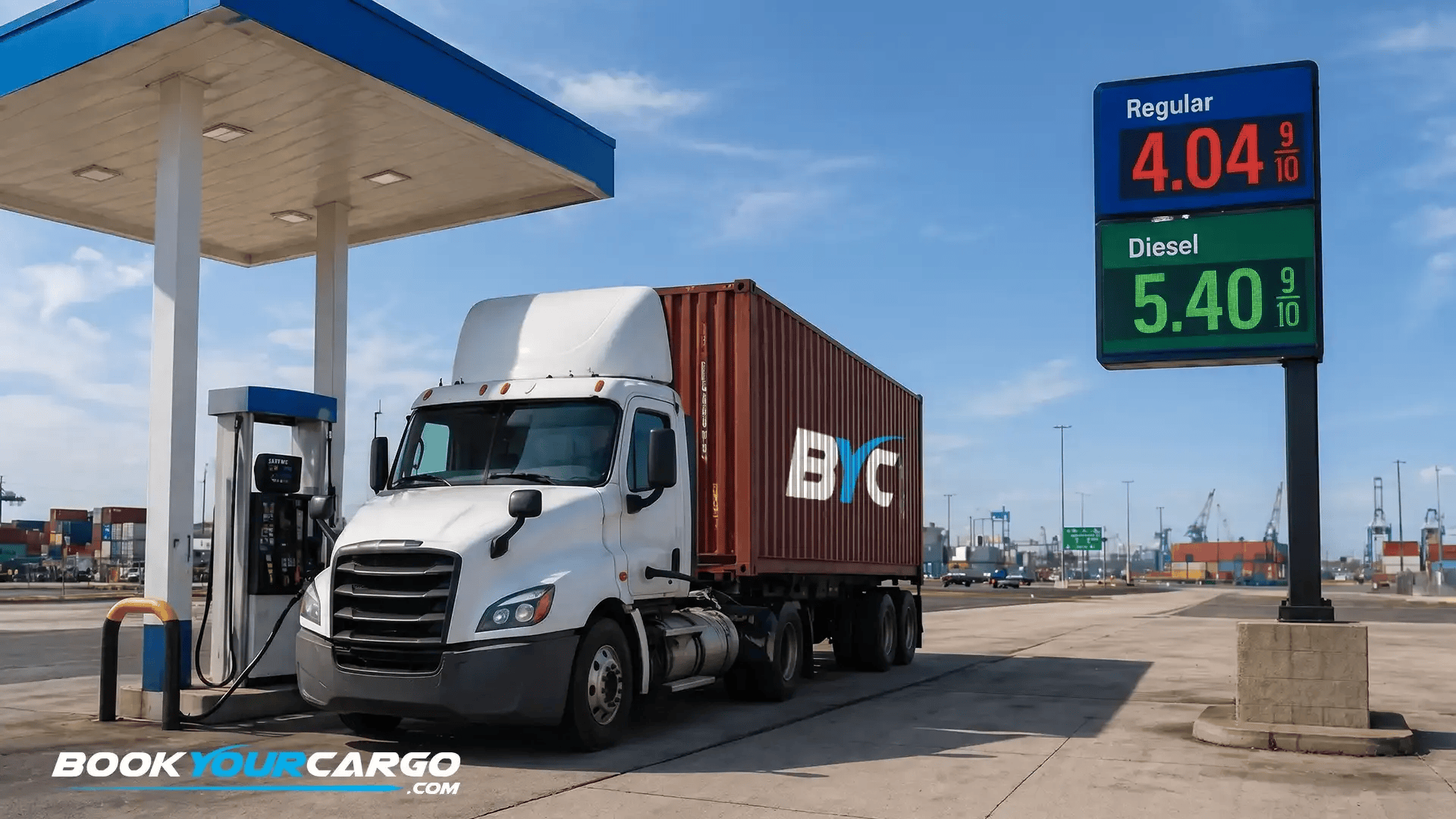
The 2026 Strait of Hormuz crisis has forced vessels off Suez Canal routes and onto the Cape of Good Hope, adding 10 to 15 days to transit times and concentrating arriving container volumes at U.S. West Coast ports. Diesel prices hit $7 per gallon at California ports in March, pushing drayage fuel surcharges to 40 to 55%. Chassis pools are tightening at LA/LB, Jacksonville is posting 3 to 4 hour truck turn times, and carrier capacity at the smallest drayage operators is under financial stress. Importers who have not pre-booked drayage capacity are directly exposed.
| Metric | Current Level | Why It Matters |
|---|---|---|
| Extra Transit Time | 10 to 15 days | Via Cape of Good Hope versus Suez |
| Fuel Surcharge Range | 40 to 55% | California port drayage, April 2026 |
| Jacksonville Turn Time | 3 to 4 hours | Gate constraints and landside bottlenecks |
As of April 20, 2026, the Strait of Hormuz has partially reopened under a ceasefire set to conclude April 26, but the operational damage already done to global container routing is not reversing on a ceasefire timeline. Vessels are still completing Cape of Good Hope voyages that began weeks ago. Cargo that was diverted, delayed, or stranded is now arriving at U.S. ports in compressed, overlapping windows. The congestion and cost pressure importers are encountering today is the downstream consequence of a disruption that started in late February.
For shippers, BCOs, NVOCCs, and freight forwarders managing port drayage in this environment, the question is not whether the market has changed. It has. The question is whether your drayage strategy has adjusted to match the market that exists now, not the one that existed in January.
How Hormuz Disruption Flows Downstream Into U.S. Port Drayage
Step 1: Vessels reroute around Africa, adding weeks to every voyage
Vessels that previously transited Hormuz and Suez to reach the U.S. East Coast are now sailing around the Cape of Good Hope. That adds approximately 3,500 to 4,000 nautical miles and 10 to 14 additional days per voyage. For vessels making multiple annual rotations, this removes two to three full round trips per year per ship and compresses effective global container capacity.
Step 2: Cargo concentrates at U.S. West Coast ports
Asia to U.S. West Coast Pacific routes are not affected by the Hormuz closure. As a result, importers are diverting cargo to Los Angeles, Long Beach, and Seattle Tacoma to avoid longer East Coast transit. West Coast ports are absorbing that diverted volume on top of existing throughput, tightening drayage capacity and chassis supply in key markets.
Step 3: Diesel costs spike and carriers pass through immediately
The Hormuz crisis drove Brent crude to peak levels, with Bay Area diesel reaching $7 per gallon in March 2026. Drayage carriers operate on tight margins and pass fuel increases through within weeks. Fuel surcharge ranges at California ports reached 40 to 55% under base-case scenarios, with prolonged-disruption scenarios projected higher.
Step 4: Carrier financial stress reduces capacity as demand rises
Financial pressure at smaller drayage operators is reducing available capacity as diverted cargo adds demand. Shippers relying on spot market trucking are discovering that the capacity they assumed would be available is increasingly constrained.
Port-by-Port Conditions Right Now: Where Drayage Risk Is Highest
| Port / Gateway | Current Utilization | Drayage Risk Level | Key Pressure Points |
|---|---|---|---|
| Los Angeles / Long Beach | Rising, absorbing diversion volume | Elevated and Building | Chassis tightening, dwell pressure, 40 to 55% fuel surcharges |
| New York / New Jersey | ~65% utilization | Moderate, watch incoming wave | Cape arrivals create compressed appointment windows |
| Seattle / Tacoma | ~55 to 60% utilization | Relatively fluid today | Inland rail constraints behind the gate |
| Jacksonville | High yard utilization | Actively congested | 3 to 4 hour truck turn times and gate limitations |
| Savannah | Generally stable | Stable with monitoring | Sensitive to East Coast volume shifts |
| Houston | Moderate | Elevated fuel pressure | Fuel pass-through moving faster than normal cycles |
Your container is arriving into this market. To explore drayage services and get a quote with all fees visible upfront, including current fuel surcharges, visit: https://bookyourcargo.com/contact.html
The Three Drayage Cost Components That Are Spiking Right Now
1. Fuel surcharges: the largest immediate impact
Fuel surcharges are typically calculated as a percentage of base drayage rates and reviewed against diesel indexes. With Bay Area diesel crossing $7 per gallon, carriers recalculated surcharges quickly. The 40 to 55% range at California ports is being applied to every container move, not only long-haul drayage. Contracts from earlier cycles may not reflect current escalation language.
2. Detention and demurrage: amplified by congestion
Time-based charges rise when containers exceed free time at terminals or when equipment return windows are missed. Jacksonville's 3 to 4 hour turn times increase breach risk even in well-managed operations. Vessels delayed at sea still face the same free-time clocks on arrival, and arrival bunching makes appointment slots harder to secure.
3. Chassis fees: directly exposed to pool tightening
Chassis availability determines whether pickup executes on schedule. As utilization rises, chassis fees increase and windows narrow. At LA/LB, the cost of shortage includes both chassis fees and cascading detention risk when same-day dispatch cannot be secured.
What the Ceasefire Timeline Means for Your Drayage Planning
The partial reopening improved headlines, but operational impacts lag. Vessels that departed on Cape voyages 4 to 6 weeks ago are still arriving, and their cargo surge will hit gates over the next 2 to 4 weeks regardless of diplomatic signals. Fuel-based surcharges also lag crude moves by review cycles that can run 30 to 60 days.
The ceasefire timeline does not equal immediate drayage normalization. A prudent procurement horizon is 60 to 90 days minimum, not two weeks.
The Importer Action Checklist: What to Do Before Your Container Arrives
- Book drayage before vessel ETA confirmation, not after.
- Request fully itemized quotes with base rate, fuel surcharge, chassis fee, and accessorials.
- Calculate free-time exposure on every container now.
- Verify chassis availability for your specific discharge terminal.
- Evaluate transloading if chassis constraints are building at your port.
- Confirm API or EDI tracking connectivity for automatic milestone updates.
- Verify permit lead times early for overweight or specialized loads.
- Align warehouse receiving slots to revised vessel ETAs.
- Review carrier financial stability signals before tendering freight.
BYC monitors chassis conditions, fuel surcharge shifts, and congestion trends in real time across major U.S. and Canadian gateways. To plan with pre-committed capacity and full cost transparency before your container arrives, visit: https://bookyourcargo.com/contact.html
How a Technology-Enabled Drayage Provider Changes the Equation in a Volatile Market
Real-time visibility prevents free-time breaches
In extended turn-time environments, the difference between on-time pickup and demurrage often comes down to how fast a provider detects availability and dispatches. Automated status monitoring catches windows manual workflows miss.
Carrier network depth protects capacity commitment
A large vetted partner network provides dispatch redundancy when individual carriers face breakdowns, staffing disruptions, or lane refusals. Narrow spot-market dependence creates fragility.
Transparent pricing eliminates invoice surprises
In weekly-moving surcharge markets, base-rate-only quoting leads to budget variance and disputes. Presenting total cost at quote stage removes operational friction and protects planning confidence.
