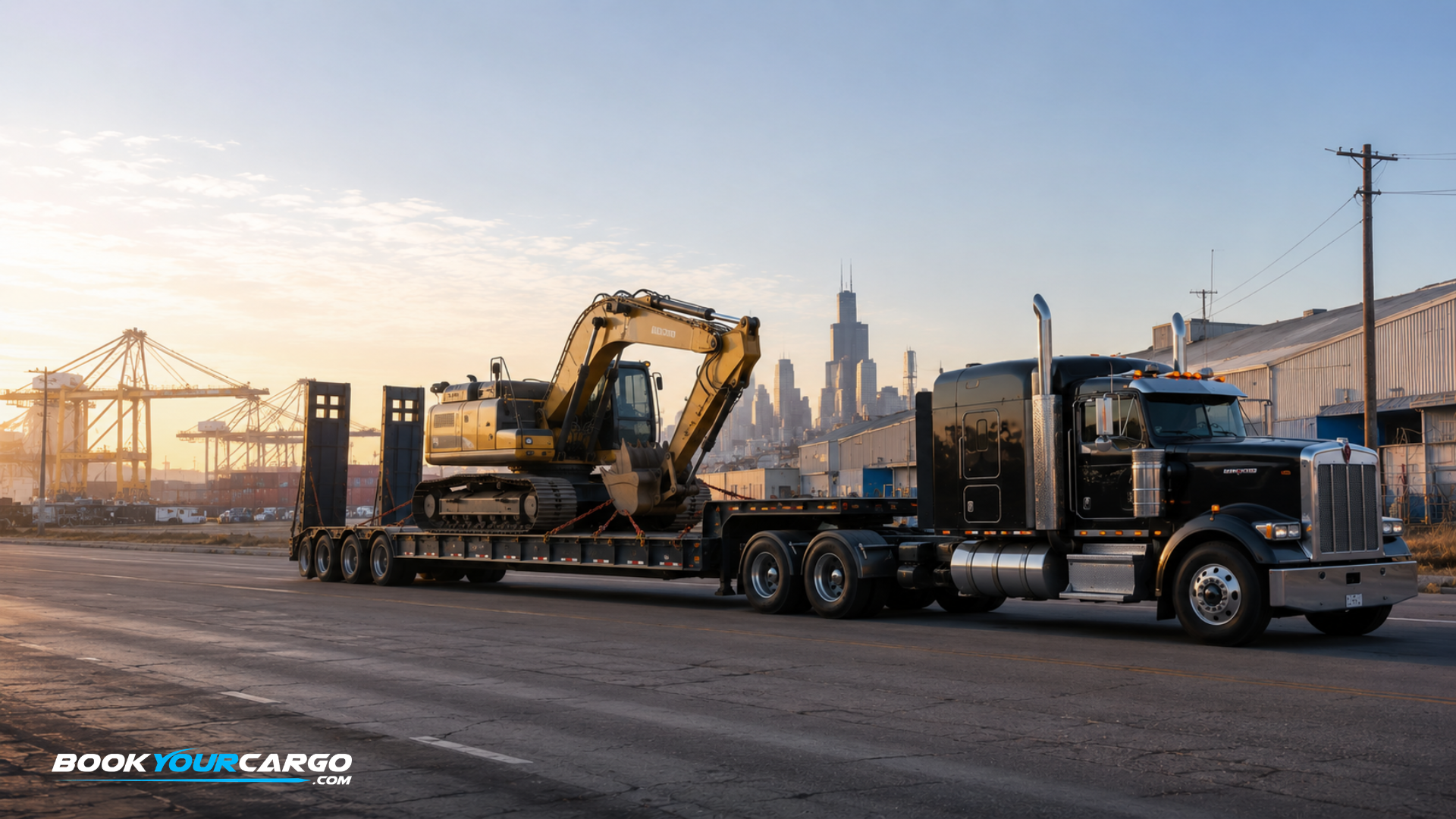
Reshoring is here, Section 232 tariffs are holding at elevated levels, including 50% duties on many commodity steel and aluminum imports, and U.S. manufacturing buildouts are accelerating. The freight category absorbing the biggest demand shock is heavy haul, specialized freight, and overweight drayage. These are the loads tied to factory equipment, processed steel and aluminum, and industrial machinery that cannot move on standard 53-foot dry van trailers. Capacity in these categories was already tight before the reshoring wave. Now it is becoming a critical-path constraint on factory ramp-up timelines.
Industry analysis suggests domestic manufacturing generates up to 400 truckloads for every one truckload of imported goods. Imports arrive consolidated in containers. Domestic production fragments freight across raw materials, components, and equipment, with a heavy weighting toward oversized industrial loads.
Most analysis of the manufacturing reshoring story focuses on jobs, capital expenditure, and policy debate. The freight question gets buried under the headlines. That is a mistake, because the operational truth on the ground is that reshoring is not just changing who produces goods. It is changing the shape, weight, and complexity of the freight that moves them.
For manufacturers, plant managers, procurement leaders, and supply chain teams responsible for facility buildouts and production ramps, this matters. The capacity you assumed would be available, because there has historically been plenty of standard FTL, is not the capacity you actually need. The capacity you actually need is in the segment of trucking that has the highest barriers to entry, the slowest carrier growth, and the most complex permitting requirements. Heavy haul. Specialized freight. Overweight drayage.
This briefing breaks down the structural shift, why heavy haul is the segment most directly exposed, what specific freight categories are surging, and the concrete planning moves manufacturers must make before the next phase of reshoring construction puts the squeeze on permits, equipment, and qualified carriers.
The Tariff Math That Is Reshaping Freight Flows
On June 4, 2025, President Trump doubled Section 232 tariffs on steel and aluminum imports from 25% to 50%. The new rate has held since, and on April 6, 2026, the administration formally adjusted the regime to keep 50% on commodity steel and aluminum while introducing 15% to 25% duties on derivative products, which are finished and semi-finished goods that contain meaningful quantities of those metals.
The freight implication is direct. Roughly one-fourth of the steel and half of the aluminum used in the U.S. is imported, much of it from Canada. With 50% tariffs holding firm and derivative products newly captured under the 15-25% range, the cost calculus for steel-intensive manufacturing has fundamentally shifted toward domestic sourcing, wherever feasible.
Manufacturers cannot reshore overnight. But they can reshore at the margin: by sourcing more steel and aluminum domestically, by adding U.S. assembly capacity for derivative components, by relocating tooling and production equipment from offshore facilities to American plants. Each of those decisions creates new freight demand. And the freight demand it creates is not standard dry van.
What the freight actually looks like under reshoring
A standard import container delivers consolidated finished goods to a U.S. distribution center. One truckload moves it from port to DC. Done.
A reshored manufacturing operation looks fundamentally different. Steel coils arriving from a domestic mill. Aluminum extrusions on flat-deck trailers. CNC machine tools weighing 60,000 to 120,000 pounds requiring multi-axle equipment and state permits. Plant utilities and HVAC systems too dimensional for a 53-foot trailer. Cured concrete forms, transformer cores, oversized fabricated assemblies. Every facility buildout is dozens to hundreds of these moves.
Why Heavy Haul Capacity Cannot Scale Quickly
Standard FTL trucking is a low-barrier business. A driver, a tractor, a 53-foot trailer, and a CDL gets a carrier into the market. New entrants can ramp capacity within weeks. Heavy haul is structurally different. The barriers to entry are high, and the ramp time for new capacity is measured in years, not weeks.
Equipment specialization
Heavy haul requires lowboys, double-drops, multi-axle trailers, jeeps, boosters, and other configurations that cost two to five times more than a standard 53-foot dry van. The equipment is built to order. Lead times for new heavy haul trailers run 6 to 18 months depending on configuration and OEM.
Permit infrastructure
Every state has its own overweight and oversize permit regime. Permits are required per state, per load, with specific weight and dimensional thresholds, route restrictions, time-of-day restrictions, and escort vehicle requirements. Carriers that handle heavy haul efficiently maintain permit operations as a dedicated function, not something a dispatcher does between calls. New entrants cannot match that infrastructure quickly.
Driver qualification and retention
Heavy haul drivers are among the most qualified in trucking. They handle loads where mistakes are not just expensive but dangerous. The pool is small, training pipelines are slow, and retention is competitive. The FMCSA Non-Domiciled CDL Final Rule that took effect March 16, 2026 is reducing the broader driver pool simultaneously. Heavy haul drivers were never the bulk of non-domiciled CDL holders, but the broader market tightening creates upward wage pressure that affects every segment.
Route survey and engineering
Many heavy haul moves require pre-trip route surveys: bridge weight analyses, overhead clearance verification, low-hanging utility identification, traffic pattern analysis. These surveys take time. They cannot be skipped. They cannot be outsourced cheaply. They are part of why heavy haul costs more, and part of why the carriers who do this work well are not easily replaceable.
The Freight Categories Surging Under Reshoring
Here is the granular picture of what kinds of freight are growing fastest as reshoring moves forward, and which of BYC's services is the natural fit for each.
| Freight Category | Why It's Growing | Equipment & Service Required |
|---|---|---|
| Industrial machinery & CNC equipment | New plant equipment relocations and capital purchases for facility ramp-ups. Often 60,000 to 200,000 lbs. | Heavy haul with multi-axle trailers, escort vehicles, multi-state permits, route surveys |
| Steel coils, plate, structural beams | Domestic mill output rising as Section 232 tariffs make import steel uneconomic for many derivative manufacturers | Flatbed FTL, step-deck for tall coils, dedicated steel haulers with proper securement |
| Aluminum extrusions and large profiles | Tariff-driven domestic sourcing shift and growing aerospace/automotive demand for aluminum-intensive components | Flatbed and step-deck specialized freight with experienced load-securement crews |
| Plant utilities, transformers, HVAC | Greenfield facility buildouts driving demand for oversized utility infrastructure deliveries | Heavy haul, specialized freight, often requires escort vehicles and engineering review |
| Overweight ocean containers | Heavier industrial inputs now arriving by sea: chemical raw materials, processed metals, machine components | Overweight tri-axle drayage, state overweight permits, port-specific equipment |
| Project cargo & turnkey assemblies | Pre-fabricated production lines, modular building components, energy infrastructure | Specialized freight planning, multi-modal coordination, possible heavy haul + transload combinations |
| Construction materials at scale | Factory and warehouse construction itself driving inbound demand for structural steel, precast concrete, building systems | Flatbed FTL, heavy haul for oversized precast elements, dedicated construction logistics support |
Notice the pattern: every category in the reshoring freight surge requires more than standard 53-foot dry van. Most require equipment a typical FTL carrier does not have, expertise a typical brokerage cannot provide, and permitting infrastructure that takes years to build. This is the structural mismatch driving capacity tightness in the segment that reshoring needs most.
Your reshoring freight needs a partner that runs all four categories.
BookYourCargo handles heavy haul, specialized freight, overweight drayage, and flatbed FTL within one platform, with the equipment, permits, and route engineering already in place.
Where Heavy Haul Tightness Is Hitting Hardest Right Now
The reshoring freight surge is not landing evenly. Specific corridors and load categories are running tighter than the national averages suggest. Here is what the operational picture looks like across the regions where BYC sees the most direct demand pressure.
Midwest manufacturing belt
Indiana, Ohio, Michigan, Illinois, and Tennessee are absorbing a significant share of new manufacturing buildout activity. Every major auto OEM, EV battery plant, and semiconductor facility expansion is creating heavy haul and specialized freight demand in this corridor. Indiana's flatbed market was already tight before the manufacturing surge, and the state's CDL revocations under the FMCSA rule have added to capacity pressure.
Texas and Gulf Coast
Texas is absorbing significant industrial relocation activity, particularly in semiconductor manufacturing, energy infrastructure, and chemical processing. The volume of oversized loads moving through Houston, Dallas, San Antonio, and the Texas Triangle is rising. State overweight permit processing times are extending as volume rises.
Southeast manufacturing corridor
The corridor running from North Carolina through South Carolina, Georgia, Alabama, and Tennessee, historically anchored by automotive manufacturing, is now absorbing additional reshoring activity in industrial equipment, aerospace components, and electrical infrastructure. Heavy haul corridors through the Appalachian foothills carry routing complexity that adds cost and time.
Cross-border with Canada
Despite the 50% Section 232 tariff on Canadian steel and aluminum, cross-border manufacturing flows remain massive. Auto plants, equipment manufacturers, and steel-intensive supply chains continue to operate transcontinental networks. U.S.-Canada drayage and FTL for industrial and oversized freight is in a structurally different demand environment than it was 12 months ago.
The Common Mistake That Costs Manufacturers Six-Figure Delays
The most expensive mistake manufacturers make in heavy haul planning is treating it as a procurement problem rather than a project planning problem. Procurement teams are trained to source freight reactively: equipment shows up at a port, equipment needs to move, freight RFP goes out. That model works for standard FTL. It fails for heavy haul.
Here is why. The lead time on a heavy haul move is not the day the carrier arrives. It is the lead time on the permit, the route survey, the equipment positioning, the escort coordination, and the destination site readiness. State overweight permits take 1 to 5 business days under normal conditions; 5 to 10 days when state DOT permit volumes are running high. Route surveys for non-standard loads take 3 to 10 business days. Equipment positioning, which means getting the right multi-axle trailer to the origin, can take a week if the closest available equipment is in a different region.
Stack those constraints, and the actual lead time on a heavy haul move from order to execution can run 14 to 30 days. Manufacturers who do not plan for this, who assume the move can be sourced 5 days before equipment arrival, discover the mismatch when their facility ramp slips by weeks. The carrying cost of a delayed factory commissioning runs into six and seven figures per week of slip.
The Manufacturer's Heavy Haul Planning Playbook
The following playbook is built for plant managers, procurement leaders, project managers, and supply chain teams responsible for facility buildouts, production ramps, and reshoring projects. It is sequenced for a typical manufacturing equipment relocation or factory commissioning project.
Heavy Haul Planning Playbook for Reshoring Projects
- Engage your heavy haul partner during site planning, not equipment ordering. The earliest valuable conversation is when site selection is finalized and equipment specifications are being defined. The carrier can flag routing, permit, and access constraints that influence equipment selection or facility design before they become problems.
- Build a freight inventory by load. List every inbound move tied to the facility buildout: machinery, utilities, structural materials, fixtures, racking, finished-floor assets. Capture weight, dimensions, origin, and required delivery sequence. This inventory becomes the master plan for capacity reservations.
- Categorize each load by service type. Standard FTL. Flatbed. Heavy haul with permits. Specialized freight requiring escorts. Overweight drayage from port. Project cargo with multi-modal coordination. The categorization determines who handles each move and what lead time applies.
- Map permit lead times by state and corridor. Overweight permits, oversize permits, escort requirements, and route restrictions vary by state. A move from a Pennsylvania mill to a Tennessee plant traverses three to five state permit regimes. Build the permit timeline backward from required delivery dates.
- Reserve heavy haul capacity in advance, not at need. For known move sequences, secure carrier capacity commitments 30 to 90 days ahead. Heavy haul carriers operate with limited equipment, and last-minute capacity is the most expensive and least reliable.
- Verify destination site readiness before scheduling delivery. Heavy haul deliveries that arrive at a site not ready to receive them, with no crane, no rigging crew, no dock, no laydown space, turn into expensive delays and detention charges. Coordinate the site readiness sign-off with the delivery schedule, not after.
- Combine port drayage and inland heavy haul under one provider where possible. When industrial equipment arrives by ocean container, the port drayage and overweight drayage handoff to inland heavy haul is a high-friction point. A provider that operates port drayage, overweight drayage, and heavy haul under one roof eliminates that friction.
- Plan for transloading and warehousing as buffers. When site readiness lags equipment arrival, transloading and warehousing create timing flexibility. Equipment can be received at a regional facility, staged, and delivered when the destination site is ready, without paying detention on the original move.
- Build technology integration with your provider. Visibility on heavy haul moves matters more than on standard FTL. Real-time location tracking, milestone updates, permit status, and escort coordination all benefit from API or EDI connectivity between the carrier and the manufacturer's project management system.
- Document the move history for audit and replication. Reshoring is not a one-time project for most manufacturers. The lessons learned from the first facility buildout, including which corridors had permit delays, which carriers performed, and which routes carried hidden costs, become the template for the next one.
Why a Multi-Service Logistics Partner Reduces Reshoring Project Risk
The freight challenge under reshoring is not solved by hiring a single specialist. It is solved by partnering with a logistics operation that integrates the multiple services a manufacturing buildout actually requires, and integrates them under one accountable structure.
A reshoring project typically requires:
- Port drayage for ocean-arriving industrial inputs and equipment
- Overweight drayage for heavy containerized cargo
- Heavy haul for industrial machinery and large fabricated assemblies
- Specialized freight for oversized or sensitive loads
- Flatbed FTL for steel, aluminum, and construction materials
- Standard FTL for components and finished goods
- LTL for smaller component and tooling deliveries
- Transloading and warehousing for staging and timing flexibility
- Rail drayage for inland intermodal connections
Most logistics providers handle two or three of these. A few handle five or six. BookYourCargo's platform handles all of them, with the same vetted carrier network, the same technology platform, the same compliance discipline, and the same project management visibility across every mode.
The operational value of consolidation under one provider is clear when something goes wrong. A delayed equipment arrival, a port chassis shortage, a permit hold, a destination site readiness slip: when these happen on a project with five different vendors managing different segments, the manufacturer becomes the integrator. When they happen on a project with one provider managing the full freight chain, the provider is the integrator. The difference is measured in resolution speed, project schedule integrity, and ultimately commissioning timing.
Stop integrating five vendors. Run your reshoring freight through one platform.
BYC's team builds project-level freight plans for facility buildouts, production ramps, and equipment relocations. Heavy haul, drayage, FTL, transloading. All coordinated, all visible, all accountable.
Frequently Asked Questions
Reshoring Freight Doesn't Wait. Neither Should Your Capacity Plan.
BYC's heavy haul, specialized freight, and overweight drayage teams build project-level capacity plans for manufacturers, plant managers, and supply chain leaders. Equipment, permits, route engineering, and multi-modal coordination. All under one accountable platform.
