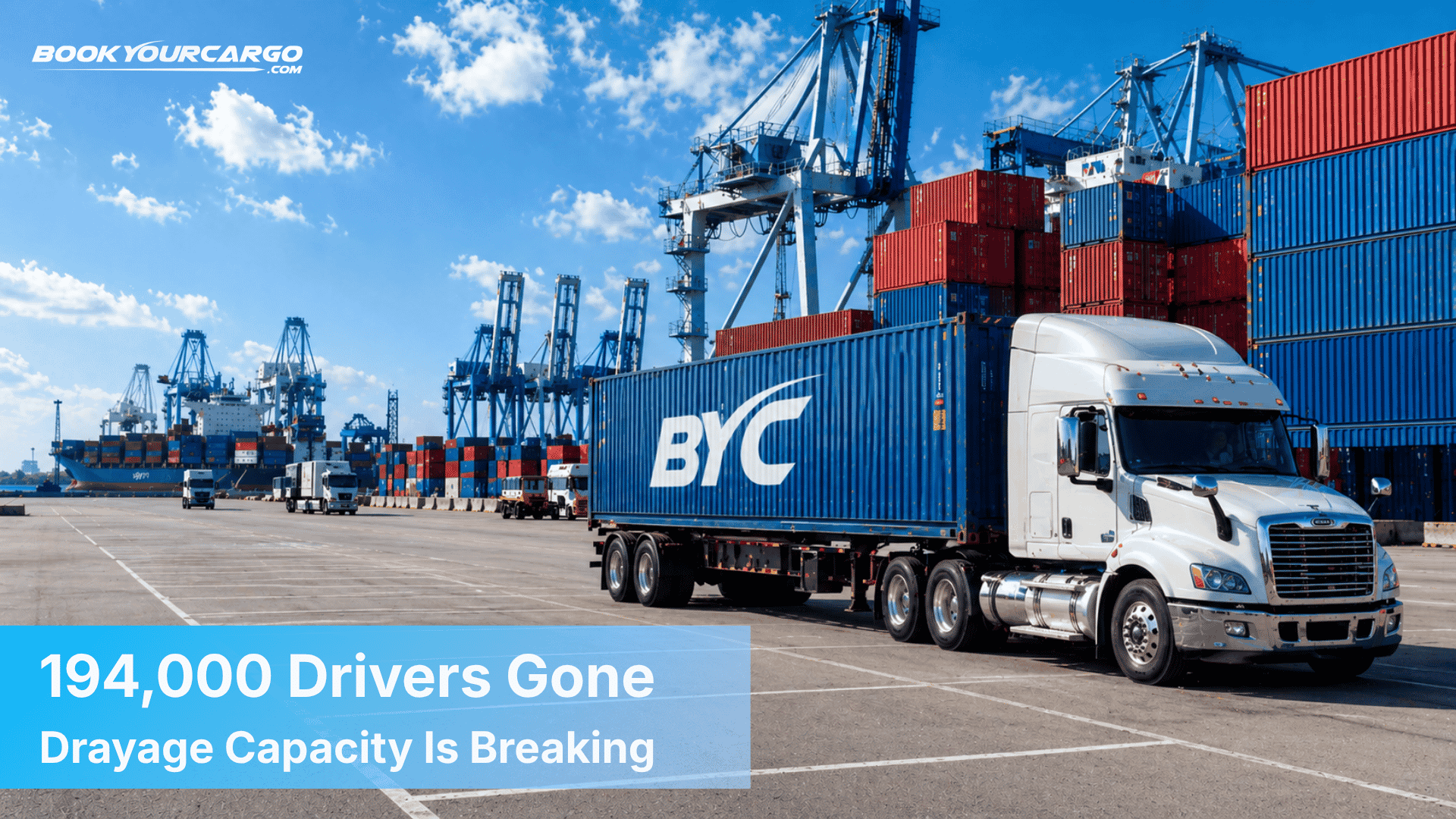
The FMCSA Non-Domiciled CDL Final Rule took effect March 16, 2026. It is projected to remove approximately 194,000 truckers from the U.S. CDL pool over the coming months. Non-domiciled CDL holders are concentrated in port drayage at LA/Long Beach, Oakland, and the New York metro area. California has already revoked 17,000 licenses. Federal funding has been withheld from New York. Drayage capacity is tightening fastest in exactly the lanes that import-heavy supply chains rely on — and shippers without a national carrier network are most exposed.
Most shippers and freight forwarders are tracking the headlines on the FMCSA Non-Domiciled CDL Final Rule. Far fewer are translating those headlines into operational consequences on their own drayage lanes. That gap — between awareness and pricing — is where the next two quarters of capacity surprises will happen.
This briefing breaks down what the rule actually does, where the operational pressure is concentrating, which port complexes are most exposed, and the specific structural changes that decision makers running national drayage programs need to make before Q3 of 2026.
What the FMCSA Non-Domiciled CDL Rule Actually Does
On February 11, 2026, the Federal Motor Carrier Safety Administration finalized the rule restricting non-domiciled CDL eligibility. The rule took effect March 16, 2026, with state licensing agencies given 30 days to complete required downgrades, putting full enforcement around April 13.
The structural changes embedded in the rule:
- Eligibility narrowed to three visa categories. Only holders of H-2A (temporary agricultural workers), H-2B (temporary non-agricultural workers), and E-2 (treaty investors) visas qualify. Employment Authorization Documents are no longer accepted.
- Mandatory SAVE system verification. States must query the federal SAVE system to confirm lawful immigration status for every applicant.
- One-year maximum validity. Down from previous multi-year terms, with mandatory in-person renewal — no online or mail renewals.
- Audit and revocation requirement. States must audit every existing non-domiciled CDL on their rolls. Credentials issued out of compliance are subject to immediate revocation.
- FMCSA target outcome. The agency estimates the rule will reduce non-domiciled CDL holders from approximately 200,000 today to around 6,000 over a few years.
The compliance mechanism that makes this rule operationally severe is the federal funding leverage. On April 16, 2026, the federal government announced it was withholding $73,502,543 in National Highway Performance Program and Surface Transportation Program Block Grant funds from New York after a federal audit found that 107 of 200 sampled non-domiciled CDLs were issued in violation of federal law — a 53 percent failure rate.
That funding pressure is forcing rapid state action. New York holds approximately 32,000 non-domiciled CDLs. If the audit failure rate holds across the full population, more than 16,000 drivers may have their credentials revoked in the coming weeks. California has already revoked roughly 17,000 CDLs, concentrated among small owner-operator fleets running short-haul and intermodal drayage. Indiana has revoked approximately 1,790. Texas is conducting active audits with phased revocations expected. Pennsylvania, Minnesota, and New Jersey carry meaningful exposure as well.
Why Port Drayage Takes the Biggest Hit
The CDL crackdown is not landing evenly across trucking. Long-haul over-the-road, regional flatbed, and dedicated fleet operations are absorbing some impact. But the disproportionate hit is on port drayage. There are three reasons for that, and understanding them is the foundation of a good capacity strategy.
Reason 1: Drayage carrier economics select for non-domiciled CDL holders
Drayage operates on tight margins, short-haul lanes, and high turnover. The labor pool that fills these positions skews toward owner-operators and small-fleet operators in port-adjacent metros — exactly the workforce demographics where non-domiciled CDLs concentrated. Worldwide Express noted that port drayage, alongside agriculture and seasonal produce, sits among the highest-risk lanes under the rule because the workforce composition exposes it directly.
Reason 2: The geographic overlay matches the highest-revocation states
The states with the largest non-domiciled CDL populations — California, New York, Texas, New Jersey — are the same states that host the country's largest port complexes. LA/Long Beach. Oakland. New York/New Jersey. Houston. As state revocations roll out, the impact concentrates in the workforce that handles the freight moving through these gateways. Industry tracking has identified LA/Long Beach and Oakland as the port complexes where non-domiciled CDL drivers represent a disproportionate share of the drayage pool.
Reason 3: Smaller drayage carriers absorb compliance risk poorly
Drayage fleets are dominated by small operators — many running 1 to 5 trucks. These operators do not have dedicated compliance teams, sophisticated HR systems, or legal counsel to manage the rapid documentation and verification requirements that the rule introduces. They are simultaneously losing drivers to revocation and unable to onboard replacements at the rate the market demands. The April 8, 2026 Chapter 11 filing of Southern California drayage carrier National Road Logistics LLC — citing mounting debts tied to leases, vendor obligations, and contract disputes — is one early signal of carrier financial stress at the small-operator level.
Lane-by-Lane Risk Map: Where the Pressure Is Highest Right Now
Here is the operational picture by region as of April 21, 2026, based on documented state actions, federal enforcement signals, and market data.
| Region / Port Complex | Risk Level | Specific Pressure Points |
|---|---|---|
| LA / Long Beach Largest U.S. port complex |
Severe | 17,000 California CDLs revoked, concentrated in drayage owner-operators. Outbound West Coast van and reefer rates firming. Chassis pool tightening alongside Hormuz-driven volume diversion. |
| Oakland West Coast secondary gateway |
Severe | Disproportionate share of drayage pool affected by California revocations. Diesel surcharges 40-55%. Smaller carrier base limits redundancy. |
| New York / New Jersey East Coast primary gateway |
Severe — escalating | $73.5M federal funding withheld April 16. 16,000+ NY drivers projected for revocation. NJ and PA exposed as well. 3-5% capacity attrition forecast over 60 days. |
| Houston / Gulf Coast Texas import gateway |
Building | Texas active audit phase. Revocation count not yet public but signaled by state DOT. Given Texas size as a CDL-issuing state, eventual count could rival California. |
| Savannah / Charleston Southeast gateways |
Watching | Less direct CDL exposure but inland rail constraints and Cape of Good Hope volume diversion creating overflow pressure. |
| Seattle / Tacoma Pacific Northwest |
Watching | Lower direct CDL exposure than California ports but absorbing diverted West Coast volume. Drayage demand rising faster than driver pool. |
| Midwest Inland Ramps Chicago, Memphis, Indianapolis |
Building | Indiana revoked 1,790 CDLs. Flatbed and manufacturing demand already tight. Rate environment carrier-favorable through summer. |
Your lane is on this list. So is the cost of doing nothing.
BYC operates a national drayage carrier network with redundant capacity across every major U.S. and Canadian port — exactly the structure built to absorb regional disruptions like this one.
The Compounding Effect: CDL Crackdown Plus Hormuz Plus Fuel
No single regulatory action collapses a market. The CDL rule, taken alone, would tighten capacity gradually. The danger right now is that it is rolling out simultaneously with the Strait of Hormuz crisis — which has already redirected ocean cargo onto Cape of Good Hope routes, concentrated arrivals at U.S. West Coast ports, and pushed diesel costs to record-near levels at California pumps.
These three pressures land at the same drayage operations:
- Driver pool shrinking — CDL revocations remove capacity that cannot be quickly replaced.
- Container volume rising — Cape of Good Hope rerouting adds inbound containers to West Coast gateways already running at capacity.
- Operating costs spiking — Bay Area diesel hit $7 per gallon in March 2026, pushing drayage fuel surcharges to 40-55% at California ports under base-case scenarios.
For a drayage carrier, this is a three-sided squeeze. Fewer drivers, more containers, higher fuel costs. The carriers absorbing it best are the ones with deep, vetted networks and technology infrastructure that lets them redeploy capacity across geographies as conditions shift. The carriers absorbing it worst are the small spot-market operators whose entire business model depends on a stable local driver pool and predictable diesel pricing — neither of which exists right now.
What a National Drayage Carrier Network Actually Solves
The phrase "national drayage" gets used loosely. Some providers use it to describe scattered regional brokerage relationships. Others use it to describe a true unified carrier network with consistent vetting, compliance, technology integration, and redundancy across every major port complex.
The difference matters in this market because the regulatory shocks are happening at the state and regional level, not nationally and uniformly. When California revokes 17,000 CDLs and New York revokes 16,000+ more, capacity loss in those markets needs to be backfilled from somewhere. A drayage operation with truly national carrier depth can redeploy capacity across regions. A regional or single-port operation cannot.
The four capabilities that define real national drayage coverage
1. Vetted carrier network across every major U.S. and Canadian port
Capacity needs to be available at LA/Long Beach, Oakland, Seattle/Tacoma, NY/NJ, Savannah, Charleston, Houston, Jacksonville, Norfolk, Vancouver, Toronto, and Montreal — not just the operator's home port. BookYourCargo's network covers tens of thousands of zip codes across the U.S. and Canada through thousands of vetted trucking partners.
2. Documented carrier compliance practices
The CDL rule is creating a real compliance distinction between drayage carriers. Operations that maintain rigorous CDL verification, run regular SAFER refreshes, and document compliance status across their carrier base are positioned to continue operating. Operations that do not are at risk of audit-triggered service interruptions. Shippers should be asking their drayage providers about carrier vetting practices, not just rates.
3. Technology infrastructure for real-time visibility
In a market where capacity allocation is shifting on a weekly basis, manual coordination through phone calls and emails is insufficient. API and EDI connectivity between the drayage provider and the shipper's TMS or ERP becomes operationally essential. Real-time tracking, transparent quoting with current fuel surcharges visible upfront, and automated milestone updates remove the coordination burden that is otherwise consumed managing the disruption.
4. Multi-modal optionality including transloading and rail drayage
When direct port drayage capacity is constrained at a specific gateway, alternate routing through transloading at off-dock facilities or rail drayage to inland ramps often provides the lowest-friction path to delivery. A provider that handles only one mode forces the shipper to manage multi-vendor coordination during a disruption. A provider that operates all modes within a single platform absorbs that complexity.
The Action Checklist for Shippers, BCOs, NVOCCs, and Forwarders
These are the steps that materially reduce exposure to the CDL crackdown over the next 90 days. They are sequenced by urgency.
Drayage Capacity Action Checklist — April 2026
- Map your drayage volume by port and lane. Identify which percentage of your total drayage moves through California ports, New York/New Jersey, Texas, and Indiana. The higher your concentration in these four regions, the higher your CDL crackdown exposure. Use this map to prioritize the next steps.
- Audit your current drayage carrier base for compliance posture. Ask your providers directly whether they have run SAFER refreshes on their full carrier network in the last 30 days, what their CDL verification process looks like for new carriers, and whether any of their dispatched carriers operate out of New York, California, Texas, or Indiana. The answers will tell you what kind of provider you are working with.
- Identify lanes with single-carrier dependency and add backup capacity. Any drayage lane that depends on a single trucking partner is a single point of failure. In this market, single points of failure break. Diversify before the disruption arrives, not after.
- Move from spot-market sourcing to capacity-committed relationships on critical lanes. Spot market drayage capacity is the first to disappear when the broader market tightens. For containers that absolutely must move, secure capacity-committed relationships with national providers that can guarantee execution.
- Integrate API/EDI connectivity with your drayage provider. Manual visibility is insufficient in a volatile market. Real-time tracking, automated status updates, and transparent quote-to-invoice reconciliation are now operational requirements. If your provider cannot offer this, that is information.
- Evaluate transloading at off-dock facilities for high-risk port complexes. At LA/Long Beach and Oakland — where both CDL revocations and Hormuz-driven volume diversion are concentrating — transloading the ocean container off the terminal quickly removes free-time exposure and reduces dependency on chassis pool conditions and carrier availability for direct delivery.
- Review your contractual protections for capacity shortfall scenarios. Many drayage agreements were written assuming stable capacity conditions. Review your tender acceptance language, force majeure clauses, and capacity guarantee provisions. Where coverage is thin, renegotiate or move volume.
- Build a 90-day rolling capacity forecast with your provider. Reactive capacity sourcing fails in tight markets. Forward-looking capacity planning succeeds. Share your 90-day import forecast with your drayage provider and ask them to confirm capacity commitments in writing.
- Quarterly compliance reviews with your top drayage carriers. Make compliance review a contractual requirement, not an afterthought. Industry guidance recommends carriers report fewer than 5% of their fleet operating on non-domiciled CDLs. If a carrier reports 15% or higher, that signals concentration risk worth addressing.
- Track state-level enforcement actions weekly. The rollout is happening in waves. Texas audits are next. Other states will follow. A weekly read on enforcement actions in the states where your freight moves provides early warning before capacity problems hit your invoices.
BYC built its drayage platform exactly for markets like this one.
National coverage. Vetted carriers. Transparent pricing with fuel surcharges visible upfront. API and EDI connectivity. One platform for port drayage, rail drayage, and transloading.
The Bigger Picture: Why This Disruption Is Different From Past Driver Shortages
Trucking has experienced driver shortages before. The 2018 capacity crunch. The 2021 supply chain crisis. The 2022 reefer shortage. In each of those, market forces eventually balanced — wages adjusted, training pipelines expanded, capacity returned.
The CDL crackdown is structurally different. It is not market-driven attrition. It is regulatory removal of a defined population from the eligible workforce. The drivers losing CDLs do not return when wages rise. The replacement pipeline is not flexible — new domestic CDL holders take 18 to 36 months to train and gain the experience required for port operations. And the rule is not transitional; it is the new permanent baseline.
For shippers and forwarders, this means the operating environment of late 2026 will not look like the operating environment of late 2025. The drayage market is being structurally reshaped, and the providers that survive and thrive will be the ones with the network depth, technology infrastructure, and compliance discipline to operate through structural change. The shippers that protect their supply chains will be the ones who build relationships with those providers now, before the disruption fully lands.
Frequently Asked Questions
Don't Manage the CDL Crackdown With a Single-Carrier Relationship.
BYC's national drayage platform is built for exactly this market — a vetted carrier network across every major U.S. and Canadian port, transparent pricing with all fees upfront, real-time tracking, and 99.9% service execution. Lock in your drayage capacity before the next state action.
