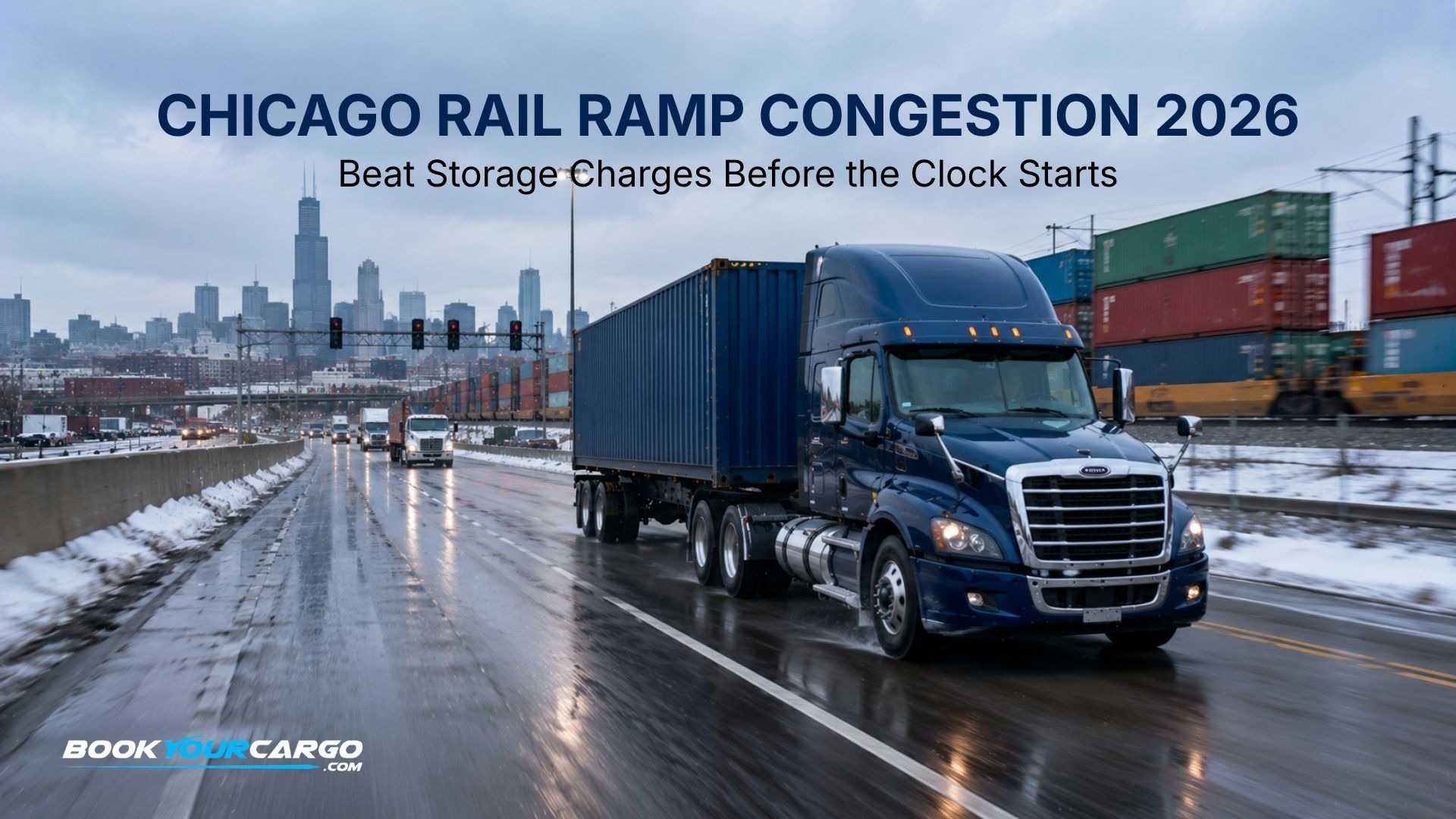
Chicago rail ramp congestion is a last-mile problem, not a long-haul one. The railroad moves the container across the country efficiently. Cost forms in the interval between the railroad grounding it and a truck pulling it out, and during that interval rail storage and container per diem accrue at the same time from two different parties.
Chicago is the largest inland intermodal hub in North America and the crossroads of the national rail network. Nearly every major east-west routing passes through it, containers are interchanged between railroads here, and that concentration is what makes the hub efficient at scale and fragile under stress. When volume surges, weather hits or rail dwell backs up, Chicago is where congestion concentrates first and clears last.
This guide is for importers and freight forwarders moving containers through the Chicago gateway. It covers why the hub congests, how the major ramps differ under load, the cut-off and gate rules that decide whether a container makes its train, how the two billing clocks accumulate, and the timing disciplines that keep freight moving when the hub is under pressure.
1. Why Chicago congests
Four inputs drive it, and congestion appears when any one falls out of balance with the others.
- Volume concentration. As the largest inland intermodal hub in North America, Chicago absorbs a disproportionate share of import volume bound for the Midwest and beyond. When volume surges, the ramps fill faster than they clear.
- Interchange between railroads. Containers moving between carriers have to be interchanged here, which adds handling and time. Upstream rail dwell arrives in Chicago as delayed grounding and longer availability times.
- Chassis availability. Chicago chassis pools tighten quickly under concentrated demand. A container that is grounded and available still cannot move without equipment, which backs up the ramp behind it.
- Weather. Chicago winters are an operational variable rather than an inconvenience. Snow and extreme cold close gates, slow ramp operations and compress the pickup window while the storage clocks keep running.
The common thread is that the rail leg performed. The cost forms in the gap between grounding and pickup, which is exactly the interval a drayage provider controls, and it is why rail drayage execution at an inland hub is a different discipline from marine terminal work.
2. The Chicago ramps and how they behave under load
Chicago is not one facility. It is a dense cluster of Class I intermodal ramps spread across the metro area, each operated by a different railroad with its own gate hours, appointment behaviour, chassis situation and congestion pattern. A container grounding at one ramp is in a completely different operating environment from one grounding at another.
| Ramp | Railroad | Drayage note |
|---|---|---|
| Logistics Park Chicago (Elwood) | BNSF | Large container-only facility in the CenterPoint complex; primarily West Coast origins |
| Cicero, Willow Springs, Corwith | BNSF | Additional Chicago-area facilities with their own gate patterns |
| Global IV (Joliet) | Union Pacific | Largest UP Chicago facility, co-located with BNSF at CenterPoint |
| Global I, II and III | Union Pacific | Chicago, Northlake and Rochelle facilities |
| Bedford Park and 59th Street | CSX | Eastern routings with distinct gate and appointment behaviour |
| Landers, Calumet, 47th and 63rd Street | Norfolk Southern | Eastern and southeastern routings across several facilities |
| Harvey and Joliet | CN | Joliet is a common discharge point for Transpacific cargo routed via Prince Rupert |
| Bensenville and Schiller Park | CPKC | Part of the single-line network connecting Canada, the US and Mexico |
The practical consequence is that a provider serving only one or two ramps leaves an importer exposed everywhere else. When one facility is congested but a container is grounding at another, the importer needs capacity at that specific ramp. National drayage coverage with vetted capacity across the metro network is what allows a programme to route around a congested facility rather than wait it out.
3. Rail cut-offs, ingate and outgate rules
Every Chicago ramp sets its own gate rules, and the differences matter more here than at a marine terminal because rail free time is shorter and recovery from a missed window is longer. This is the area where general knowledge of a railroad is least useful and facility-specific knowledge is worth most.
Rail cut-offs
An outbound cut-off is the deadline for delivering a container to the ramp for a given train. Miss it and the container waits for the next departure, which on some lanes is a day and on others considerably longer. Cut-offs are set per ramp and per service rather than per railroad, so a provider working from a general assumption about a carrier will miss facility-specific deadlines.
Ingate and outgate rules
Ingate is delivering a container into the ramp; outgate is collecting one. Each facility sets its own documentation requirements, equipment checks and permitted transaction types, and some restrict certain transactions to particular hours. A driver arriving with the wrong paperwork or outside a permitted window is turned away, which costs the trip and the slot together.
Appointment systems
Several Chicago ramps operate appointment systems, and where they apply the appointment is the scarce resource rather than the truck. Slot release schedules differ by facility. The useful question to ask a provider is not whether it can book an appointment, but how it monitors release across every ramp your containers ground at.
4. The two clocks at a Chicago ramp
The most expensive misunderstanding in Chicago intermodal is treating a rail ramp like a marine terminal with generous free time. It is neither generous nor measured the same way.
The rail storage clock
Rail free time is the period after the railroad notifies that a container is grounded and available before storage charges begin. It is typically shorter than ocean free time, and the clock starts at railroad notification rather than at train arrival or at the moment the importer notices. In a congested hub the gap between grounding and pickup can consume the entire window before a truck is dispatched, which is how storage forms on containers the importer believed were moving.
The container per diem clock
On international intermodal moves the steamship line continues to assess per diem on the container itself until the empty is returned. That clock runs independently of rail storage and does not stop because the container is stuck at a congested ramp. During Chicago congestion an importer can be paying rail storage to the railroad and per diem to the steamship line simultaneously on the same container, which is why congestion compounds cost rather than adding to it.
5. The timing disciplines that beat Chicago congestion
Surviving congestion is a timing problem, and timing is what a drayage provider controls. Five disciplines separate importers who move cleanly through a congested hub from those who accumulate storage and dwell.
Queue dispatch from railroad notification
The highest-leverage discipline available. Because the storage clock starts at notification, the dispatch has to be queued and ready before the container grounds. A provider watching the inbound train, the notification and ramp availability captures the pickup window before storage forms. A provider waiting for the importer to flag an available container is already behind the clock.
Maintain chassis readiness ahead of grounding
A grounded, available container with no chassis cannot move, and in a congested hub with tight pools chassis is frequently the binding constraint rather than the tractor. Positioning equipment ahead of grounding, and managing the relationship across more than one provider, prevents a shortage at one pool stranding the container.
Use cross-ramp capacity to route around congestion
When one ramp is congested but the container is grounding elsewhere, or when volume is grounding across several ramps in the same window, cross-ramp capacity keeps the programme moving. A provider with vetted capacity at every major Chicago ramp can dispatch to wherever the container actually is rather than being constrained to the facilities it happens to serve.
Convert street dwell into controlled dwell
When a consignee cannot receive immediately, leaving the container at the ramp accrues rail storage and holding it on a chassis accrues per diem. Pulling it to a nearby yard, or moving the freight into domestic equipment through transloading, converts those charges into cheaper controlled dwell and releases the ocean container from the steamship line clock.
Monitor both clocks in real time
Rail storage and container per diem both run silently until the charges appear on an invoice. Real-time container tracking across railroad notification, ramp availability, free time expiration and per diem status is what surfaces exposure before it becomes a charge, and it matters more in Chicago than almost anywhere because two clocks run at once.
6. Winter at a Chicago ramp
Cold-weather degradation is physical rather than operational, which is why it cannot be scheduled away. In subzero conditions trains run shorter and slower to maintain air brake performance. Metal contracts, making track, switches and signals less reliable and requiring additional inspection. Snow clearance in yards requires specialised equipment and time, and delays in clearing produce terminal congestion that persists after the storm passes.
For an importer the practical consequences are that winter transit variability is a planning input rather than an exception, and that backlogs behind a weather event outlast the weather itself. Where a gate suspension occurs, document the closure period and affected containers contemporaneously, because relief on storage charges is sometimes available and is far harder to claim from memory weeks later.
7. Cost control checklist for Chicago intermodal drayage
A practical scoreboard. Each line is where congestion most often turns into cost, and the action that prevents it.
| Risk | What it costs if unmanaged | Action that prevents it |
|---|---|---|
| Rail free time expiration | Storage charges beginning shortly after notification | Queue dispatch against notification and be ready to move at grounding |
| Stacked container per diem | Steamship line charges running while the box is stuck | Coordinate empty return concurrently; transload to release the ocean box early |
| Missed outbound cut-off | Container waits for the next departure | Confirm the cut-off per ramp and per service, not per railroad |
| Ingate refusal | Wasted trip and a burned slot | Verify documentation and permitted transaction hours before dispatch |
| Chassis shortage at grounding | Available container stranded with no equipment | Position chassis ahead of grounding across more than one provider |
| One congested ramp blocking the programme | Whole flow stalled behind a single facility | Use vetted cross-ramp capacity across the metro network |
| Consignee cannot receive | Rail storage plus chassis charges while waiting | Pull to a nearby yard or transload to convert to controlled dwell |
| Winter gate closure | Compressed pickup window with clocks still running | Build buffer into winter schedules; document closures for relief claims |
| No visibility on notification or per diem | Charges appearing with no warning | Monitor the storage clock and the per diem clock together |
8. How BookYourCargo moves freight through a congested Chicago hub
BookYourCargo is a national drayage company with vetted carrier capacity at every major Chicago intermodal ramp and across every major U.S. and Canadian port and rail ramp. The operating model is built around the timing disciplines above.
- Cross-ramp capacity. Vetted carriers at the BNSF, Union Pacific, CSX, Norfolk Southern, CN and CPKC facilities across the Chicago metro area, so containers are pulled from wherever they ground.
- Notification-driven dispatch. Planning queued from railroad notification rather than train arrival, so the pickup window is captured before the storage clock consumes it.
- Facility-level cut-off and gate knowledge. Outbound cut-offs, ingate requirements and appointment release tracked per ramp rather than per railroad.
- Chassis readiness. Equipment positioned ahead of grounding and sourced across multiple providers so a pool shortage does not strand a container.
- Yard and transload options. Transloading and warehousing capacity to convert street dwell into controlled dwell and free the ocean container when a consignee cannot receive.
- Dual-clock visibility. Railroad notification, ramp availability, rail free time and container per diem monitored together so exposure surfaces before it becomes a charge.
This connects to BYC port drayage coverage, so an importer running West Coast pickups and Chicago rail delivery on the same containers has one drayage company managing both ends. Execution runs on the drayage technology platform, with first-party Midwest rate context published monthly in the BYC Drayage Index. Inc. 5000-recognised, BBB A+ rated, IANA Member, NCBFAA Member, and WOSB-certified through the U.S. Small Business Administration.
Frequently asked questions
Four facility-specific questions. What is the outbound cut-off for this ramp and service, and how far ahead is it published. What documentation is required at ingate, and are any transaction types restricted to particular hours. Does the ramp operate an appointment system, and when is slot inventory released. And how is rail free time measured here, from railroad notification or from availability.
A provider that answers these ramp by ramp is running an operation built on facility knowledge. A provider that answers by railroad is generalising, and that generalisation is where missed cut-offs and refused ingates come from.
Chicago is the largest inland intermodal hub in North America and the crossroads of the national rail network, so it absorbs a disproportionate share of import volume and handles most interchange between railroads. Congestion forms when volume, rail dwell, chassis availability and gate capacity fall out of balance, which lengthens the interval between a railroad grounding a container and a truck pulling it out.
Winter is an additional factor. Snow and extreme cold close gates and slow ramp operations, and because snow clearance is slow the resulting backlog persists after the weather itself has passed.
Rail free time varies by railroad, ramp and service contract, and it is typically shorter than the free time importers are used to at a marine terminal. Critically, the clock starts at railroad notification of availability rather than at train arrival, so in a congested hub the interval between grounding and pickup can consume the window before a truck is dispatched.
Container per diem runs alongside rail storage on international containers and does not stop because the box is stuck at a ramp, so a delayed container can accrue two charges from two parties at the same time.
Rail storage is charged by the railroad when a container sits at the ramp past its free time. Container per diem is charged by the steamship line on the container itself until the empty is returned. The two clocks run independently and are billed by different parties.
During Chicago congestion an importer can be paying both simultaneously on the same stranded container, which is why congestion compounds cost rather than simply adding to it. Monitoring only the clock that triggers first is the commonest way importers are surprised by an invoice.
Plan the drayage pickup against railroad notification rather than train arrival so dispatch is ready the moment the container grounds. Maintain chassis readiness ahead of grounding, and use a provider with vetted capacity at every major Chicago ramp so a single congested facility does not strand freight.
Where a consignee cannot receive immediately, convert street dwell into controlled yard or transload dwell, which also frees the ocean container from the steamship line per diem clock. Monitor both the storage clock and the per diem clock in real time rather than checking at dispatch.
Six Class I railroads operate intermodal facilities across the Chicago metro area: BNSF, Union Pacific, CSX, Norfolk Southern, CN and CPKC. BNSF and Union Pacific operate the largest container facilities, co-located at the CenterPoint complex in Elwood and Joliet.
Each railroad sets its own gate hours, appointment behaviour and cut-off schedules, and those differ by facility rather than by carrier, so a container grounding at one ramp is in a different operating environment from one grounding at another.
Keep Chicago freight moving when the hub backs up
Chicago congestion is a last-mile timing problem, and the drayage layer controls the interval where the cost forms. The importers who move cleanly through a congested hub are the ones whose provider queues from notification, keeps chassis ready, knows the cut-offs facility by facility, and can pull a container from whichever ramp it grounds at.
If you move containers through the Chicago gateway and want to talk to BYC about keeping intermodal freight out of the storage and dwell traps, request a quote.
