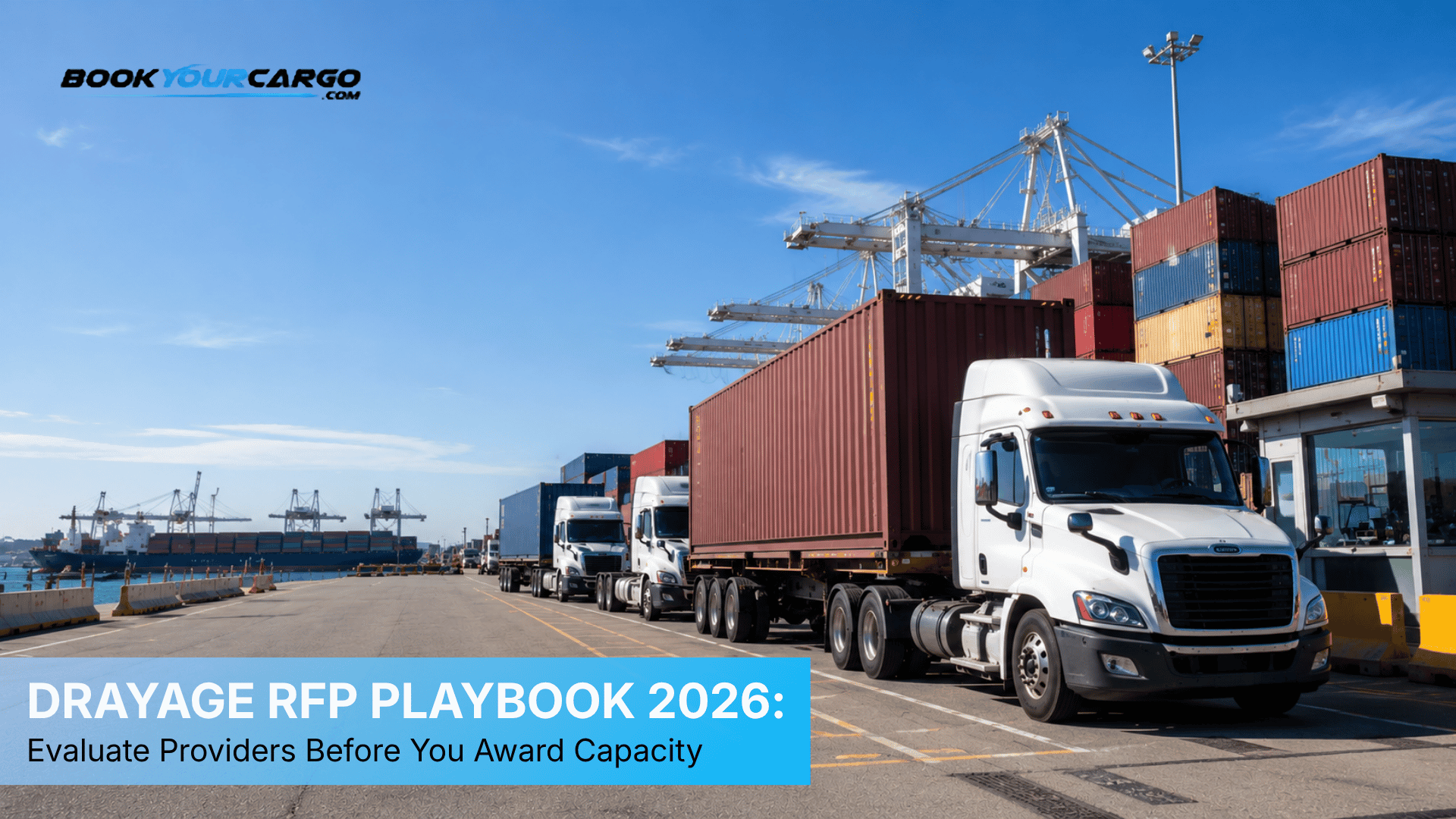
A drayage RFP done well removes most of the operational pain that operations teams quietly absorb every week. It locks in fair pricing, sets enforceable performance standards, surfaces capacity risk before it becomes a no-trucks day, and gives procurement a defensible scorecard for renewal conversations. A drayage RFP done poorly locks the business into twelve months of avoidable demurrage, missed appointments, and status chasing, then makes those problems look like everyone's fault instead of the carrier selection's fault.
This playbook is built for the procurement and operations leaders who own drayage carrier decisions in 2026. It walks through the scoring framework that separates good drayage providers from average ones, the pricing structures to ask for and avoid, the service level agreements that actually hold up, the compliance and credentialing checks that protect the business, and the red flags in RFP responses that should disqualify a carrier before the conversation goes further. Whether you are an NVOCC running an annual tender, a freight forwarder consolidating drayage providers across multiple ports, or a BCO procurement team taking drayage in-house from a 3PL, the goal is the same: pick the provider whose operating model matches your actual freight, not the lowest line on a spreadsheet.
A drayage RFP is a structured procurement process used by importers, freight forwarders, and NVOCCs to evaluate and select drayage carriers across a defined network of ports and rail ramps for a contract period, typically twelve months. A strong drayage RFP in 2026 evaluates providers on six dimensions: pricing structure and rate stability, operational execution and SLA performance, technology and integration capability, compliance and credentialing, network coverage and capacity redundancy, and strategic fit. Evaluating on price alone is the most common reason drayage RFPs fail in their second quarter and produce higher landed cost than the previous contract.
What this playbook helps you control
- Carrier selection that protects the business through volatile 2026 capacity cycles, not just the first month of the contract.
- Pricing structures that are transparent on the base rate and predictable on accessorials, fuel surcharge, and per-diem exposure.
- Service level agreements with enforceable metrics, escalation paths, and measurable consequences.
- Compliance and credentialing checks that prevent regulatory exposure on the importer or forwarder side.
- Technology integration that removes manual status chasing and pushes milestones directly into your TMS or ERP.
1. Why most drayage RFPs underperform
Across the drayage RFPs that look strong on paper and disappoint in execution, the same patterns appear:
- The award goes to whoever bid lowest on base rate, with no normalization of fuel surcharge methodology, accessorial structure, or chassis billing. The headline savings evaporate within the first quarter as accessorials and per-diem charges fill the gap.
- Execution criteria are not measurable. The RFP asks for "on-time performance" but does not define on-time, the measurement window, the data source, or the consequence of missing the threshold.
- Network depth is assumed rather than verified. The carrier says it covers every major port and ramp. Operations later discovers that the coverage is single-carrier dependent in two of those markets, with no redundancy when capacity tightens.
- Compliance is treated as a yes or no question. Insurance certificates and authority numbers are collected, but PDTR registration, CTPAT participation, FMCSA safety ratings, and driver credentialing standards are not verified. See Know Your Carrier: Top 5 Drayage Problems for the operational version of this risk.
- Technology is asked about but not tested. The carrier checks the box for API and EDI integration in the RFP, but the actual mapping work, milestone push frequency, and TMS connector quality never get validated until the contract is signed.
- The RFP is built around a snapshot of current freight flow, not the next twelve months. Capacity volatility, regulatory changes, and lane shifts that are visible in early 2026 do not show up in the evaluation criteria.
2. The drayage RFP scoring framework
A strong drayage RFP uses a weighted scorecard across six categories. The weights below are a defensible starting point for a typical North American drayage tender. Adjust them based on freight profile: volume-heavy and time-critical operations should weight execution and technology higher, while spot-heavy or seasonal operations should weight network coverage and capacity redundancy higher.
| Category | Weight | What you are actually measuring |
|---|---|---|
| Pricing and rate stability | 20% | Base rate competitiveness, accessorial transparency, fuel surcharge methodology, chassis billing structure, and rate stability commitments. |
| Operational execution | 25% | On-time appointment performance, container clear-before-LFD rate, exception response time, claim resolution speed, and historical SLA results. |
| Technology and integration | 15% | Live tracking quality, milestone push frequency, API and EDI capability, dashboard depth, integration with CargoWise, Descartes, Magaya, and custom TMS or ERP systems. |
| Compliance and credentialing | 15% | FMCSA safety rating, insurance limits, CTPAT status, PDTR registration where applicable, driver credentialing standards, and hazmat or specialized cargo authorities where relevant. |
| Network coverage and capacity redundancy | 15% | Coverage at the ports and rail ramps that match your freight, depth of the vetted carrier network at each location, and ability to absorb capacity volatility through redundancy. |
| Strategic fit and account management | 10% | Quality of the proposed account team, escalation structure, willingness to support operational integration, and alignment with the importer or forwarder operating model. |
3. Pricing structures and what to ask for
Drayage pricing looks simple on the surface and gets complicated underneath. The strongest RFPs require pricing to be submitted in a normalized format across three layers:
- Base rate by lane. Per-move or per-mile, clearly defined per lane, per container size, and per service type (live unload versus drop pull). Avoid weighted blends that hide individual lane economics.
- Fuel surcharge methodology. Indexed to a specific published source (DOE national or regional ULSD), with a clearly defined refresh cadence (weekly or monthly) and the exact formula used to convert the fuel index to the per-move surcharge.
- Accessorials. A complete schedule of every potential surcharge, including chassis daily, pre-pull, yard storage, dual transaction, weekend or after-hours, hazmat, residential delivery, detention beyond X hours, dry runs, layover, and stop-offs. Anything not on the schedule should not appear on an invoice.
Rate stability matters as much as headline price. Strong RFPs ask carriers to commit to a defined rate review cadence (typically quarterly or semi-annually) and to surface market-driven adjustments with documentation rather than ad hoc invoice increases. For first-party rate context that helps benchmark carrier bids, the BYC Drayage Index publishes monthly regional rate trends going back to 2022.
4. Operations and execution criteria
Execution criteria need to be measurable, sourceable, and consequential. The standard battery of operational metrics that hold up in a drayage SLA includes:
- On-time appointment performance. Container pickup or delivery within a defined window (typically 30 to 60 minutes of the scheduled time), measured from carrier and terminal data, not self-reported.
- Container clear-before-LFD rate. Percentage of import containers cleared from the terminal before the Last Free Day. The single most important operational metric for protecting demurrage exposure.
- Exception response time. The interval between an exception event (hold, missed appointment, chassis issue) and carrier communication to the customer. Typically measured in minutes, not hours.
- Milestone push reliability. Percentage of expected status milestones (gate in, gate out, delivered, empty returned) pushed via API or EDI within the defined cadence.
- Claim resolution time. Average days from claim submission to resolution, with a defined escalation path for unresolved claims beyond the SLA threshold.
For the operational discipline behind these metrics, see Real-Time Drayage Tracking: Why Visibility Is Now a Non-Negotiable for Importers.
5. Technology and integration criteria
The technology category often gets the lightest evaluation and produces the most operational pain when underweighted. Three areas should be specifically tested before contract award, not just claimed in the RFP response:
- Live tracking depth. Container-level visibility across terminal status, holds, ERD and LFD windows, chassis status, and consignee appointment activity, in one view. Ask for screenshots of the live dashboard, not marketing materials.
- API and EDI integration. Validated connectors to the major TMS and forwarding platforms (CargoWise, Descartes, Magaya) and the ability to integrate with custom in-house ERP or TMS systems. Ask for the milestone schema, the push cadence, and reference customers using the integration in production.
- Dashboards and reporting. KPI reporting, spend analytics, and ad hoc query capability that procurement and operations can use during the contract, not just at renewal. Ask for sample reports from existing customers, redacted as appropriate.
A drayage provider that treats technology as a marketing checkbox usually delivers a manual operations experience. A provider whose operating model is built around its digital drayage platform typically delivers the visibility and integration depth the RFP asked for.
6. Compliance, credentialing, and insurance
Compliance failures on the carrier side become exposure on the importer or forwarder side. The minimum credentialing battery for a 2026 drayage RFP should verify, at the carrier level:
- FMCSA Operating Authority active and current, with no unresolved out-of-service orders.
- FMCSA Safety Rating of Satisfactory or unrated with clean violation history. Conditional or unsatisfactory ratings should disqualify.
- Auto liability insurance at $1 million minimum, with cargo coverage typically at $100,000 minimum. Specialized cargo (hazmat, high-value) typically requires higher cargo limits.
- CTPAT certification for carriers handling significant cross-border or high-security cargo. Many BCOs require CTPAT participation as a baseline.
- Port Drayage Truck Registry (PDTR) registration and CARB Drayage Truck Regulation compliance at the San Pedro Bay complex. Non-registered trucks cannot enter LA or Long Beach terminals.
- Hazmat authority where applicable, with documented driver hazmat endorsements and emergency response plans.
Equally important is the carrier's policy on driver credentialing. The FMCSA non-domiciled CDL rule that took effect March 16, 2026 has tightened the driver credentialing environment. RFP responses should describe how the carrier validates CDL status, English language proficiency, and driver record reviews on its dispatched capacity, not just on direct employees.
7. Service level agreement framework
The SLA section of the contract is where execution standards become enforceable. Each SLA category should specify the metric, the measurement source, the threshold, the measurement window, and the consequence for missing the threshold. Below is a baseline framework that holds up in production:
| SLA category | Target threshold | Measurement and consequence |
|---|---|---|
| On-time appointment performance | 95% within window | Measured from terminal and carrier gate data. Below threshold triggers monthly performance review and remediation plan. |
| Container clear-before-LFD | 98% of import containers | Measured from steamship line LFD versus actual gate out. Below threshold triggers root cause review and potential demurrage cost share. |
| Exception response time | 30 minutes | From exception event timestamp to customer communication. Below threshold triggers escalation review and account team adjustment if persistent. |
| Milestone push reliability | 99% of expected milestones | Measured via API or EDI integration logs. Below threshold triggers technical review and remediation timeline. |
| Claim acknowledgment | 24 hours | From claim submission to acknowledgment. Below threshold triggers account review and potentially carrier scorecard impact. |
| Claim resolution | 30 days | From submission to resolution. Below threshold triggers escalation to defined contact and contractual interest accrual if applicable. |
A note on consequences. SLA enforcement does not have to be punitive to be effective. Many strong drayage contracts use a tiered model: persistent under-performance triggers a remediation plan, repeat under-performance triggers a portion of the lane volume moving to a backup carrier, and chronic under-performance allows contract termination without penalty. Consequence design should match the importer or forwarder operating model, not borrow heavily from generic procurement templates.
8. Red flags in RFP responses
Patterns in RFP responses that should slow down or disqualify a carrier before contract conversations advance:
- Pricing that materially undercuts the market without an explanation. Either the carrier is buying the business at a loss and will reset within 90 days, or the accessorial schedule contains the real margin. Both outcomes are bad.
- Vague language on accessorials. Phrases like "standard accessorials apply" or "as per market" with no schedule attached. Strong carriers publish their accessorial schedule and stand by it.
- Self-reported execution metrics with no data source. An on-time performance claim with no measurement methodology, no baseline period, and no third-party data is a marketing number, not an operational one.
- Single-carrier dependence at major markets. A carrier that says it covers a market but uses a single sub-carrier with no vetted backup is one capacity event away from a no-trucks day. Ask for the carrier network depth at each major market.
- Technology capability that cannot produce a live demo. If the RFP response describes a sophisticated platform but the sales team cannot show it working on a real container during the evaluation, the platform is incomplete.
- Insurance certificates that meet minimums but not the cargo profile. $100,000 cargo coverage on a $4 million high-value electronics container is a paper compliance check, not a real risk transfer.
- No clear escalation structure. "Call your account manager" is not an escalation structure. A real one names the operations contact, the account owner, the regional director, and the executive sponsor with response time commitments at each level.
9. How to structure the RFP process
A drayage RFP is roughly an 8 to 12 week process when run well. The structure that produces the strongest outcomes:
- Weeks 1 to 2. Internal preparation. Define freight scope (ports, ramps, lanes, container count), assemble historical data (volume, accessorials, exception rate), set evaluation criteria and weights, and draft the SLA framework.
- Weeks 3 to 4. Carrier longlist and qualification. Identify 8 to 12 candidates, validate baseline compliance and network coverage, and shortlist 4 to 6 carriers to participate in the formal RFP.
- Weeks 5 to 7. RFP issuance and response period. Distribute the full RFP package, hold a clarification call in week 5 or 6, and collect responses by the end of week 7.
- Week 8. Initial scoring and shortlist. Apply the weighted scorecard to all responses and shortlist 2 to 3 carriers for final evaluation.
- Weeks 9 to 10. Demo, references, and BAFO. Live technology demos, customer reference calls, and best and final offer (BAFO) on pricing and SLAs.
- Weeks 11 to 12. Award and onboarding. Notify finalists, negotiate contract specifics, schedule integration kickoff, and stand up the carrier in operations before the contract effective date.
Reserving the last two to three weeks for proper integration and onboarding is the most underused practice in drayage procurement. Carriers that look strong in evaluation but get rushed through onboarding regularly underperform in the first quarter of the contract.
Frequently asked questions about the drayage RFP process
Run a stronger drayage RFP without underestimating the operational layer
A strong drayage RFP is the foundation of stable landed cost and predictable execution for the next twelve months. It is also the moment where the carrier decision either matches the actual freight or quietly mismatches it for a year. If you are running a drayage RFP in 2026 and want a partner with the network depth, national drayage, port drayage, and rail drayage coverage at every major U.S. and Canadian gateway, plus the integration and SLA structure to back it up, talk to BYC strategic accounts.
