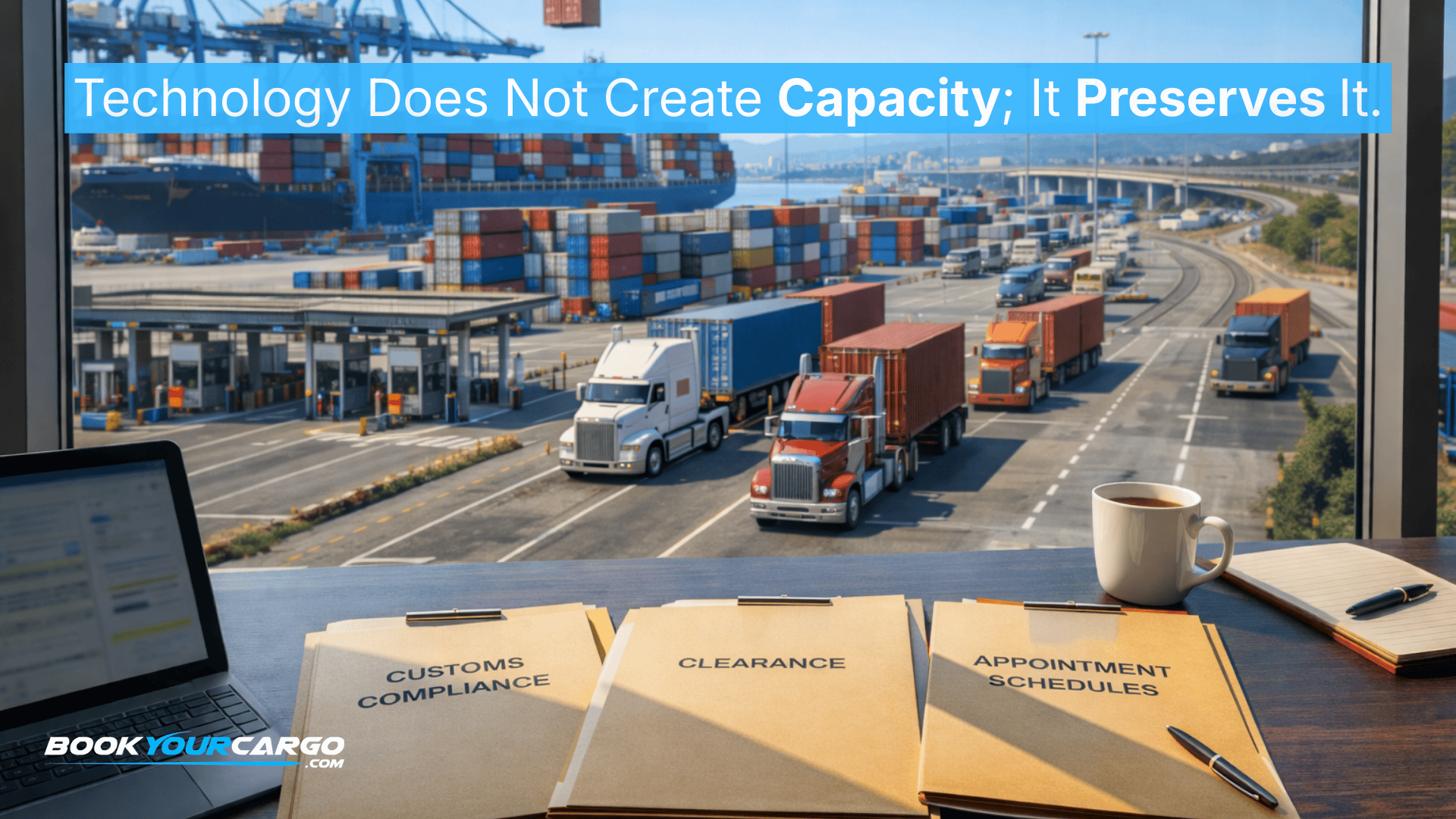
In today's port environment, capacity only exists if a move can clear compliance checks, align with terminal rules, secure an appointment window, and be executed inside shrinking free-time margins. A truck that fails any one of these conditions is not delayed capacity. It is non-capacity.
This is why many shippers feel they are operating in truck-rich markets that behave like truck-poor ones. The problem is not supply. The problem is execution readiness.
BYC has seen this pattern repeat across the US & Canada. Capacity becomes unreliable not because trucks vanish, but because decisions arrive late and coordination fragments early. Technology matters here only when it addresses those failure points directly.
Why Traditional Drayage Models Break Under Modern Port Conditions
Legacy drayage models were built for looser environments. Appointments were flexible. Compliance checks were lighter. Recovery windows existed.
That environment is gone.
Today, ports operate on fixed appointment systems. Compliance is enforced at the gate. Equipment cycles are tighter. Inland delivery windows are less tolerant. Under these conditions, reactive drayage models fail quietly. They confirm trucks early and discover constraints late.
This is why capacity appears to evaporate during execution.
BYC's operating philosophy assumes that most capacity loss is self-inflicted. When planning starts after a container is available, the provider has already surrendered control. Digital drayage exists to move planning upstream, not to automate failure.
Capacity Is Conditional, Not Physical
A truck is not capacity unless it can move now, under current conditions, without triggering exceptions.
Digital drayage models change capacity economics by validating those conditions before commitment. Compliance status, documentation readiness, terminal access, appointment feasibility, and free-time exposure must align simultaneously.
BYC's platform is built around this principle. Capacity is selected based on execution readiness, not availability alone. This is why BYC does not treat its 3,000+ vetted container truckers as a marketplace. It treats them as a controlled execution pool.
Reliable capacity is not found. It is verified.
Compliance Is the First Gate Where Capacity Is Lost
Compliance is no longer a back-office concern. It is the first filter that determines whether capacity survives long enough to reach the gate.
Non-compliant drivers, equipment mismatches, filing errors, or documentation gaps remove trucks from circulation without notice. When this happens late, shippers interpret it as a shortage.
BYC embeds compliance into capacity selection. Its vetted network operates within defined regulatory and operational standards, ensuring trucks do not disappear during execution. Technology matters here because compliance cannot be manually revalidated for every move at scale.
When compliance is treated as an execution prerequisite rather than a checklist, capacity becomes predictable.
Visibility Does Not Create Capacity. It Preserves It.
Most shippers already have tracking. That is not the issue.
The issue is timing control.
Capacity collapses when release holds surface after appointment slots are booked, when ERDs shift without warning, or when free time erodes unnoticed. Late visibility converts usable capacity into recovery cost.
BYC's end-to-end visibility is structured around milestone risk. Holds, release readiness, appointment confirmation, and free-time countdowns are surfaced early so execution can be resequenced before capacity is wasted.
This is how digital drayage stabilizes trucking availability. It prevents avoidable churn.
Digital Coordination Is How Capacity Scales Without Fragmentation
One of the least discussed capacity killers in drayage is coordination noise.
Emails, phone calls, manual updates, and duplicated status requests slow decisions and block redeployment. Over time, this friction reduces how much capacity a network can actually deliver.
BYC integrates digitally with shipper and forwarder systems via API and EDI so quotes, bookings, and updates flow into existing workflows. This removes handoffs and preserves momentum.
Capacity is not lost only at the port. It is lost between inboxes.
Why Open Marketplaces Feel Fast but Execute Slow
Open marketplaces surface trucks quickly, but they also surface variability.
Different carriers operate with different standards, response times, and exception-handling discipline. Under stable conditions, this variability is manageable. Under port pressure, it becomes a liability.
BYC's vetted network model reduces this variability by enforcing consistent execution standards across its carrier base. This allows capacity to behave predictably even when conditions tighten.
Reliability is not about finding a truck fast. It is about knowing how that truck will behave when something goes wrong.
What Reliable Port Trucking Capacity Looks Like Today
In practice, reliable capacity means:
- compliance-validated trucks that clear gates without friction
- appointments secured with feasibility confirmed, not assumed
- early detection of holds and release blockers
- proactive free-time management
- centralized coordination that absorbs exceptions quietly
These outcomes are not produced by more trucks. They are produced by better execution systems.
BYC's pillars around compliance, built-for-execution technology, end-to-end visibility, and a vetted carrier network exist to deliver those outcomes consistently.
Closing Perspective
Technology does not magically create trucking capacity. It determines whether existing capacity survives execution.
In modern port environments, reliability belongs to operators who validate conditions early, coordinate digitally, and manage drayage as a control layer rather than a dispatch function.
BYC was built for this reality. Not to chase digital trends, but to make port trucking capacity behave predictably in environments where forgiveness no longer exists.
Frequently Asked Questions
Ready to Secure Reliable Port Trucking Capacity?
BYC's digital drayage model—compliance-validated capacity, execution-grade visibility, and vetted carrier networks—helps shippers secure port trucking that behaves predictably under pressure. See how Book Your Cargo can support your drayage needs across the USA and Canada.
Get Started Today