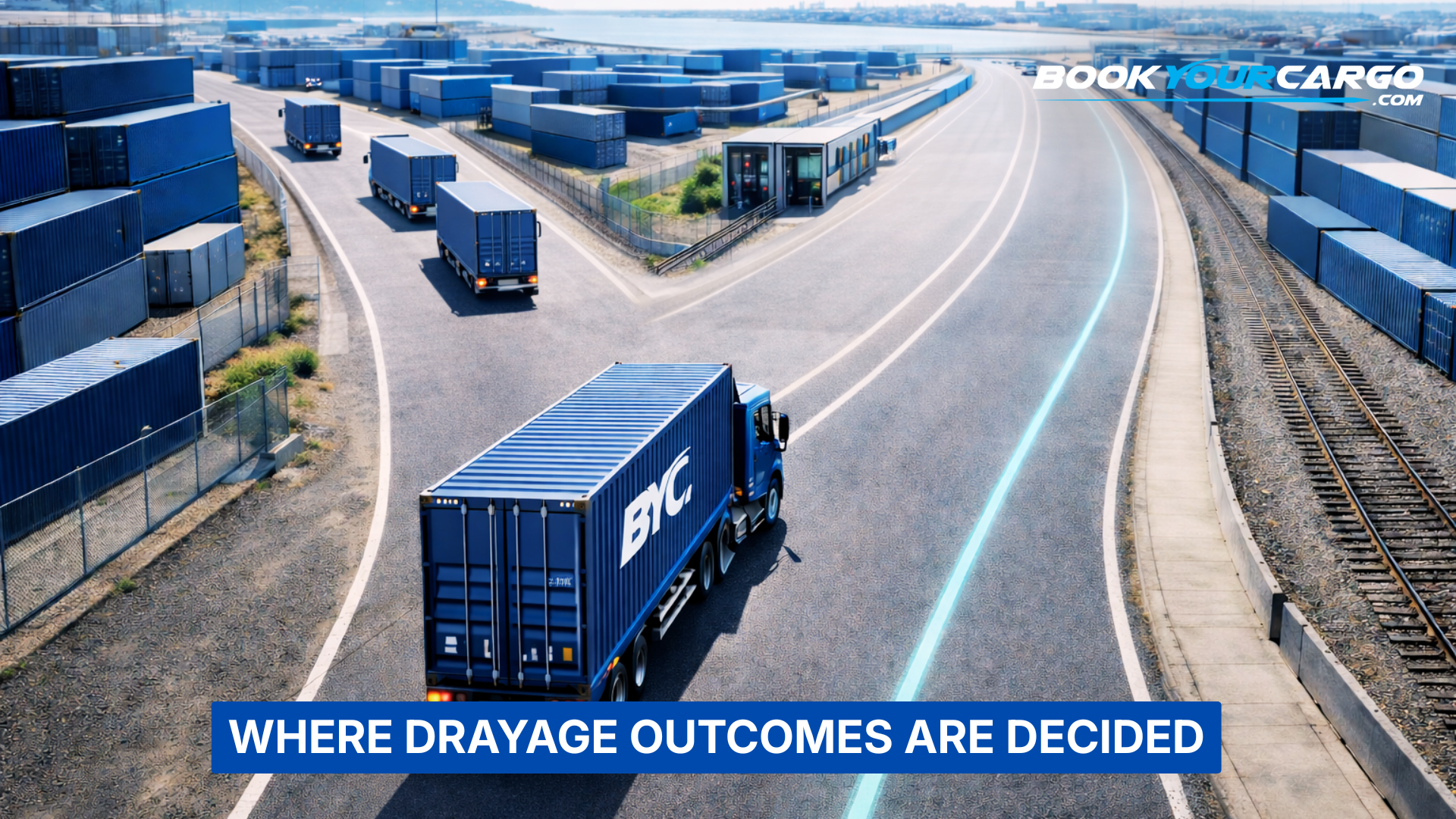
Drayage decisions are usually made when time is already running out.
The vessel is close. Free time has started ticking. Someone needs to move the container. A drayage company confirms availability and the process feels complete.
That moment creates a false sense of control.
Because the real performance of a drayage company is not revealed at booking. It is revealed after the booking when terminal behavior shifts, appointments tighten, chassis availability fluctuates, and rail cutoffs stop being flexible.
This is where many drayage relationships quietly fail not through obvious breakdowns, but through small execution gaps that compound into cost.
Choosing a container drayage provider is therefore not a procurement decision. It is a risk allocation decision. The provider you select determines whether execution risk is absorbed operationally or passed back to you through demurrage, detention, missed appointments, and escalation cycles.
This is the lens through which experienced shippers evaluate a drayage company.
Before breaking execution down into individual components, let's deepdive to understand the structural difference between how drayage companies operate.
At a high level, most providers fall into one of two models. Understanding which model you are dealing with explains nearly every downstream outcome.
Transactional vs Structured Drayage Execution
| Execution Dimension | Transactional Drayage Company | Structured Drayage Services (BYC Model) |
|---|---|---|
| Planning start point | After container availability | From vessel milestone forward |
| Appointment handling | Booked once, rarely monitored | Actively monitored and protected |
| Chassis strategy | Assumed available | Planned as part of execution |
| Rail execution | Treated like port pickup | Operated as a distinct workflow |
| Exception visibility | Discovered after failure | Detected early enough to adjust |
| Risk ownership | Shipper absorbs downstream impact | Provider absorbs and manages risk |
| Geographic consistency | Location dependent | Unified execution framework across USA and Canada |
Every cost overrun or service failure in drayage can be traced back to one of these structural differences. This is not a feature comparison. It is an execution model comparison.
Once this distinction is clear, the individual considerations stop feeling fragmented. They become predictable outcomes of structure.
Where Execution Really Begins
Generally drayage companies begin planning when a container becomes available at the terminal or rail ramp. At that point, appointment availability, chassis positioning, and recovery options are already constrained.
Planning earlier does not eliminate congestion, but it preserves optionality.
Drayage services that plan from vessel milestones forward are able to sequence moves with greater flexibility, target appointments more intelligently, and avoid forced decisions once free time is active.
Book Your Cargo operates its drayage planning from this upstream position not as a technology claim, but as an operating discipline that reduces exposure when conditions tighten.
Why Appointment Discipline Separates Drayage Companies
Appointments are often treated as administrative steps. In reality, they are capacity rights governed by terminal behavior, not guarantees issued to drayage companies.
Terminal productivity shifts daily. Appointment availability tightens without notice. Missed windows rarely recover cleanly.
Transactional drayage companies book appointments and react when they fail.
Structured drayage companies monitor appointment risk continuously and adjust execution before the window collapses.
BYC runs centralized appointment oversight across its drayage network to reduce rolled pickups and prevent last-minute escalation not through preferential access, but through early risk detection and replanning.
Chassis Is Not a Commodity When Timing Is Tight
Chassis shortages are not uniform. They vary by pool, terminal, time of day, and cycle length.
When chassis strategy is not integrated into planning, failures surface late as dispatch issues, missed pickups, or idle drivers.
Structured drayage services treat chassis as an execution variable rather than a commodity.
BYC incorporates chassis availability into sequencing logic to reduce failed attempts and unnecessary rework. This does not eliminate shortages, but it materially reduces their impact on execution.
Why Rail Drayage Exposes Weakness Faster Than Ports
Rail ramps remove flexibility from execution.
Cutoffs are rigid. Recovery windows are narrow. Missed timing often means losing an entire cycle.
Drayage companies that treat rail execution as an extension of port pickup experience sharp performance drop-offs as rail volumes increase.
Book Your Cargo separates rail workflows operationally. Planning, sequencing, and exception handling behave differently at rail ramps because they have to. This distinction is one of the clearest indicators of execution maturity in a drayage company.
Operational Scenario
Consider a shipper moving containers through a congested rail ramp where dwell time variability is high.
If appointments are booked without monitoring dwell signals, the driver arrives only to miss the cutoff. The container rolls. Costs accumulate quietly.
In a structured model, dwell signals surface early, appointments are resequenced, and pickup windows are adjusted before the cutoff is breached.
The difference is not speed. It is timing control.
Why Coverage Alone Is a Weak Selection Signal
Many drayage companies advertise coverage but coverage alone does not equals to consistency.
Operating as a drayage company in USA requires precision under dense appointment pressure. Operating as a drayage company in Canada often requires rail-centric sequencing and longer inland coordination.
Providers that perform well in one environment frequently degrade in the other.
Book Your Cargo operates under a unified North American execution framework, allowing its drayage services to perform predictably across U.S. and Canadian gateways rather than excelling in isolated pockets.
How Experienced Shippers Evaluate a Drayage Company
Experienced operators no longer start with rates.
They start with execution questions.
Key Evaluation Questions:
- When does planning begin relative to vessel arrival
- How are appointments protected when terminal conditions change
- How is chassis availability factored into sequencing
- When do exceptions surface
- Can execution remain consistent across regions
These questions reveal structure immediately.
BYC's drayage services are designed to answer them operationally, not rhetorically.
Final Perspective
Choosing a container drayage provider is a decision about who manages timing inside systems that do not forgive mistakes.
When the drayage company absorbs execution risk, cost remains predictable. When the shipper absorbs it, cost surfaces later through penalties, delays, and operational noise.
The most capable drayage company is not the one with the lowest rate or widest coverage, but the one that demonstrates control before pressure arrives.
That is why structured drayage services like those provided by Book Your Cargo increasingly replace transactional providers across the USA and Canada.
Frequently Asked Questions
Ready to Choose the Right Drayage Provider?
Don't let execution gaps compound into cost. Book Your Cargo's structured approach to drayage execution absorbs risk, protects appointments, and delivers consistent performance across the USA and Canada.
Get Started Today