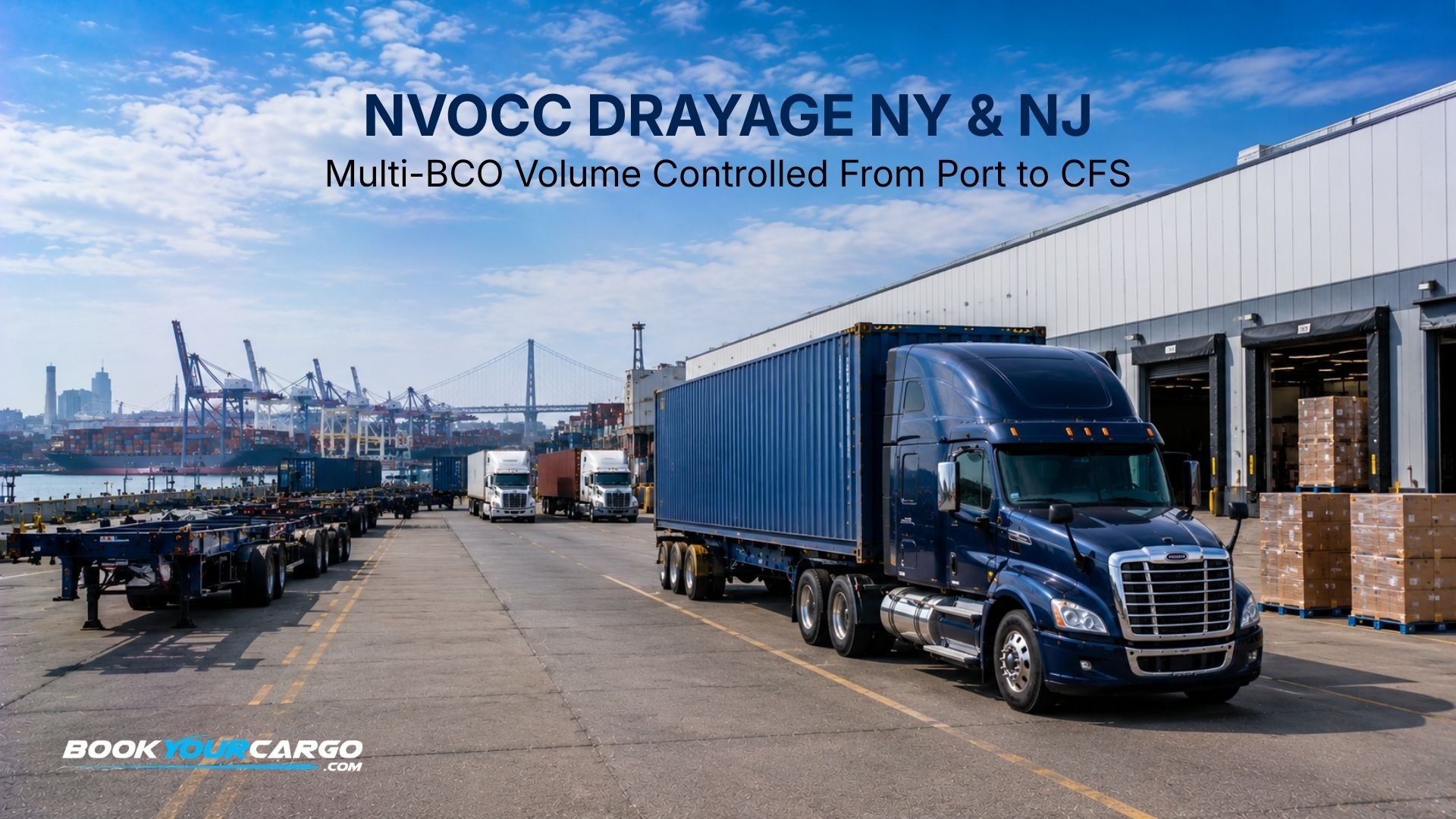
NVOCC drayage at the Port of New York and New Jersey is a different operational problem than moving a single FCL box for a single importer. A non-vessel operating common carrier is accountable to many beneficial cargo owners on a single co-loaded container, or to many containers arriving on the same vessel bound for different consignees, different deconsolidation points, and different final destinations across the Northeast. One missed appointment, one chassis shortage, one container held past its Last Free Day does not affect one shipment. It cascades across every house bill inside that container and every BCO waiting on the other side.
This guide is built for the NVOCCs, co-loaders, and consolidators moving volume through the PANYNJ complex in 2026. It walks through what makes NVOCC drayage structurally different, how container freight station and deconsolidation timing interacts with terminal free time, the chassis and appointment strategy that holds up across many containers at once, how the Cargo Facility Charge lands on co-loaded volume, and the operating disciplines that keep landed cost predictable when the drayage layer is serving dozens of consignees rather than one.
NVOCC drayage at the Port of New York and New Jersey is the movement of co-loaded and multi-consignee containers between the PANYNJ marine terminals (APM Terminals Elizabeth, Maher Terminals, Port Newark Container Terminal, GCT Bayonne, GCT New York, and Red Hook) and container freight stations, deconsolidation warehouses, or inland delivery points across the Northeast. It differs from single-BCO drayage because a non-vessel operating common carrier is accountable to many beneficial cargo owners on the same container or vessel, which means free time, chassis, and appointment failures cascade across every house bill of lading rather than affecting one shipment. The operational priorities for NVOCC drayage at PANYNJ are deconsolidation timing against terminal Last Free Day, chassis and appointment strategy at scale, transparent handling of the per-laden-TEU Cargo Facility Charge on co-loaded volume, and visibility across many containers at once. BookYourCargo is a national drayage company built to execute this at the Port of New York and New Jersey for NVOCCs, freight forwarders, and BCOs.
What this guide helps NVOCCs control at PANYNJ
- Cascading demurrage exposure, where a single container held past Last Free Day generates cost against every house bill of lading inside it.
- Deconsolidation timing, where CFS and warehouse dwell interacts with terminal free time and per diem in ways that single-FCL importers never encounter.
- Chassis and appointment strategy at scale, when the drayage layer is moving many containers off the same vessel to different destinations in the same window.
- The Cargo Facility Charge and cost allocation across co-loaded containers serving multiple BCOs.
- Multi-container visibility, so exceptions surface at the container level before they compound across the consignee base.
1. Why NVOCC drayage at PANYNJ is a different problem
A non-vessel operating common carrier books ocean space, consolidates cargo from multiple shippers into containers, and issues its own house bills of lading to consignees. On the import side at the Port of New York and New Jersey, that structure creates operational realities a single-FCL importer never faces. A co-loaded container arriving at APM Terminals Elizabeth or Maher Terminals may hold cargo for a dozen different consignees, each with its own delivery requirement, its own clearance status, and its own tolerance for delay. The NVOCC is the party accountable for getting that container off the terminal, deconsolidated, and distributed before free time expires and the per diem clock compounds against the whole shipment.
The multiplication is the point. When a single-BCO importer misses a Last Free Day, one container accrues demurrage. When an NVOCC misses a Last Free Day on a co-loaded box, the cost lands against every house bill inside it, and the service failure is visible to every BCO on the container. The drayage execution layer is where that risk is either contained or multiplied, which is why NVOCC drayage at PANYNJ rewards providers who understand consolidation structure, not just container movement.
2. Where NVOCC containers land at the Port of New York and New Jersey
PANYNJ operates six marine terminals and public berths, with container volume concentrated in the Newark and Elizabeth cluster on the New Jersey side, which is where most NVOCC and co-loaded volume moves. Each terminal runs its own appointment system and gate behavior, so an NVOCC moving containers off the same vessel across different terminals is coordinating several distinct operating environments at once.
- APM Terminals Elizabeth. Major container facility in the Elizabeth cluster, part of the Maersk Group network, and a common landing point for consolidated Transatlantic and Transpacific volume.
- Maher Terminals. The largest single container terminal at PANYNJ by acreage and throughput, handling a broad mix of ocean carrier services relevant to consolidated cargo.
- Port Newark Container Terminal (PNCT). Operating under a long-term lease through 2050, with active berth and yard expansion, on the Newark side of the complex.
- GCT Bayonne. A modern, automated-assist terminal on the Bayonne side of the harbor at Port Jersey.
- GCT New York (Howland Hook). The only major container terminal on the Staten Island side of the harbor.
- Red Hook Container Terminal. A smaller container and breakbulk facility in Brooklyn, part of the broader Brooklyn Marine Terminal footprint.
For an NVOCC, the practical consequence is that a drayage provider must maintain vetted, redundant carrier capacity at every one of these terminals. A provider covering four of the six leaves the NVOCC exposed at the other two on any vessel that discharges across the complex. A genuine port drayage operation at PANYNJ maintains capacity everywhere the NVOCC's consolidated volume can land.
3. Deconsolidation, CFS timing, and the free time clock
The defining operational sequence in NVOCC import drayage is the interaction between deconsolidation and terminal free time. A co-loaded container has to be pulled from the terminal, delivered to a container freight station or deconsolidation warehouse, unloaded and separated by consignee, and then distributed. Every one of those steps consumes time, and the terminal free time clock does not wait for the CFS schedule.
The deconsolidation sequence
On import, a bonded container freight station receives the full container, deconsolidates it under customs supervision, separates each consignee's cargo, verifies condition, and prepares each house shipment for release or onward delivery. Deconsolidation typically takes a few business days depending on container complexity, the number of house bills, and customs clearance status across the consignee base. The drayage move that feeds the CFS is the pressure point. If the container is not pulled from the terminal and delivered to the CFS before Last Free Day, terminal demurrage begins against the entire consolidated shipment while the deconsolidation has not even started.
Why pre-pull is often the right move for co-loaded volume
For NVOCC volume, a pre-pull to a nearby Northern or Central New Jersey yard or CFS before Last Free Day is frequently the difference between a clean move and cascading demurrage. Pulling the container off the terminal converts terminal demurrage exposure into controlled yard or CFS dwell, which is both cheaper and within the NVOCC's operational control. When a single container carries a dozen house bills, the economics of a pre-pull are compelling, because the alternative is demurrage multiplied across every consignee on the box.
4. Chassis and appointment strategy at NVOCC scale
Single-FCL importers manage chassis and appointments one container at a time. NVOCCs are often moving many containers off the same vessel in the same window, which turns chassis availability and appointment capture into a scale problem. Three disciplines matter more for NVOCC volume than for single-box moves:
- Appointment capture across terminals in parallel. When consolidated volume discharges across APM Elizabeth, Maher, and PNCT on the same vessel, the drayage provider needs to capture appointment slots at all three terminals in the same window. A provider running lean on capacity will sequence these serially and lose free time on the containers that wait.
- Chassis pool depth under concentrated demand. PANYNJ operates under a Pool of Pools framework among the major Intermodal Equipment Providers, with chassis choice rights for the cargo interest under the Ocean Shipping Reform Act. When an NVOCC needs many chassis in the same window, chassis pool depth and the provider's ability to source across multiple IEPs becomes the constraint. Single-IEP dependence shows up fast under concentrated NVOCC demand.
- Chassis dwell across the deconsolidation cycle. A container sitting at a CFS on a chassis through a multi-day deconsolidation is accruing chassis per diem the entire time. Dropping the container and recovering the chassis, or using CFS live-unload where it fits, controls the chassis cost that otherwise stacks across every co-loaded box in the deconsolidation queue.
A drayage company that treats chassis and appointments as one-container-at-a-time questions cannot execute NVOCC volume cleanly. The disciplines that separate strong NVOCC drayage execution are the same ones covered in the broader analysis of what the best drayage companies do differently, applied at the scale of many containers and many consignees at once.
5. The Cargo Facility Charge on co-loaded volume
The Port of New York and New Jersey assesses the Cargo Facility Charge, a per-laden-TEU charge funding container infrastructure projects across the complex, on laden containers only. For NVOCC volume, the CFC has a specific characteristic worth understanding: it is assessed at the container level, but the economics of a co-loaded container are spread across many house bills. A single laden TEU carrying cargo for a dozen consignees generates one CFC charge, which the NVOCC must account for and allocate across the house bills inside the box.
The CFC is a true pass-through at every stage. The Port Authority assesses it, the ocean carrier collects it and remits it to the Port, and it reaches the NVOCC as a line item on the carrier's invoice, not a charge the drayage provider generates. The practical point for NVOCC cost management is that the CFC, like every terminal-level charge, is most predictable when the drayage provider passes it through transparently rather than blending it into an opaque per-move rate. When an NVOCC is reconciling landed cost across dozens of house bills, a clean, itemized pass-through of the CFC and every other terminal charge is what makes accurate cost allocation possible. Spot-market context for the Northeast lives in the monthly BYC Drayage Index, which publishes regional rate trends going back to 2022 so NVOCCs can benchmark their PANYNJ drayage cost against the broader market.
6. Multi-container visibility across the consignee base
The single most valuable operational capability in NVOCC drayage is container-level visibility across many containers at once. A non-vessel operating common carrier managing consolidated volume through PANYNJ needs to see, in one view, the terminal status, ERD and Last Free Day windows, chassis status, customs hold status, and deconsolidation progress for every container in the pipeline, not one at a time. Exceptions that surface early can be contained. Exceptions that surface at the gate cascade across the consignee base.
This is where integration matters most for NVOCCs. Many NVOCCs run their own operating systems and platforms, and the drayage provider's ability to push container milestones directly into those systems through API or EDI removes the manual status-chasing that otherwise consumes operations staff on high-volume consolidated freight. The integration depth of BookYourCargo's drayage technology platform is built to feed container-level milestones into an NVOCC's own systems so the consolidated pipeline is visible without manual reconciliation.
7. Cost control checklist for NVOCC drayage at PANYNJ
A practical scoreboard for NVOCCs moving consolidated volume through the Port of New York and New Jersey. Each line is a place where cost most often multiplies across the consignee base, and the action that contains it.
| Risk | What it costs if mismanaged | Action that contains it |
|---|---|---|
| Missed Last Free Day on a co-loaded box | Terminal demurrage against every house bill inside the container | Pre-pull to a controlled yard or CFS before LFD, plan against terminal clock not CFS slot |
| Serial appointment capture across terminals | Free time lost on containers waiting their turn | Use a provider that captures appointments across APM, Maher, and PNCT in parallel |
| Chassis shortage under concentrated demand | Containers stranded when many chassis are needed at once | Confirm chassis pool depth and multi-IEP sourcing before peak vessel arrivals |
| Chassis dwell through deconsolidation | Per diem stacking across every box in the deconsolidation queue | Drop and recover chassis, or use CFS live-unload where it fits the flow |
| Customs hold on part of a co-loaded box | Whole container held while one house bill clears | Confirm clearance status across all house bills before dispatch, coordinate CFS release |
| Opaque terminal charge pass-through | CFC and fees that cannot be allocated cleanly across house bills | Require itemized pass-through of CFC and every terminal charge for accurate allocation |
| No container-level visibility across the pipeline | Exceptions surfacing at the gate and cascading across consignees | Use API or EDI integration to feed container milestones into the NVOCC operating system |
8. How BookYourCargo executes NVOCC drayage at PANYNJ
BookYourCargo is a national drayage company headquartered in West Long Branch, New Jersey, and the Port of New York and New Jersey has been a core operating environment for the company since it was founded. For NVOCCs moving consolidated volume through the complex, the operating model is built around the specific realities of multi-BCO freight.
- Redundant capacity at every PANYNJ terminal. Vetted, multi-carrier capacity at APM Terminals Elizabeth, Maher Terminals, PNCT, GCT Bayonne, GCT New York, and Red Hook, so consolidated volume discharging across the complex is covered everywhere it lands.
- Deconsolidation-aware dispatch. Drayage planning that treats terminal Last Free Day, chassis dwell, and CFS timing as one connected sequence, with pre-pull strategy applied to protect the whole consignee base on co-loaded boxes.
- Chassis and appointment capture at scale. Parallel appointment capture across terminals and multi-IEP chassis sourcing under the Pool of Pools framework, so concentrated NVOCC demand does not strand containers.
- Container-level visibility with integration. Live tracking across every container in the pipeline, with API and EDI integration that feeds milestones directly into the NVOCC operating system, removing manual reconciliation across many house bills.
- Transparent terminal charge pass-through. Itemized handling of the Cargo Facility Charge and every terminal charge, so cost allocates cleanly across house bills.
BookYourCargo delivers this alongside nationwide drayage coverage, transloading, and warehousing so an NVOCC can run terminal-to-CFS-to-distribution as a single coordinated workflow. Inc. 5000-recognized, BBB Accredited, IANA Member, NCBFAA Member, and WOSB-certified through the U.S. Small Business Administration, with editorial coverage in The Journal of Commerce, DC Velocity, Supply Chain Brain, American Shipper, FreightWaves, and Yahoo Finance.
Frequently asked questions about NVOCC drayage at the Port of New York and New Jersey
Move consolidated volume through PANYNJ without the cost multiplying across your BCOs
NVOCC drayage at the Port of New York and New Jersey rewards a drayage company that understands consolidation structure, plans deconsolidation against the terminal clock, and contains exceptions at the container level before they cascade across the consignee base. If you are an NVOCC, co-loader, or consolidator moving volume through PANYNJ in 2026 and want to talk to BYC about how your consolidated freight would execute, request a quote.
