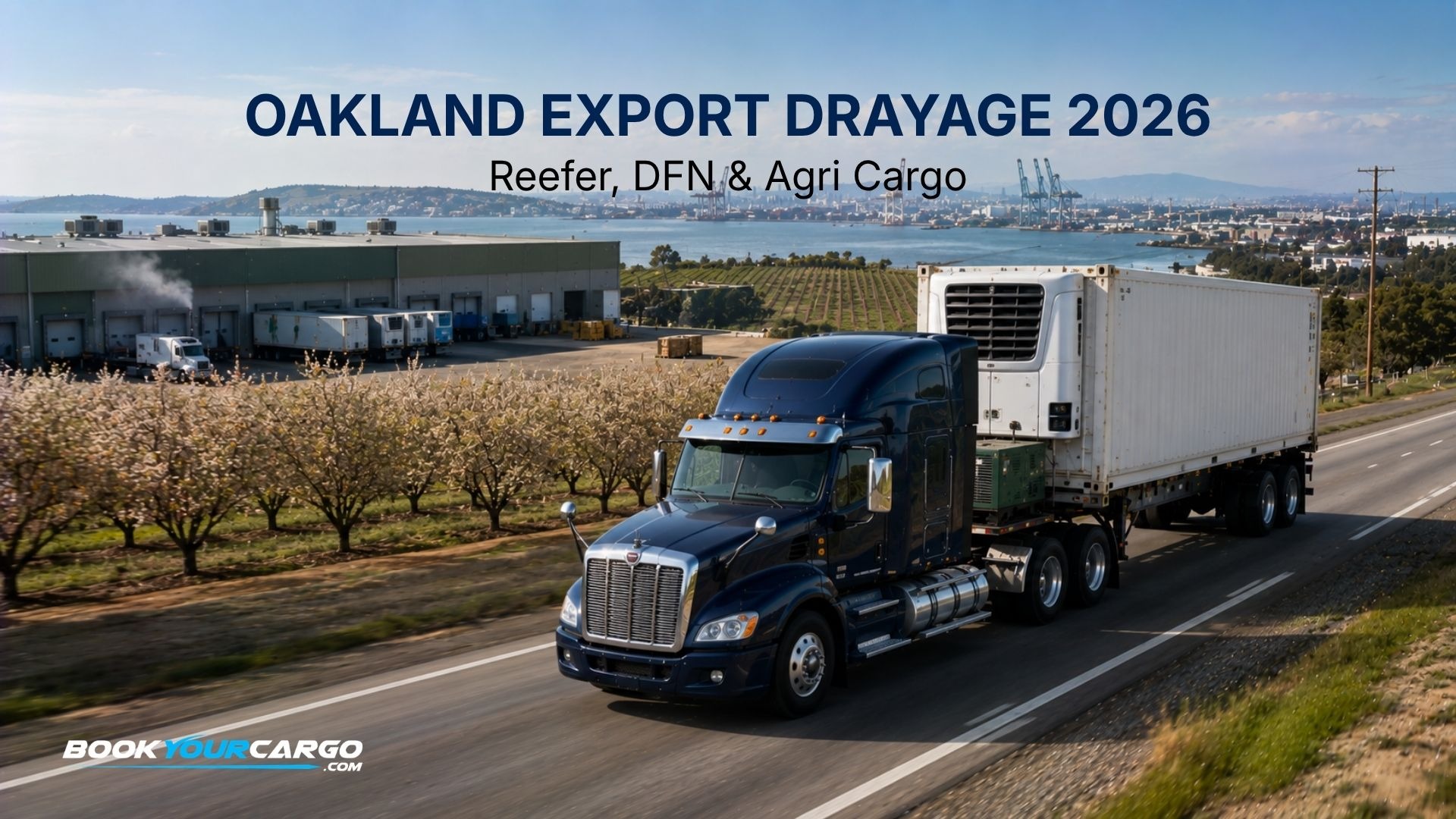
The Port of Oakland is the one major U.S. container gateway where exports, not imports, define the identity. While most West Coast ports are dominated by inbound consumer goods, Oakland is the primary ocean gateway for Northern California and Central Valley export cargo bound for Asian and global markets. But treating that export cargo as one undifferentiated block of agriculture is where a lot of drayage programs go wrong. Oakland actually moves three genuinely different export freight categories, each with its own container type and handling discipline: refrigerated perishables, dried fruit and nuts, and agricultural commodities. The drayage playbook for one is not the drayage playbook for another, and a provider who does not draw the distinction ends up mismatching equipment and cost to cargo.
This guide is built for the exporters, and the freight forwarders serving them, who move cargo through the Port of Oakland in 2026. It walks through why Oakland is an export gateway, the three export freight categories and how their drayage differs, how the terminals and their reefer capacity work, the reefer disciplines that protect perishables, the dry-container disciplines that protect dried fruit, nuts, and agricultural commodities, how export timing and empty repositioning to the Central Valley shape every move, and the California clean-truck compliance that governs the drayage leg. If you export through Oakland, the goal is to give you the drayage playbook that matches the specific cargo you actually ship.
The Port of Oakland is the primary ocean gateway for Northern California and Central Valley exports, and unlike most U.S. container ports it is export-oriented rather than import-oriented. Its export cargo falls into three distinct freight categories, each with a different container type and drayage discipline. Refrigerated perishables (fresh and frozen produce, meat, chilled dairy, and temperature-controlled wine) move in refrigerated containers and require reefer plugs, gen-sets, and cold chain continuity. Dried fruit and nuts, known in the trade as DFN (almonds, walnuts, pistachios, raisins, and dried fruit), move in dry containers and require moisture and condensation control rather than refrigeration. Agricultural commodities (cottonseed, cotton, rice, wheat, and soy) move in dry containers or bulk and are dense, weight-driven field and row crops. Oakland operates container terminals including Oakland International Container Terminal (OICT), TraPac Oakland, and the Ben E. Nutter Terminal operated by Everport. Common to all three categories are empty container repositioning to Central Valley loading points, export timing against vessel cut-offs, and California Air Resources Board clean-truck compliance. BookYourCargo is a national drayage company that executes reefer, DFN, and agricultural commodity export drayage at the Port of Oakland.
What this guide helps you control
- The right container type and drayage discipline for each of Oakland’s three export categories, so equipment and cost match the cargo.
- Reefer plug availability and cold chain continuity for refrigerated perishable exports.
- Moisture and condensation control for dried fruit and nuts moving in dry containers.
- Weight and dry-container handling for dense agricultural commodities like cottonseed, rice, and grain.
- Export timing, empty repositioning to the Central Valley, and California clean-truck compliance common to all three categories.
1. Why Oakland is an export gateway, not an import machine
Most U.S. container ports are import machines: consumer goods arrive from Asia, get drayed to distribution centers, and empty containers cycle back. Oakland runs differently. As the primary ocean gateway for one of the most productive agricultural regions in the world, Oakland has a heavy outbound flow, which inverts the usual drayage model. Instead of pulling loaded import boxes off a vessel and racing a free time clock, an Oakland export program is repositioning empty containers inland, loading them at Central Valley facilities, and draying them back to the port ahead of a vessel cut-off.
That export orientation is the first thing that makes Oakland drayage distinctive. The second is that export cargo is not one thing. It spans three freight categories that the trade treats very differently, and conflating them, calling almonds and cotton and fresh produce all simply agriculture, hides the fact that each needs a different container and a different drayage discipline. Getting the category right is the starting point for an Oakland export program, which connects to the broader port drayage model in an export-specific way.
2. The three export freight categories at the Port of Oakland
Oakland export cargo divides into three categories that the freight world names and handles distinctly. The difference is not academic: it determines the container type, the handling discipline, and the drayage equipment for every move.
Refrigerated perishables (reefer)
Fresh and frozen produce, meat and poultry, chilled dairy such as cheese and butter, and temperature-controlled wine. This cargo is perishable and moves in refrigerated containers, which require continuous power, reefer plugs at the terminal, gen-sets on the drayage leg, and cold chain monitoring. Reefer is the most equipment-intensive of the three categories and carries the highest cargo-loss risk from a temperature failure.
DFN: dried fruit and nuts
Almonds, walnuts, pistachios, raisins, and dried fruit, known across the export trade as DFN. California is the dominant global exporter of almonds and several other tree nuts, and DFN is one of the largest export streams through Oakland. DFN is shelf-stable and moves in dry containers, not refrigerated ones, so it does not need reefer plugs or gen-sets. What it does need is moisture and condensation control, because dried product is vulnerable to humidity and container sweat on a long ocean transit, along with fumigation and phytosanitary certification for many destination markets. DFN is also dense, so container weight is a real consideration.
Agricultural commodities
Cottonseed, cotton, rice, wheat, and soy: the field and row crops that the trade calls agricultural commodities, or simply agri. This is a distinct category from DFN, and the distinction matters in shipping. Agri commodities move in dry containers, sometimes loaded loose with container liners, and some volume moves in bulk. They are dense and weight-driven, so overweight and tri-axle considerations often apply, and like DFN they frequently require fumigation and phytosanitary certification for export.
| Category | Container type | Example cargo and key drayage discipline |
|---|---|---|
| Refrigerated perishables (reefer) | Refrigerated container | Fresh and frozen produce, meat, chilled dairy, temperature-controlled wine. Reefer plugs, gen-sets, cold chain continuity. |
| DFN (dried fruit and nuts) | Dry container | Almonds, walnuts, pistachios, raisins, dried fruit. Moisture and condensation control, fumigation, phytosanitary, container weight. |
| Agricultural commodities (agri) | Dry container or bulk | Cottonseed, cotton, rice, wheat, soy. Dense and weight-driven, container liners for loose loads, fumigation, and phytosanitary. |
Why this matters for drayage: a refrigerated container needs a plug and a gen-set, a DFN container needs a dry, condensation-controlled box, and an agri commodity container needs weight-appropriate equipment. A drayage provider that treats all three as generic export boxes mismatches equipment to cargo, which shows up as either cargo risk or unnecessary cost.
3. The Oakland terminals and their reefer capacity
The Port of Oakland operates its container terminals along the Oakland Estuary. For the reefer share of export volume, the reefer plug capacity at each terminal is as important as berth and crane capacity; for DFN and agri commodities moving in dry containers, terminal plug capacity is not the constraint, but gate efficiency and dry-container handling are.
- Oakland International Container Terminal (OICT). The largest terminal at Oakland and the primary node for Asia-Pacific trade, handling a high volume of vessel calls. OICT has substantial refrigerated capacity, roughly 1,500 reefer plugs, and sits adjacent to two Class I rail yards, the Oakland International Gateway served by BNSF and Railport Oakland served by Union Pacific.
- TraPac Oakland. A container terminal that has invested in reefer capacity, adding hundreds of reefer plugs, and modernized with new electric ship-to-shore cranes capable of servicing the largest container vessels.
- Ben E. Nutter Terminal. Operated by Everport, this terminal handles trans-Pacific cargo on deep-water berths at the eastern edge of the port.
For the reefer exporter, the key point is that reefer plug availability and reliability vary by terminal, and a refrigerated container that cannot get a working plug is a cold chain risk. For DFN and agri commodity exporters, the terminal-side priority is instead clean, on-time gate execution and dry-container availability, which keeps loaded export boxes flowing to the vessel without the plug dependency that governs reefer.
4. Reefer disciplines for perishable exports
For the refrigerated perishable category, reefer drayage lives or dies on continuous power and temperature continuity. A refrigerated container has to stay powered from the loading point through the terminal to the vessel, and any gap in that chain is a cargo risk. Three disciplines govern reefer perishable drayage at Oakland:
Reefer plugs at the terminal
When a loaded reefer arrives at the terminal ahead of vessel loading, it needs to plug into terminal power to hold temperature while it waits. Reefer plug availability is therefore a real constraint: a terminal with limited or unreliable plugs can leave a refrigerated export container without power during the wait, which threatens the cargo. Planning the delivery so the container reaches a working plug, and monitoring temperature through the wait, is a core reefer discipline.
Gen-sets on the drayage leg
Between the loading point and the terminal, a reefer container that is not plugged into facility power runs on a gen-set, a portable diesel generator that clips to the chassis. For a perishable exporter loading at a Central Valley facility and draying to Oakland, the gen-set has to have the fuel and the runtime to hold temperature across the full drayage leg, and gen-set fuel management is a basic but consequential discipline.
Cold chain continuity and documentation
Perishable export cargo often carries strict temperature requirements, and the temperature record is part of the export documentation and the claim record if anything goes wrong. Continuous temperature monitoring through the drayage leg and the terminal wait protects both the cargo and the exporter, which is the cold chain discipline that separates a reliable reefer drayage provider from one that treats a reefer like a dry box.
5. Dry-container disciplines for DFN and agricultural commodities
DFN and agricultural commodities move in dry containers, so they do not carry the reefer plug and gen-set requirements of perishables. But dry does not mean simple. Each category has its own dry-container disciplines that a drayage provider has to manage:
Moisture and condensation control for DFN
Dried fruit and nuts are shelf-stable but moisture-sensitive. On a long ocean transit with temperature swings, container sweat and humidity can damage dried product, so DFN often ships with desiccant and in containers checked for dryness and integrity. The drayage provider’s role is to ensure the container supplied for a DFN load is a clean, dry, sound box, because a container that has moisture or damage becomes a cargo problem that surfaces on arrival overseas.
Weight and equipment for agricultural commodities
Cottonseed, rice, grain, and similar agri commodities are dense, and a container loaded with them can approach or exceed standard over-the-road weight limits. This means overweight and tri-axle considerations often apply to agri commodity drayage, the same equipment discipline that governs heavy freight elsewhere. Some agri volume is loaded loose using container liners, and some moves in bulk, each of which changes the handling and the drayage equipment. Matching the right equipment to a heavy agri load is covered in the broader analysis of overweight and tri-axle drayage.
Fumigation and phytosanitary certification
Both DFN and agricultural commodities frequently require fumigation and phytosanitary certification for export, depending on the commodity and the destination market. These steps sit in the export sequence ahead of or around the drayage move, and a drayage program that coordinates with the fumigation and certification schedule keeps the loaded container moving to the vessel without missing a cut-off while paperwork or treatment is pending.
6. Export timing and empty repositioning to the Central Valley
All three categories share the same export clock, and it runs differently than an import clock. Instead of racing the terminal free time clock after a vessel discharges, an Oakland export program is racing to get loaded containers to the terminal within the export receiving window and ahead of the vessel cut-off, and it has to solve the empty container problem first.
The export timing sequence
An Oakland export move typically runs: reposition an empty container to the Central Valley loading point, load the product, dray the loaded container to Oakland, and deliver it within the export receiving window ahead of the vessel cut-off. Missing the receiving window or the cut-off means the container rolls to a later vessel, which for perishable cargo can be a serious problem and for DFN and agri commodities still carries cost and schedule consequences. The timing discipline is the mirror image of import free time, and it is covered from the arrival side in the analysis of what happens after ocean freight arrives, applied here to the export departure side.
Empty repositioning to Central Valley loading points
The structural challenge of Oakland export drayage is that the empty containers are at the port and the cargo is in the Central Valley, often a significant drive inland. Getting empty containers repositioned to inland loading points on time, dry and sound boxes for DFN and agri commodities and working refrigeration units for perishables, is a large part of the drayage problem. A drayage provider serving Oakland exporters has to manage this empty repositioning as a core function, not an afterthought, because a loading facility with no empty container is a stalled export.
7. California clean-truck compliance at Oakland
Every drayage move at the Port of Oakland, reefer or dry, operates under the California Air Resources Board framework, which sets emissions and equipment requirements for drayage trucks in California. A truck that does not meet the current CARB drayage requirements cannot legally perform the move, which makes fleet compliance a hard constraint rather than a preference.
- CARB drayage truck requirements. California’s clean-truck regulations govern which trucks can perform drayage at Oakland, with the state moving toward zero-emission drayage over time. A compliant provider maintains equipment that meets the current requirements across its dispatched capacity.
- Compliance on dispatched capacity. The requirement applies to every truck performing the move, so a drayage provider has to verify CARB compliance across its full carrier network, not just its owned equipment.
- The interaction with reefer. Reefer moves add gen-set diesel emissions to the equation, and California’s regulatory direction affects both the tractor and the refrigeration power source over time, which is a planning variable for perishable exporters specifically.
The practical lever an exporter has is choosing a drayage provider that maintains CARB-compliant equipment across its dispatched capacity, so compliance is handled as part of the service rather than becoming the exporter’s problem at the gate.
8. Cost and cargo control checklist for Oakland export drayage
A practical scoreboard for exporters moving cargo through the Port of Oakland across all three categories. Each line is a place where cargo, timing, or compliance most often goes wrong, and the action that prevents it.
| Risk | What it costs if mismanaged | Action that prevents it |
|---|---|---|
| Wrong container type for the category | Reefer risk, moisture damage, or overweight problems | Match container to category: reefer for perishables, dry for DFN and agri |
| No working reefer plug at terminal | Temperature drift on a waiting perishable container | Plan delivery to a working plug, monitor temperature through the wait |
| Container sweat on a DFN load | Moisture damage to dried fruit and nuts on transit | Supply clean, dry, sound containers, use desiccant for DFN |
| Overweight agri commodity load | Illegal move or forced partial unload | Use overweight and tri-axle equipment for dense agri commodities |
| Missed export receiving window | Cargo rolled to a later vessel | Plan the dray against the receiving window and vessel cut-off |
| No empty container at the loading point | Stalled export, missed loading schedule | Manage empty repositioning to the Central Valley as a core function |
| Non-compliant CARB equipment | Truck barred from the move, delay | Use CARB-compliant equipment across dispatched capacity |
9. How BookYourCargo handles Oakland export drayage
BookYourCargo is a national drayage company with vetted carrier capacity at the Port of Oakland and across every major U.S. and Canadian port and rail ramp. For exporters across all three of Oakland’s freight categories, the operating model is built around matching equipment and discipline to the specific cargo:
- Reefer-capable perishable drayage. Vetted reefer-capable carrier capacity for moves to and from Oakland International Container Terminal, TraPac Oakland, and the Ben E. Nutter Terminal, with plug-aware delivery planning, gen-set management, and continuous temperature monitoring to protect cold chain.
- Dry-container DFN drayage. Clean, dry, sound container supply for dried fruit and nut loads, coordinated with fumigation and phytosanitary certification schedules.
- Agri commodity drayage. Overweight and tri-axle equipment for dense agricultural commodities like cottonseed, rice, and grain, including liner-loaded and bulk-adjacent handling.
- Central Valley empty repositioning. Coordination of empty container repositioning to inland loading points, with the right box for each category, so loading facilities are not stalled waiting on equipment.
- CARB-compliant capacity and export visibility. Equipment that meets the California clean-truck requirements across dispatched capacity, with live tracking across the full export sequence from empty repositioning through terminal delivery and API or EDI integration into the exporter or forwarder operating system.
This connects to BYC’s broader national drayage, transloading, and warehousing capabilities, execution runs on the BYC drayage technology platform, and first-party West Coast rate context lives in the monthly BYC Drayage Index, published going back to 2022. Inc. 5000-recognized, BBB Accredited, IANA Member, NCBFAA Member, and WOSB-certified through the U.S. Small Business Administration.
Frequently asked questions about export drayage at the Port of Oakland
Move Oakland exports with the right box and discipline for each category
Oakland is an export gateway with three distinct freight categories, and reefer perishables, dried fruit and nuts, and agricultural commodities each reward a drayage company that matches the container and the discipline to the cargo rather than treating everything as a generic export box. If you are a perishable, DFN, or agricultural commodity exporter moving cargo through the Port of Oakland in 2026 and want to talk to BYC about how your export freight would execute, request a quote.
