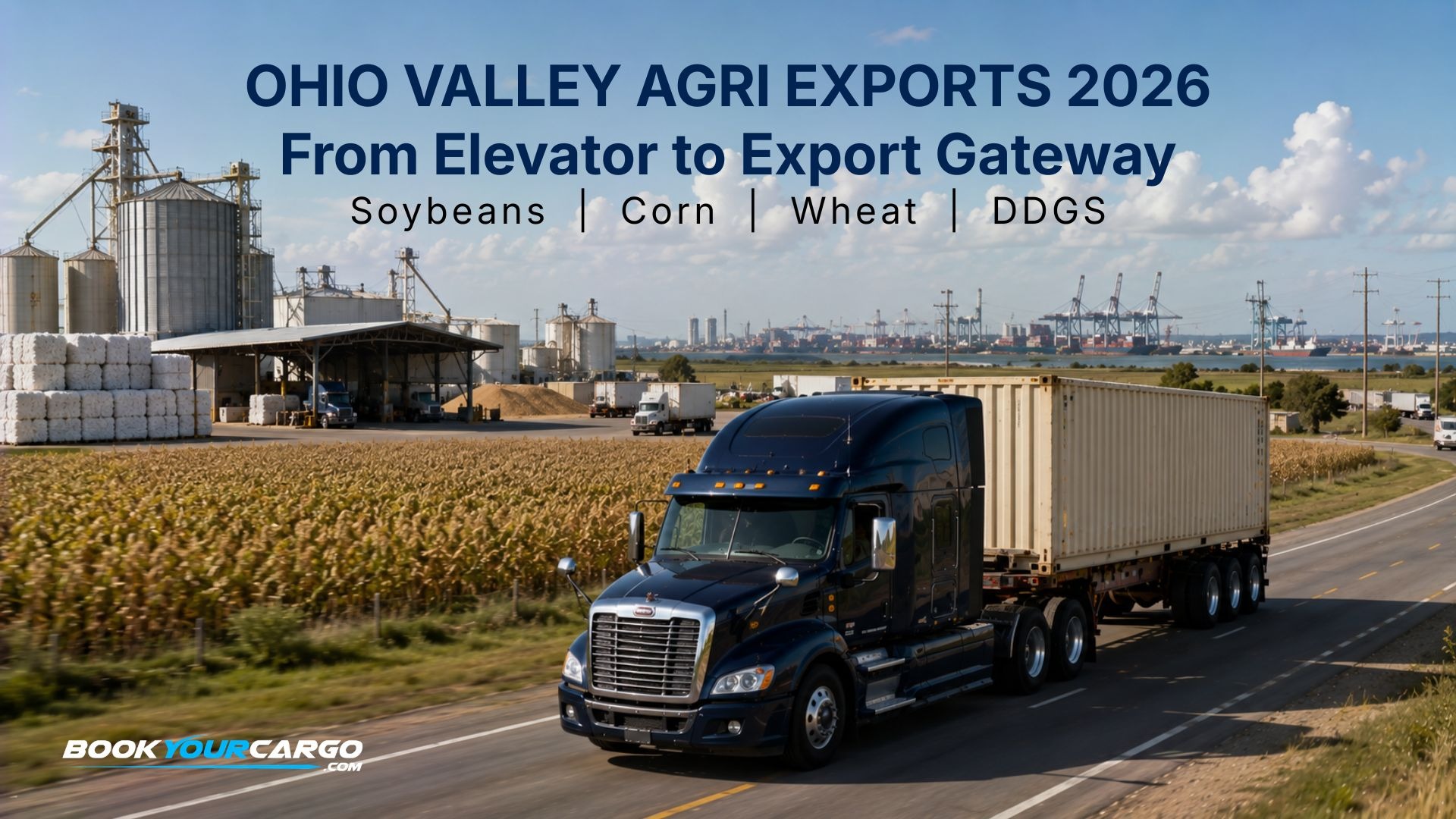
Agricultural commodities do not originate at a seaport. They originate in the field, and for the United States that means the Ohio Valley and the broader Corn Belt: Ohio, Indiana, Illinois, Kentucky, and the surrounding states that produce the soybeans, corn, wheat, and processed grain products that move to global markets. For a containerized agricultural export program, this is the operative fact. The port is the last step, not the first, and the cost and reliability of the whole move are determined hundreds of miles inland, at the country elevator, the processing plant, and the transload facility where bulk product becomes a loaded marine container.
This guide is built for the agricultural commodity exporters, and the freight forwarders serving them, who move soybeans, corn, wheat, soybean meal, and distillers dried grains out of the Ohio Valley in 2026. It is specific to agri commodities as the trade defines them, the field and row crops, which are a different freight category than dried fruit and nuts and a different category again than refrigerated perishables. It walks through why the Ohio Valley is the origin that matters, how bulk product becomes a containerized export, how inland drayage connects elevators to transload and intermodal ramps, how rail routing to export gateways works, the empty container availability problem that constrains the whole system, and the fumigation and phytosanitary timing that governs the sequence.
Containerized agricultural commodity exports originate in the Ohio Valley and the Corn Belt, not at the port. Agricultural commodities in the shipping sense are the field and row crops: soybeans, corn, wheat, soybean meal, and distillers dried grains (DDGS), a distinct freight category from dried fruit and nuts (DFN) and from refrigerated perishables. The export sequence runs from country elevators and processing plants in Ohio, Indiana, Illinois, and Kentucky, by truck to a transload facility where bulk product is loaded into marine containers, then by rail to an export gateway. Rail typically becomes cost competitive against truck beyond roughly 210 miles, and Ohio Valley origins sit closer to East Coast gateways such as the Port of Virginia and New York and New Jersey than to the West Coast. The drayage disciplines that govern this flow are empty container positioning to inland loading points, bulk-to-container transload coordination, dense-load equipment, and fumigation and phytosanitary timing ahead of the vessel cut-off. BookYourCargo is a national drayage company that executes agricultural commodity export drayage across Ohio Valley inland ramps and every major U.S. export gateway.
What this guide helps you control
- Empty container positioning to Ohio Valley country elevators, processing plants, and transload facilities, the first step in every export move.
- Bulk-to-container transload coordination, where loose grain and meal become a loaded, sealed marine container.
- Inland drayage between elevators, transload sites, and intermodal ramps across Ohio, Indiana, Illinois, and Kentucky.
- Dense dry-container loads, where soybeans, meal, and grain push against over-the-road weight limits.
- Fumigation and phytosanitary certification timing, which sits between loading and the vessel cut-off.
1. Why the Ohio Valley is the origin that matters
The Ohio Valley and the eastern Corn Belt are among the most productive agricultural regions on earth. Ohio, Indiana, Illinois, and Kentucky, together with the surrounding states, produce soybeans, corn, and wheat at a scale that makes the region a primary source of U.S. agricultural exports, along with the processed products that come from crushing and ethanol production: soybean meal and distillers dried grains. The overwhelming majority of that volume moves in bulk, by barge on the Ohio and Mississippi river systems or by unit train to bulk export elevators. But a meaningful and growing share moves in marine containers, and containerized agri export is a different logistics problem entirely.
Containerized agricultural export exists because certain buyers and certain products require it: identity-preserved and food-grade soybeans that must not be commingled with commodity bulk, specialty grains, soybean meal and DDGS moving to buyers who receive in container lots, and markets that lack the bulk discharge infrastructure to take a vessel parcel. For these shipments, the cargo has to get from an inland elevator into a marine container and then to a port, and every one of those steps is a drayage and inland logistics problem. It connects to the broader rail drayage and inland intermodal model in an agri-export-specific way.
2. What counts as an agricultural commodity in export shipping
Precision matters here, because the freight world draws lines that a general reference to agriculture blurs. Agricultural commodities, or agri, are the field and row crops and their processed derivatives. They are a distinct category from dried fruit and nuts and from refrigerated perishables, and the distinction determines the container and the handling.
- Soybeans. Including identity-preserved and food-grade soybeans destined for buyers who require segregation from commodity bulk, which is one of the primary drivers of containerized agri export.
- Corn and wheat. Moving containerized to markets and buyers that receive in container lots rather than vessel parcels.
- Soybean meal and distillers dried grains. Processed feed products from crushing and ethanol operations across the Ohio Valley, exported in volume.
- Other grains and oilseeds. Sorghum, specialty and cleaned grains, and related crops moving to global feed and food markets.
What unites these is that they are dry, dense, loaded loose or in liners rather than palletized, and subject to agricultural export controls like fumigation and phytosanitary certification. They do not need refrigeration, which separates them from perishables, and they are not the moisture-sensitive dried fruit and nut category. Getting the category right is the starting point, because the equipment, the loading method, and the export documentation all follow from it.
3. The core problem: turning bulk product into a loaded container
The defining operational challenge of Ohio Valley agri export is that the product is produced, stored, and moved in bulk, but it has to leave the country in a container. Somewhere between the field and the vessel, loose grain or meal has to be loaded into a marine container, weighed, sealed, and documented. That step is transload, and it is where a containerized agri export program succeeds or fails.
Where transload happens
Transload takes place at facilities positioned to receive bulk product by truck and load it into marine containers, frequently located at or beside inland intermodal terminals so the loaded container can go straight to rail. Railroads have invested in exactly this capability: Union Pacific operates a grain transload facility within its Global 4 intermodal terminal in Joliet, Illinois, where regional producers and processors truck product in for transloading into marine containers and onward rail movement to port. Facilities of this kind are the hinge point of the entire containerized agri export flow, and the services bundled around them, container drayage, chassis days, bulkheads, export seals, certificates of weight, and inspection reporting, are the practical shape of the work.
Why the hub-and-spoke pattern governs the drayage
The inland network runs as hub and spoke. The spokes are truck moves between county elevators, crush plants, and ethanol facilities and the hubs, which are the transload and intermodal terminals. This means agri export drayage is not one move but a sequence of them: repositioning an empty container, moving product or the container between the loading point and the transload site, and delivering the loaded box to the ramp. A drayage provider serving this flow has to operate across that inland geography rather than only at a port, which is where transloading capability and inland coverage matter more than terminal proximity.
4. Rail routing from the Ohio Valley to export gateways
Once a container is loaded and sealed, it moves by rail to an export gateway. Which gateway depends on the destination market, the ocean carrier’s equipment, and the rail economics, and the Ohio Valley sits in a genuinely advantageous position.
- Rail beats truck beyond roughly 210 miles. Research on containerized soybean movement finds that rail becomes cost competitive against trucking once shipping distance exceeds approximately 210 miles, which puts nearly every Ohio Valley to port movement in rail territory and makes the inland drayage legs short by design.
- Eastern gateways are close. Ohio Valley origins sit closer to East Coast ports than the Upper Midwest does, and cargo routed east reaches gateways including the Port of Virginia and the New York and New Jersey complex efficiently. Both CSX and Norfolk Southern serve the region and connect it to those gateways.
- Western and Gulf routings remain in play. Upper Midwest containerized soybeans commonly move by rail to the Los Angeles and Long Beach complex for Asian markets, and origins near the river system can reach New Orleans by inland waterway, so the routing decision is genuinely competitive rather than automatic.
The practical drayage consequence is that an Ohio Valley agri exporter needs a drayage provider that can execute both the inland legs at origin and the drayage at whichever gateway the cargo routes through, which is the value of a national drayage network rather than a single-region carrier.
5. Empty container availability and dense-load equipment
Two constraints shape every Ohio Valley agri export move, and both sit squarely in the drayage layer.
Empty container availability and match-back
The structural challenge of containerized agri export is that empty marine containers accumulate where imports land, not where grain is grown. Getting empties positioned inland to transload facilities and loading points is therefore the first and often the hardest step, and container match-back, pairing an inbound import container with an outbound export load, is a recognized way to cut cost and improve equipment availability, though coordinating it is genuinely complex. Railroad investment in inland grain transload has been aimed at exactly this problem, giving exporters more consistent access to containers and giving ocean carriers faster container turnaround. For an exporter, a drayage provider that treats empty positioning as a core function rather than an afterthought is what protects the loading schedule.
Dense loads and equipment
Soybeans, meal, corn, and DDGS are dense. A container loaded with them can approach or exceed standard over-the-road gross weight limits, which means tri-axle or specialized chassis and sometimes overweight permitting with a compliant route. Loose product is typically loaded into containers fitted with liners and bulkheads to hold the load and keep it clean. Confirming the loaded weight before dispatch and matching it to equipment avoids discovering a weight problem at a ramp gate, the same discipline covered in the analysis of overweight and out-of-gauge drayage.
6. Fumigation, certification, and export-window timing
Agricultural commodity exports carry plant-health controls that most cargo never encounters, and these steps sit directly between loading and the vessel cut-off.
- Phytosanitary certification. Many destination markets require a certificate confirming the commodity meets the importing country’s plant-health requirements. Certification interacts with inspection and timing, and an uncertified load cannot ship.
- Fumigation. Certain commodities and destinations require fumigation before export. Fumigation takes time, and containers held awaiting or undergoing treatment typically continue to accrue daily chassis charges, so treatment time is a direct cost as well as a schedule constraint.
- Weight certification and sealing. Containerized agri export involves a certificate of weight, export seal, and inspection documentation produced at transload, all of which have to be complete and accurate before the container moves to the ramp.
7. Cost and compliance checklist for Ohio Valley agri export
A practical scoreboard for soybean, corn, wheat, meal, and DDGS exporters moving containerized agricultural commodities out of the Ohio Valley. Each line is a place where the move most often runs into trouble, and the action that prevents it.
| Risk | What it costs if mismanaged | Action that prevents it |
|---|---|---|
| No empty container inland | Stalled loading at the elevator or transload site | Manage empty positioning and match-back to inland loading points as a core function |
| Transload not coordinated with drayage | Product waiting, equipment idle, missed rail cut-off | Sequence empty supply, transload loading, and ramp delivery as one plan |
| Overweight dense load | Illegal move or forced partial unload | Confirm weight before dispatch, use tri-axle or specialized chassis and permits |
| Fumigation or certification delay | Accruing daily chassis charges and a missed vessel | Build treatment and certification time into the export schedule |
| Dirty or unsound container supplied | Contaminated food or feed cargo, rejected load | Supply clean, dry, sound containers with correct liners and bulkheads |
| Missed rail or vessel cut-off | Cargo rolled, contract and demurrage exposure | Plan backward from the vessel cut-off through the full rail transit |
| No visibility across the inland sequence | Exceptions surfacing late, far from the port | Use live tracking from empty positioning through gateway delivery |
8. How BookYourCargo handles Ohio Valley agri export drayage
BookYourCargo is a national drayage company with vetted carrier capacity across Ohio Valley inland ramps and every major U.S. and Canadian port and rail ramp. For soybean, corn, wheat, meal, and DDGS exporters, the operating model is built around the inland realities of containerized agricultural export:
- Empty positioning to inland loading points. Coordination of clean, dry, sound empty container positioning to country elevators, crush and ethanol plants, and transload facilities across Ohio, Indiana, Illinois, and Kentucky.
- Transload-integrated drayage. Drayage sequenced around bulk-to-container transload, so empty supply, loading, weight certification, and sealing connect to ramp delivery without idle time.
- Dense-load equipment. Tri-axle and specialized chassis with overweight permitting for heavy soybean, meal, corn, and DDGS loads, including liner and bulkhead handling for loose product.
- Gateway coverage wherever the cargo routes. Vetted drayage capacity at the East Coast, Gulf, and West Coast gateways an Ohio Valley export may route through, so origin and destination legs run as one coordinated operation.
- Export-sequence visibility. Live tracking across the full inland flow from empty positioning through gateway delivery, with API and EDI integration into the exporter or forwarder operating system.
This connects to BYC’s broader national drayage, overweight and tri-axle drayage, and warehousing capabilities, execution runs on the BYC drayage technology platform, and first-party inland and port rate context lives in the monthly BYC Drayage Index, published going back to 2022. Inc. 5000-recognized, BBB Accredited, IANA Member, NCBFAA Member, and WOSB-certified through the U.S. Small Business Administration.
Frequently asked questions about Ohio Valley agricultural commodity export drayage
Move Ohio Valley agri exports without a stalled elevator or a rolled container
Containerized agricultural export from the Ohio Valley has more inland steps between the field and the vessel than almost any other cargo, and soybeans, corn, wheat, meal, and DDGS reward a drayage company that manages empty positioning, transload sequencing, dense-load equipment, and treatment timing as one coordinated plan. If you are an agricultural commodity exporter moving containerized product out of the Ohio Valley in 2026 and want to talk to BYC about how your export freight would execute, request a quote.
