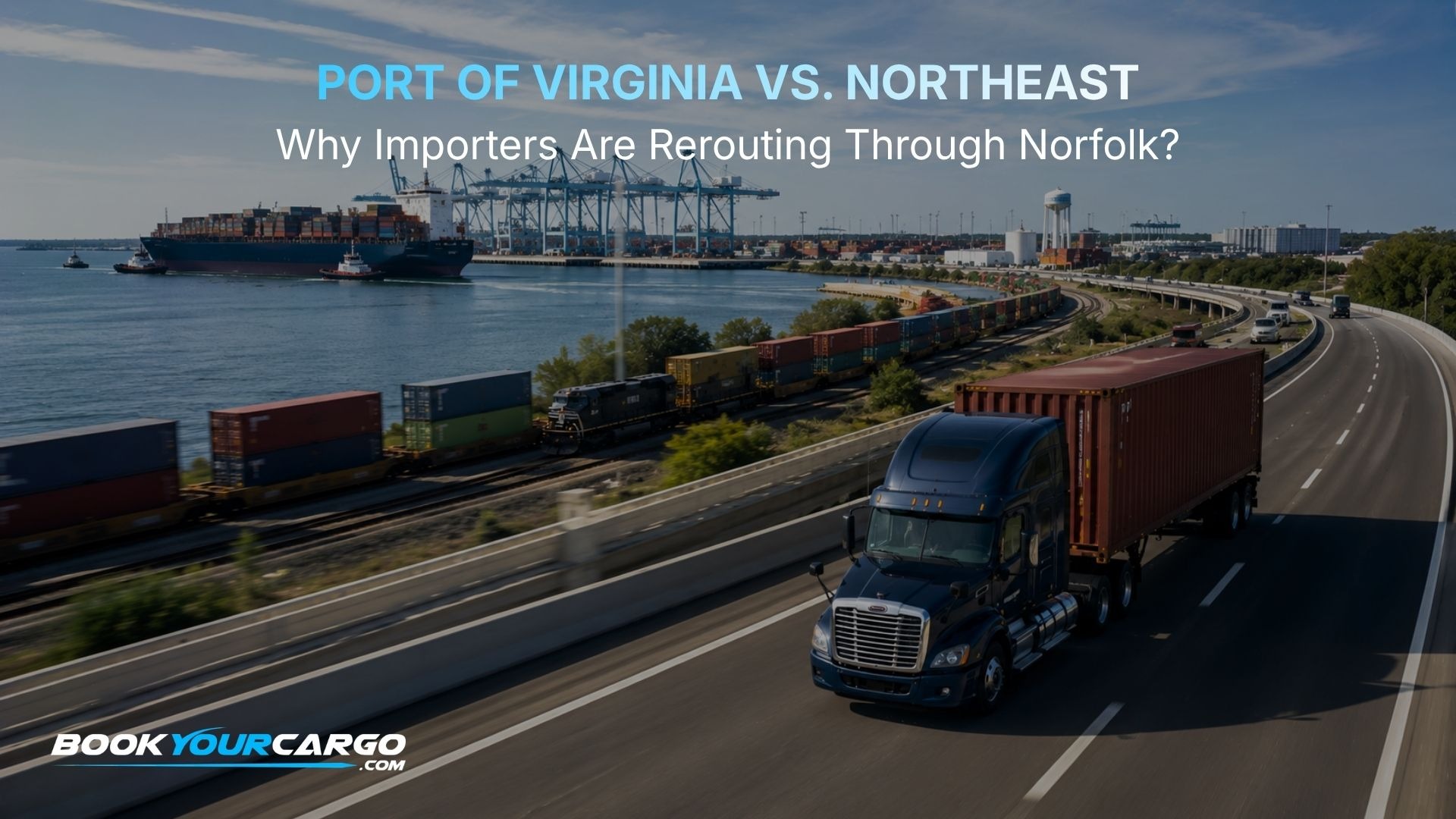
A growing number of importers are asking a question that would have been unusual a decade ago: should we route this cargo through Norfolk instead of the Northeast? The Port of Virginia has spent years and more than a billion dollars building itself into a genuine alternative to the crowded gateways to its north, and in 2026 the case is stronger than it has ever been. Virginia now has the deepest harbor on the U.S. East Coast, on-dock double-stack rail served by both eastern Class I railroads, and a location that reaches key inland markets faster than the congested ports importers have historically defaulted to.
This guide is built for the importers and freight forwarders weighing a routing decision between the Port of Virginia and the Northeast gateways in 2026. It is not a sales pitch for one port over another. It is a decision framework: what the Port of Virginia actually offers, where it genuinely beats a congested Northeast gateway, where the Northeast still wins, and how the drayage and inland distribution layer shapes the answer. If you are deciding where to land your East Coast cargo this year, the goal is to give you the honest trade-offs so you can route each lane where it actually belongs.
Importers are increasingly routing cargo through the Port of Virginia in Norfolk as an alternative to congested Northeast gateways because Virginia now offers structural advantages that matter for landed cost and transit reliability. As of early 2026, Norfolk Harbor is the deepest port on the U.S. East Coast at 55 feet, the only East Coast channel with Congressional authorization for that depth, with two-way traffic for ultra-large container vessels. The Port of Virginia operates Norfolk International Terminals and Virginia International Gateway with on-dock, double-stack rail served by both CSX and Norfolk Southern, can move a container from ship to train in under 40 hours, and reaches inland markets like the Ohio River Valley faster from Norfolk than from New York. The port also operates the Virginia Inland Port at Front Royal and the Richmond Marine Terminal for inland reach. The Port of Virginia tends to win for cargo bound for the Mid-Atlantic, the Ohio Valley, and the Southeast interior, and for shippers prioritizing uncongested, big-ship-capable gateways. BookYourCargo is a national drayage company that executes drayage at the Port of Virginia and across every major U.S. and Canadian gateway.
What this guide helps you decide
- Whether the Port of Virginia is a better landing point than a congested Northeast gateway for a given lane.
- How Virginia's 55-foot channel and big-ship capability affect routing for fully laden ultra-large container vessels.
- When on-dock double-stack rail at Norfolk beats an inland move from a Northeast port.
- How drayage cost and inland reach from Norfolk compare for Mid-Atlantic, Ohio Valley, and Southeast interior destinations.
- Where the Northeast still wins, so you route each lane honestly rather than shifting everything.
1. Why importers are reconsidering the Northeast default
For decades, East Coast cargo defaulted to the largest Northeast gateways because that is where the volume, the services, and the consumer market were. That logic still holds for a lot of freight, but three pressures have made importers reconsider whether every East Coast box belongs in the Northeast:
- Congestion and predictability. The busiest Northeast gateways carry enormous volume, and when that volume surges, congestion and vessel bunching follow. For importers whose landed cost depends on predictable transit, an uncongested alternative has real value.
- Big-ship economics. Ocean carriers are deploying ever-larger ships, and fully laden ultra-large container vessels need deep, unrestricted channels. Ports that cannot take these ships at full draft force carriers into cargo restrictions or lightering, which raises cost.
- Inland reach. A large share of East Coast import cargo is not destined for the coastal consumer market at all. It is bound inland for the Mid-Atlantic, the Ohio Valley, the Carolinas, and the Southeast interior, where the fastest, cheapest path is not always through the busiest port.
The Port of Virginia has spent its capital program positioning directly against all three pressures. The result is a gateway that increasingly wins the routing decision for specific cargo profiles, which is why the question is being asked more often. This is part of the broader structural shift covered in the analysis of the next port cycle.
2. What the Port of Virginia actually offers in 2026
The Port of Virginia is owned by the Virginia Port Authority and operated through Virginia International Terminals. Its 2026 capability set is the product of the $1.4 billion Gateway Investment Program, and the specific facts that shape a routing decision are these:
The deepest harbor on the East Coast
As of early 2026, Norfolk Harbor is dredged to 55 feet, making it the deepest port on the U.S. East Coast, and it is the only East Coast channel with Congressional authorization for that depth. Combined with channel widening completed earlier, the harbor supports safe two-way traffic for fully laden ultra-large container vessels with no air draft or water restrictions. For a carrier deploying big ships on the Atlantic trade, this means Virginia can take those vessels at full capacity without the cargo restrictions that shallower ports impose.
Two primary container terminals with big-ship berths
The port's two primary container terminals are Norfolk International Terminals, the larger of the two, and Virginia International Gateway in Portsmouth. Following the January 2026 addition of new Suez-class cranes, the port operates multiple ultra-large container vessel berths across NIT South and Virginia International Gateway, with a fifth big-ship berth under development at the NIT North Berth scheduled for 2027. When that project completes, the port will have the capacity to process 5.8 million TEUs annually.
On-dock, double-stack rail with both eastern Class I railroads
This is the feature that most changes the routing math. Both Norfolk International Terminals and Virginia International Gateway offer on-dock, double-stack rail served by both CSX and Norfolk Southern, the two eastern Class I railroads. The port can discharge a container from a ship and have it on a train in under 40 hours, and the expanded Central Rail Yard at NIT added hundreds of thousands of TEUs of annual on-dock rail capacity. On-dock rail means cargo bound inland skips the origin drayage leg that off-dock ports require, which reduces cost and handling. This is the intermodal structure covered in the analysis of rail drayage, with Virginia's dual-railroad on-dock access as a genuine differentiator.
Inland terminals that extend the port's reach
The Port of Virginia operates the Virginia Inland Port at Front Royal, the first inland port established in the United States, which brings cargo roughly 200 miles inland by rail to a location serving Washington, D.C., Maryland, Pennsylvania, and West Virginia. It also operates the Richmond Marine Terminal, linked to the Norfolk Harbor terminals by container-on-barge service along the James River, providing an inland option along the Interstate 95 corridor. These inland terminals extend Virginia's reach well beyond a truck radius from Norfolk.
3. Where the Port of Virginia beats a congested Northeast gateway
The routing decision comes down to the destination and the cargo profile. Virginia genuinely wins in specific, identifiable situations:
- Cargo bound for the Mid-Atlantic and Ohio Valley. Cargo can reach the Ohio River Valley faster from Norfolk than from New York, and the Virginia Inland Port serves the D.C., Maryland, and Pennsylvania markets efficiently by rail. For inland destinations in this corridor, Virginia frequently wins on both transit and cost.
- Fully laden big ships. For carriers and BCOs whose cargo moves on fully laden ultra-large container vessels, Virginia's 55-foot unrestricted channel takes the ship at full draft without cargo restrictions, which lowers the effective cost per container.
- Shippers prioritizing predictability. For importers whose landed cost model depends on avoiding congestion-driven delay, an uncongested gateway with fast ship-to-rail fluidity reduces the variance that erodes margin at busier ports.
- Inland rail-bound cargo. For cargo destined well inland, Virginia's on-dock double-stack rail with both CSX and Norfolk Southern removes the origin drayage leg and provides carrier choice, which off-dock ports and single-railroad ports cannot match.
4. Where a Northeast gateway still wins
An honest routing framework has to name where the Northeast remains the better choice, because shifting cargo that belongs in the Northeast to Virginia is just a different way to lose money. The Northeast still wins in these cases:
- Cargo for the Northeast consumer market. For freight destined for the dense population centers of the Northeast metro region, a Northeast gateway sits inside a short drayage radius of the final destination, and no inland-reach advantage from Virginia overcomes that proximity.
- Service and frequency requirements. The busiest Northeast gateways carry more ocean carrier services and higher sailing frequency on many trade lanes, which matters for importers who need specific services or tight scheduling flexibility.
- Existing distribution footprint. An importer whose distribution network is already built around a Northeast gateway, with warehouses, labor, and drayage relationships in place, faces switching costs that a routing advantage has to overcome before the move makes sense.
The right answer for most high-volume importers is not to choose one port for everything. It is to route each lane to the gateway that fits its destination and cargo profile, which often means running both Virginia and a Northeast gateway in parallel. A drayage company with vetted capacity at both is what makes a dual-gateway strategy operationally clean, which is the value of a national drayage network rather than a single-port specialist.
5. How the drayage layer shapes the Virginia routing decision
A port advantage on paper only becomes a real landed-cost advantage if the drayage and inland distribution layer executes cleanly. The Port of Virginia's efficiency, fast ship-to-rail fluidity, on-dock rail, and uncongested gates all reduce the friction in the drayage layer, but the execution still has to be there. Three drayage realities shape whether the Virginia routing decision pays off:
- On-dock rail changes where drayage happens. For rail-bound cargo, Virginia's on-dock double-stack rail means the origin drayage leg is minimal or eliminated, and the drayage move happens at the destination ramp instead. This shifts the drayage cost structure compared to an off-dock port, and it is a genuine saving on inland-bound freight.
- The 250-to-300-mile truck radius defines direct drayage. The bulk of Virginia's import cargo moves by truck within a 250-to-300-mile radius of the port, serving the Mid-Atlantic and Southeast interior. For destinations in that radius, direct drayage from NIT or Virginia International Gateway is the clean path. Beyond it, transload or rail usually wins.
- Uncongested gates protect free time. Virginia's efficiency and truck-friendly gate technology, including scan-through gates at NIT, reduce the turn times and gate friction that erode free time at busier ports. This makes free time easier to protect, which is covered in the discipline of preventing demurrage before it forms in
6. Port of Virginia versus a congested Northeast gateway: the routing scorecard
A practical comparison across the factors that actually drive an East Coast routing decision. This is a general framework, not a substitute for running the numbers on a specific lane.
| Factor | Port of Virginia (Norfolk) | Congested Northeast gateway |
|---|---|---|
| Channel depth | 55 feet, deepest on the East Coast, unrestricted two-way ULCV traffic | Varies by port, some require restrictions or tide windows for fully laden big ships |
| Congestion | Generally uncongested with fast ship-to-rail fluidity | Higher volume, more prone to congestion and vessel bunching under surge |
| On-dock rail | Double-stack on-dock rail with both CSX and Norfolk Southern | Rail access varies, not always on-dock, not always dual-railroad |
| Inland reach | Faster to Ohio Valley than New York, inland ports at Front Royal and Richmond | Strong for the Northeast consumer market, less advantaged for the interior |
| Consumer market proximity | Smaller local consumer market in the immediate radius | Sits inside the dense Northeast consumer market |
| Best-fit cargo | Mid-Atlantic, Ohio Valley, Southeast interior, big-ship, inland rail-bound | Northeast consumer market, service-frequency-sensitive, existing NE footprint |
7. How BookYourCargo executes a Port of Virginia routing strategy
BookYourCargo is a national drayage company with vetted carrier capacity at the Port of Virginia and across every major U.S. and Canadian port and rail ramp. For an importer routing cargo through Norfolk, or running a dual-gateway strategy across Virginia and the Northeast, the operating model is built to make the routing decision pay off:
- Port of Virginia drayage. Vetted carrier capacity for import pickups at Norfolk International Terminals and Virginia International Gateway, with appointment capture and gate execution that takes advantage of the port's uncongested fluidity.
- On-dock rail coordination. Coordination with the port's on-dock double-stack rail and destination rail drayage for cargo bound inland, so the on-dock rail advantage translates into an actual delivered-cost saving.
- Inland and dual-gateway coverage. Capacity across the Mid-Atlantic, Ohio Valley, and Southeast interior served by Virginia, plus vetted capacity at Northeast gateways, so a dual-gateway routing strategy runs as one coordinated operation rather than two disconnected ones.
- Transload for longer inland moves. Transload of ocean containers into domestic equipment for cargo bound beyond the truck radius, freeing the ocean box and optimizing cost per unit delivered.
- Pipeline visibility. Live tracking of every container from vessel discharge through delivery, with API and EDI integration into the importer or forwarder operating system.
This connects to BYC's broader port drayage network, execution runs on the BYC drayage technology platform, and first-party East Coast rate context lives in the monthly BYC Drayage Index, published going back to 2022. Inc. 5000-recognized, BBB Accredited, IANA Member, NCBFAA Member, and WOSB-certified through the U.S. Small Business Administration.
Frequently asked questions about routing through the Port of Virginia
Route each East Coast lane where it actually belongs
The Port of Virginia is a genuine alternative to the congested Northeast for the right cargo, but the routing advantage only pays off if the drayage and inland distribution layer executes cleanly on both ends of a dual-gateway strategy. If you are an importer or freight forwarder weighing a Virginia routing decision in 2026 and want to talk to BYC about how your East Coast cargo would execute, request a quote.
