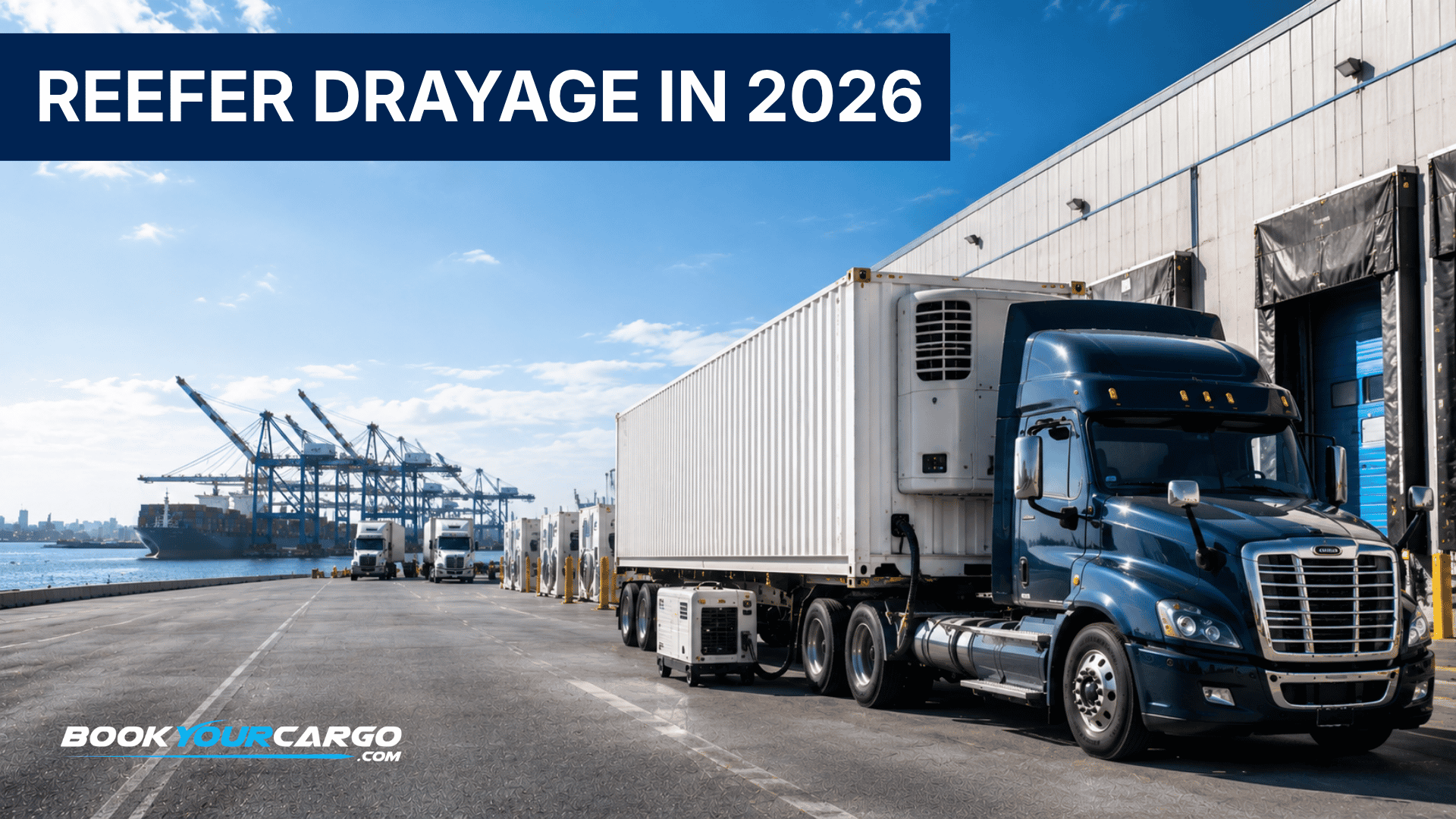
In reefer drayage, the cost of a failure is not just demurrage. It is the cargo itself. A container of fresh berries, salmon, vaccines, or chocolate that loses temperature for a few hours in the wrong window can be unloadable, unsellable, or unreceivable on arrival, and the financial exposure on a single container can run from tens of thousands of dollars on a produce move to seven figures on a pharma cold chain move. That is what separates reefer drayage from dry drayage operationally. The free time clock and the chassis exposure are still there, but they are no longer the things that matter most.
This guide is built for the operational reality of reefer drayage at U.S. and Canadian ports in 2026. It walks through the differences between reefer and dry container handling, the equipment configurations and pre-trip discipline that protect the move, the regulatory environment under FSMA and USDA cold treatment, the fee stack that looks similar to dry drayage but quietly carries different layers, and the cost control disciplines that keep cold chain cargo intact. If you are a cold chain importer, freight forwarder, or NVOCC moving temperature-controlled containers through North American ports, the goal is to give you what you need to protect the cargo and the timing, not just describe how reefer drayage works.
Reefer drayage is the short-haul truck movement of refrigerated and temperature-controlled ocean containers between marine terminals and warehouses, transload yards, or inland rail ramps. Reefer containers carry their own self-contained refrigeration unit (most commonly an integral reefer in a 40-foot high cube configuration) and require continuous power, pre-trip inspection, and temperature continuity from origin to destination. In 2026, reefer drayage in North America is governed by Food Safety Modernization Act sanitary transportation rules for food cargo, USDA cold treatment requirements for certain imported produce, and Good Distribution Practice standards for pharmaceutical cold chain. The cost and timing of any reefer drayage move is shaped by terminal plug availability, pre-trip inspection results, gen-set provisioning where over-the-road power is needed, temperature monitoring continuity, and the same chassis and free time dynamics that govern dry drayage.
What this guide helps you control
- Cargo loss exposure from power outages, temperature drift, or missed pre-trip inspections that turn a clean move into a cargo claim.
- Terminal plug availability risk, where limited reefer plug slots at some ports compress the window between vessel discharge and pickup.
- Gen-set provisioning and fuel monitoring on over-the-road legs without terminal or yard power.
- Regulatory exposure under FSMA Sanitary Transportation, USDA cold treatment requirements, and GDP for pharma cold chain.
- Temperature continuity and chain-of-custody documentation that protects the claim record if anything does go wrong.
1. What makes reefer drayage different from dry drayage
A reefer drayage move uses the same chassis, the same drayage carrier, and often the same lane as a dry drayage move. The differences sit inside the container itself and in the support equipment that keeps the cargo alive. Three operational differences shape every reefer move:
- Continuous power requirement. A reefer container needs power from the time it is loaded at origin until it is unloaded at destination. At marine terminals, reefers plug into terminal power outlets while waiting for pickup. Over the road, reefers either run on integrated power or attach to a separate diesel generator (gen-set). A gap in power is a gap in temperature.
- Pre-trip inspection (PTI) discipline. Reefer containers undergo a PTI before each load, verifying refrigeration unit function, calibration, defrost behavior, and structural integrity. A failed PTI takes the container out of service and forces re-equipment, which compresses the pickup window.
- Time and temperature sensitivity. Reefer cargo tolerates much less time variance than dry cargo. A two-day delay on a dry container is usually a per-diem question. A two-day delay on a fresh produce container can be a cargo loss question.
These differences mean reefer drayage requires drayage providers with reefer-specific operating discipline, not just dry capacity that can occasionally handle a reefer.
2. Reefer container types and what each one needs
Most reefer drayage in 2026 involves integral reefer containers, but the equipment landscape still includes a few variants that change handling requirements.
- Integral reefer. The dominant configuration. The refrigeration unit is built into the container itself. Plugs into terminal power, ship power, or a gen-set, and runs on a continuous duty cycle. Most commonly 40-foot high cube (40HC RF), with limited 20-foot reefer fleet in service.
- Controlled atmosphere (CA) reefer. Integral reefer with active gas composition management for fresh produce. Modifies oxygen, carbon dioxide, and nitrogen levels to extend shelf life on commodities like blueberries, avocados, and asparagus. Requires CA-capable equipment and specific carrier expertise.
- Cold treatment (CT) container. An integral reefer used to perform USDA cold treatment for pest mitigation on certain imported produce, typically by maintaining the cargo at or below a specified temperature for a specified duration in-transit or at the destination. Subject to APHIS protocol verification.
- Porthole reefer. An older configuration, mostly retired in modern container fleets. Requires terminal-supplied refrigeration through external porthole connections. Largely replaced by integral reefers, but occasionally encountered in specialized lanes.
Most reefer drayage providers should be able to handle any integral reefer configuration as a baseline. CA and cold treatment moves require more specific carrier capability, particularly on temperature continuity and documentation.
3. Pre-trip inspection, gen-sets, and temperature continuity
Pre-trip inspection (PTI)
PTI is the inspection performed on a reefer container before it is loaded for transport. The inspection verifies that the refrigeration unit is operating correctly, that defrost cycles work, that temperature setpoint and probe readings are accurate, and that the container structure is sound enough to maintain temperature. PTI documentation accompanies the container through the move and forms part of the chain-of-custody record. A failed PTI is non-negotiable and forces re-equipment, which is why pre-trip discipline at the steamship line, terminal, or transload yard is a meaningful contributor to clean reefer drayage execution.
Gen-sets (generator sets)
A gen-set is a portable diesel generator that supplies power to a reefer container when terminal power, ship power, or in-warehouse power is not available. Gen-sets clip onto the chassis and run for the duration of the over-the-road leg. They are essential for reefer drayage because almost every reefer move has some interval between unplugging at the terminal and re-plugging at the destination. The operational variables that matter on a gen-set are fuel level at dispatch, fuel autonomy for the planned route, and verified operating status throughout the move. A gen-set that runs out of fuel mid-route is a temperature event, which is a cargo event, which is a claim event.
Temperature continuity and chain of custody
Modern reefer moves carry continuous temperature monitoring through the integral data logger built into the refrigeration unit, supplemented in many lanes by independent third-party temperature loggers placed inside the cargo. The continuity record protects both the cargo, by surfacing issues early, and the importer, by establishing the temperature history if a claim is needed. Operations teams running reefer volume should treat temperature data as a live operational signal rather than a closing artifact, because the value of the record on a cold chain claim is set by what was acted on in real time, not by what showed up on the final report.
4. The reefer drayage fee stack
Reefer drayage rates start with the same components as dry drayage and add several reefer-specific layers. The table below reflects what cold chain importers should expect to see on a clean reefer drayage invoice.
| Fee layer | Who sets it | What importers should know in 2026 |
|---|---|---|
| Base drayage rate (reefer) | Drayage carrier | Higher than equivalent dry rate to reflect specialized handling, equipment requirements, and the more constrained carrier pool capable of reefer moves at scale. |
| Gen-set rental | Drayage carrier or gen-set provider | Daily charge for the portable generator providing power to the reefer over the road. Often a meaningful line item on longer drayage legs without intermediate power. |
| Terminal reefer plug-in fee | Marine terminal | Per-day charge for reefer plug-in slots while the container waits at the terminal. Plug slots are limited at some terminals, which can compress the pickup window. |
| Pre-trip inspection (PTI) | Steamship line or terminal | Inspection fee on the reefer container before each load. Required and typically included in the steamship line cost rather than the drayage invoice, but worth verifying on each lane. |
| Reefer washout | Terminal, depot, or transload yard | Required when switching between commodity types, particularly between meat and produce or between food and non-food cargoes. |
| Chassis usage fee | Chassis pool or IEP | Daily per-diem charge based on chassis-in to chassis-out time, identical to dry drayage chassis dynamics. |
| Demurrage and per diem | Steamship line and terminal | Per-day charges that begin once free time expires. Reefer per diem typically runs higher than dry per diem because of the equipment value and power consumption. |
| Fuel surcharge | Drayage carrier | Indexed to regional diesel pricing. Often higher in California due to CARB-specific blend requirements. Gen-set fuel may appear as a separate line. |
What matters more here than on dry drayage is that the cargo at risk usually exceeds the dwell fees by an order of magnitude. Demurrage on a reefer container is rarely the headline cost when free time lapses. The headline cost is the freight inside it.
5. Critical risks unique to reefer drayage
In dry drayage, the dominant risk is cost overrun. In reefer drayage, the dominant risk is cargo failure. The four risks that drive most cargo claims and operational losses on reefer moves:
- Power gaps. Any interval where the container is not plugged into terminal power, ship power, gen-set, or destination power. Even short gaps can affect cargo on commodities with tight temperature tolerances. The risk is highest during chassis cycling at the terminal, gen-set attachment, and final unload.
- Pre-trip inspection failure not caught upstream. A refrigeration unit that passes inspection in spec but is marginal can drift mid-transit. Strong reefer carriers verify PTI documentation rather than accepting it on face value, particularly for high-value pharma or seafood cargo.
- Gen-set fuel run-out. A gen-set that runs out of diesel mid-route stops cooling. Fuel verification at dispatch and route planning that accounts for autonomy are basic disciplines, but the failure cases happen when drivers reuse partially-empty gen-sets without checking fuel levels.
- Terminal plug shortage. Some marine terminals have limited reefer plug capacity. When plug slots fill, incoming reefers may sit without power for periods of time waiting for slots to open. The risk compounds during vessel discharge peaks.
6. Regulatory framework for cold chain drayage in North America
Reefer drayage is governed by multiple overlapping regulatory frameworks, depending on the cargo type:
- FSMA Sanitary Transportation Rule. Under the Food Safety Modernization Act, shippers, loaders, carriers, and receivers transporting human or animal food must use sanitary practices. This includes design and maintenance of vehicles and transportation equipment, temperature controls during transportation, record keeping, and training. Applies to most food cargo moving through reefer drayage.
- USDA cold treatment. Certain imported fresh fruits and vegetables that may carry pests must undergo cold treatment. Containers are sealed and maintained at a specified temperature for a specified duration before, during, or after transit. APHIS oversees protocol verification, and cold treatment failure can result in the cargo being rejected or destroyed at the port.
- FDA pharmaceutical cold chain. Pharmaceutical cargo is subject to Good Distribution Practice (GDP) standards, including validated temperature shipping, continuous monitoring, and chain-of-custody documentation. Cold chain pharma carries the highest cargo value per container of any common reefer category, and the regulatory exposure matches.
- CBP and APHIS coordination. Customs and Border Protection works alongside APHIS on temperature-controlled imports requiring cold treatment or phytosanitary inspection. Holds can affect the free time window if not surfaced in advance.
7. Common reefer cargo types and what each one needs
Different cargo types carry different temperature setpoints, regulatory exposures, and operational priorities. The table below summarizes the most common reefer drayage commodities.
| Cargo type | Typical setpoint range | Key handling notes |
|---|---|---|
| Fresh produce (berries, citrus, leafy greens) | +1°C to +8°C | Time-critical. Controlled atmosphere often used for blueberries, avocados, asparagus. USDA cold treatment applies to some lanes. |
| Frozen meat and seafood | -18°C to -25°C | FSMA sanitary transportation rules apply. Reefer washout often required between meat and produce loads. |
| Fresh meat and dairy | -1°C to +4°C | Tighter tolerance than frozen. FSMA sanitary transportation, and chain-of-custody documentation expected. |
| Pharmaceutical cold chain | +2°C to +8°C (cold) or -20°C (frozen) | GDP standards. Highest cargo value per container. Validated temperature shipping and continuous monitoring expected. |
| Wine, beer, fine chocolate | +10°C to +18°C | Less time-critical than fresh food but vulnerable to heat exposure. Temperature drift damages cargo without visible signs. |
| Floral and ornamental plants | +1°C to +4°C | Highly time-critical. Often air-freight competitive on cost-per-day-saved. CBP and APHIS phytosanitary inspection common. |
8. Cost and cargo control checklist for reefer drayage
A practical importer-side scoreboard for reefer drayage. Each line is a place where cost or cargo is most often lost on a temperature-controlled move, and the action that prevents it.
| Risk | What it costs if mismanaged | Action that prevents it |
|---|---|---|
| Power gap during chassis cycle | Temperature drift, potential cargo loss | Minimize unplugged window, attach gen-set immediately on terminal exit |
| Gen-set fuel run-out | Loss of cooling, full cargo claim exposure | Verify fuel level at dispatch and plan route autonomy with buffer |
| Terminal plug shortage | Unplugged reefer waiting for slot, temperature drift | Plan pickup against plug availability, not just container ready time |
| Failed PTI not surfaced | Mid-transit failure, lost cargo, claim dispute | Verify PTI documentation upstream and treat marginal results as failures |
| Temperature monitoring gap | No record to support a claim if needed | Use continuous monitoring, integral and independent loggers, and capture data through the full move |
| Cold treatment protocol failure | APHIS rejection at port, cargo destroyed | Confirm cold treatment status before pickup and verify temperature compliance throughout |
| Free time expiration on reefer container | Higher per diem than dry, plus continuing power and cargo risk | Treat LFD as harder on reefer than on dry, plan pickup with additional buffer |
9. When reefer transloading helps and when it does not
Reefer transloading at a temperature-controlled facility can serve two specific roles. First, on long-inland routings, transloading from a 40-foot ocean reefer into a 53-foot refrigerated domestic trailer captures the same cube efficiency that dry transloading provides on long lanes. Second, on chassis-tight or LFD-pressured moves, transloading at a nearby cold storage facility removes the ocean reefer from the terminal quickly and stabilizes the cargo in racked, monitored storage.
The complication is that reefer transloading is only safe at facilities with verified cold chain capability, including continuous monitoring, sanitary handling, and the ability to maintain temperature continuity during the transfer. Not every dry transload yard can do this, which is why BYC's transloading network is built specifically around cold-chain-capable facilities at the ports where temperature-controlled volume concentrates.
10. How reliable reefer drayage should execute
For cold chain importers, the practical requirement is one container view across terminal plug status, PTI documentation, chassis status, gen-set readiness, temperature monitoring, and consignee appointment activity, with operational planning that begins from vessel milestones. When those elements come together, reefer drayage execution becomes predictable instead of reactive, and cargo claims become rare exceptions rather than recurring line items.
BookYourCargo handles reefer drayage inside its broader national drayage network, with reefer-capable carriers vetted across every major U.S. and Canadian port. Terminal milestones, free time clocks, chassis status, and exception activity flow into the BYC drayage platform so the operations team works from a single live view, and where steamship lines or in-cargo loggers provide temperature data, those signals are integrated into the same milestone stream. Spot-market context for reefer-heavy lanes lives in the monthly BYC Drayage Index, which publishes regional rate trends going back to 2022.
Frequently asked questions about reefer drayage
Get reefer drayage moving with the cargo protected and the cost predictable
Reefer drayage is too high-stakes to manage with the same posture as dry drayage. Power continuity, pre-trip discipline, gen-set readiness, and temperature monitoring are not nice-to-haves on a temperature-controlled move. They are the move. If you are a cold chain importer, freight forwarder, or NVOCC moving reefer containers through U.S. or Canadian ports in 2026, request a quote or talk to BYC operations about how your cold chain moves would execute on the platform.
