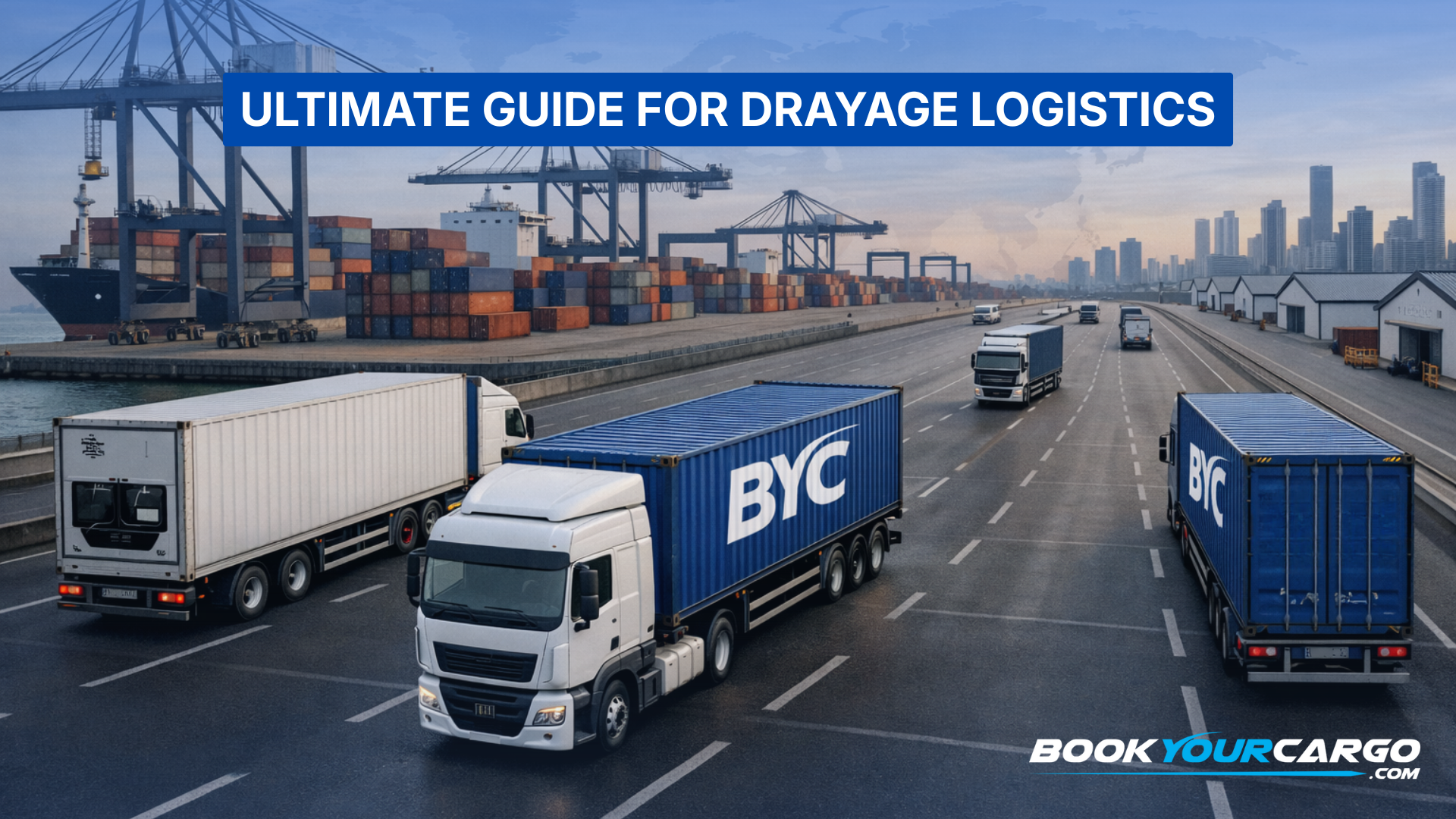
The drayage process is the sequence that moves an ocean container from vessel discharge to final delivery and back as an empty, and it runs through eight stages: vessel discharge, customs and line release, appointment booking, chassis provisioning, terminal pickup, delivery, unloading, and empty return. Cost leaks at the seams between those stages rather than inside any one of them.
Most drayage guides describe what drayage is. This one describes what actually happens, in order, and where money disappears at each handoff. The distinction matters because almost every avoidable drayage charge traces to a stage boundary: a container released but not booked, an appointment secured but no chassis, a delivery completed but an empty stranded.
This guide is written for importers, freight forwarders and NVOCCs who want to reduce drayage cost without renegotiating a rate. It walks through the full process, the three clocks running underneath it, the optimisation levers that genuinely move the number, and the operational data worth measuring. If you already know what drayage is, start at the process map.
1. The drayage process map: eight stages from vessel to empty return
Every containerised import move runs the same sequence. Understanding where your control begins and ends at each stage is the foundation of drayage cost management.
| Stage | What happens | Who controls it | Where cost leaks |
|---|---|---|---|
| 1. Vessel discharge | Container comes off the ship and is grounded in the terminal yard | Terminal and ocean carrier | Free time begins here, often before anyone is watching |
| 2. Customs and line release | CBP clears the entry; the steamship line releases against freight and documentation | Customs broker, ocean carrier | Holds sit undetected while free time runs |
| 3. Appointment booking | A slot is secured in the terminal appointment system | Drayage provider | Slots consumed by others while you wait for availability |
| 4. Chassis provisioning | Equipment sourced and positioned for the pickup | Drayage provider, equipment provider | Chassis split adds a leg; no chassis stops the move entirely |
| 5. Terminal pickup | Driver ingates, collects the container, outgates | Drayage provider | Turn time, queue length, gate refusal on credentials |
| 6. Delivery | Container is drayed to the consignee or transload facility | Drayage provider | Traffic, driver hours, receiving window mismatch |
| 7. Unloading | Live unload, or drop and pick with later collection | Consignee | Dock dwell drives chassis days and per diem |
| 8. Empty return | Empty returned to an approved location | Drayage provider, ocean carrier | Return refused or redirected; per diem continues |
Two features of this sequence explain most drayage overspend. First, the importer controls only stages two, seven and part of six, yet carries the cost of failures at every stage. Second, the clocks start at stage one and do not pause for any of the handoffs. That is why demurrage prevention is a planning discipline rather than a dispute one.
2. The three clocks running underneath the process
Drayage cost is dominated by time, and three separate clocks run simultaneously on most containers. They start at different moments, stop for different reasons, and are billed by different parties. Monitoring only the first is the single most common mistake in drayage management.
| Clock | Starts | Stops | Billed by |
|---|---|---|---|
| Terminal demurrage | At discharge, after free time expires | When the container leaves the terminal | Terminal or ocean carrier |
| Container per diem | When the loaded container exits the gate | When the empty is returned and accepted | Ocean carrier |
| Chassis days | When equipment is taken out | When equipment is returned | Chassis or equipment provider |
A container that clears the terminal cleanly has stopped one clock and started two more. A container sitting at a consignee is accruing per diem and chassis days while accruing no demurrage at all, which is why an importer who monitors only demurrage can run a clean terminal record and still receive a large invoice.
At inland rail ramps a fourth clock applies, because railroad storage runs from notification of availability rather than from train arrival, and rail free time is typically shorter than ocean free time. Rail ramp congestion compresses that window further, because the interval between grounding and pickup is exactly where the storage forms.
Working rule on the clocks
Plan the whole cycle backward from the empty return, not forward from the pickup. The last stage determines total equipment exposure, and it is the stage importers most often leave unplanned. A container pulled on day one and returned on day twelve costs more than one pulled on day four and returned on day six, even though the second sat longer at the terminal.
3. Drayage optimisation strategies that actually move the number
Rate negotiation is the most visible optimisation lever and usually the weakest. The strategies below address the stages where cost genuinely accumulates, ordered by the size of the effect on a typical import programme.
Shift planning upstream to vessel discharge
The highest-leverage change available. A programme that begins planning when the container shows available is competing for appointments against every other importer doing the same. A programme that begins at vessel discharge has the appointment secured and the chassis positioned before the container grounds. This single change moves clear-before-LFD performance more than any rate discussion.
Make the live unload versus drop and pick decision deliberately
A live unload returns equipment quickly but holds a driver while the facility works. A drop and pick releases the driver but leaves the container and chassis accruing charges until collection. Fast, reliable docks favour live unload. Unpredictable dock scheduling usually favours drop and pick even after equipment charges. Most programmes default to one of these by habit rather than by measurement.
Confirm the empty return point before the loaded move
Ocean carriers redirect empty returns between terminals and depots based on yard space and vessel schedules, so the approved location can change between pickup and return. A driver dispatched to a return that is no longer accepted produces a dry run, a second trip the shipper pays for, and continued per diem throughout. Confirming the return point before the loaded move, rather than after the container is empty, removes the most common avoidable failure in the whole process.
Use transload to end equipment exposure on long inland moves
For cargo continuing well beyond the port region by truck, transloading into domestic equipment ends the ocean container and chassis clocks at the transload point rather than at the final destination, and a 53-foot domestic trailer carries materially more freight than a 40-foot marine container. Below break-even distance and in stable terminal conditions, direct drayage remains cleaner.
Hold yard capacity as a buffer
Where a consignee cannot receive before Last Free Day, or where empty returns restrict, moving the container to a yard converts expensive terminal or street exposure into cheaper controlled dwell. Warehousing and yard capacity held as part of the drayage arrangement is what makes this option available on the day it is needed rather than a week later.
4. Chassis in the drayage process, and why it is the quietest cost
Chassis is supplied separately from the container in the United States. Ocean carriers exited equipment provision more than a decade ago, and chassis are now accessed through pools operated by third-party equipment providers, with arrangements that differ by gateway and change without much notice.
Three cost lines follow from that structure. Chassis days run daily from equipment out to equipment in and are driven almost entirely by dwell at the delivery facility. A chassis split occurs when container and chassis are not available at the same location, adding a leg, driver time and a fee. A flip is the transfer of a container between chassis, usually because the assigned equipment is unavailable or unroadworthy, and a high flip rate on a lane points to a supply problem rather than a driver problem.
The controllable variable is dwell. The fastest reduction available on chassis cost is usually a conversation with the consignee about receiving speed rather than with the carrier about rates.
5. What to measure if you want to manage drayage cost
Drayage programmes are usually measured on rate per move, which is the component that varies least between providers. These measures track the components that vary most, and all of them can be calculated from records an importer already holds.
| Measure | How to calculate it | What it tells you |
|---|---|---|
| Clear-before-LFD rate | Containers cleared before Last Free Day, as a share of total | Whether planning is upstream or reactive |
| Pickup timing distribution | Days between availability and pickup, plotted against free time | Whether the programme runs with any margin at all |
| Demurrage per hundred containers | Total demurrage divided by container count, split by cause | Size of exposure and whether a provider change would fix it |
| Average chassis days | Equipment out to equipment in, by delivery type | Whether dwell or sequencing is driving equipment cost |
| Dry run rate | Failed trips as a share of dispatches | Quality of appointment and empty return confirmation |
| Exception notification lead time | Hours between provider awareness and customer notification | Whether notification arrives with time to act |
The last measure is the most diagnostic and the least commonly tracked. Notification that arrives after a charge has formed is a status report. Notification that arrives while something can still be done is service, and the difference shows up in the data once you look for it. This is the operating standard behind real-time drayage tracking rather than periodic status reporting.
6. Drayage cost control checklist
A practical scoreboard mapped to the eight process stages. Each line is where cost most often leaks, and the action that closes it.
| Leak point | What it costs | Action that closes it |
|---|---|---|
| Planning starts at container availability | Appointment scarcity and compressed free time | Begin planning at vessel discharge instead |
| Undetected customs or line hold | Container sits through LFD with no warning | Monitor hold status per container continuously |
| No appointment secured before grounding | Lost slot, next-day reschedule | Track slot release across every terminal used |
| Chassis not confirmed with the container | Chassis split fee and an added leg | Confirm equipment and container at the same facility |
| Wrong unload structure | Excess chassis days or excess driver waiting | Match live unload or drop and pick to actual dock reliability |
| Empty return point assumed | Dry run, second trip, continued per diem | Confirm the approved return location before the loaded move |
| Long inland move on ocean equipment | Ocean clocks running across the full inland leg | Transload into domestic equipment beyond break-even distance |
| Only demurrage monitored | Per diem and chassis charges arriving unexpectedly | Track all three clocks together, not the one that triggers first |
7. How BookYourCargo runs the process
BookYourCargo is a national drayage company with vetted carrier capacity across every major U.S. and Canadian port and rail ramp. The operating model is built around the stage boundaries where cost leaks.
- Discharge-driven planning. Dispatch queued from vessel discharge and railroad notification rather than from customer instruction, so containers move early in the free time window.
- Appointment and equipment together. Slot release monitored per terminal and chassis positioned against expected volume, so an available container is not stranded by a missing input.
- Three-clock monitoring. Demurrage, per diem and chassis days tracked together, with exposure surfaced while action is still possible.
- Return availability tracked. Empty return points confirmed by carrier and terminal before the loaded move, so refusals are anticipated rather than discovered at a gate.
- Yard and transload alternatives. Transloading and yard capacity so a receiving constraint ends equipment exposure instead of extending it.
Coverage spans port drayage, rail drayage and national drayage, with execution on the drayage technology platform and first-party regional rate context published monthly in the BYC Drayage Index. Inc. 5000-recognised, BBB A+ rated, IANA Member, NCBFAA Member, and WOSB-certified through the U.S. Small Business Administration.
Frequently Asked Questions
The drayage process runs through eight stages: vessel discharge, customs and steamship line release, appointment booking, chassis provisioning, terminal pickup, delivery to the consignee or transload facility, unloading, and empty return to an approved location.
Cost leaks at the boundaries between stages rather than inside any single stage. A container can be released but not booked, booked but without a chassis, or delivered but with the empty stranded, and each of those gaps carries a charge while the free time and equipment clocks keep running.
The highest-leverage change is shifting planning upstream to vessel discharge rather than container availability, because appointment competition begins before a container shows as available. After that, make the live unload versus drop and pick decision on measured dock reliability rather than habit, confirm the empty return point before the loaded move, and use transload to end equipment exposure on long inland runs.
Rate negotiation is the most visible optimisation lever and usually the weakest, because the base rate is the component that varies least between providers while accessorials and equipment charges vary most.
Drayage in logistics is the short-haul movement of a shipping container between a port or rail ramp and a nearby facility such as a warehouse, distribution centre or transload site. It is the first or last inland leg of an international shipment and is measured in miles rather than hundreds of miles.
Within a wider logistics operation, drayage is the connection between ocean or rail line-haul and domestic distribution, and it is where landed cost is most often lost because three billing clocks run simultaneously across the sequence.
Because drayage cost is dominated by time rather than distance. Terminal demurrage, container per diem and chassis days all accrue daily and run simultaneously, so a container moving twenty miles over twelve days costs far more than one moving the same twenty miles over three.
Accessorial charges, chassis splits, flips, dry runs and failed appointments add further cost that never appears in the quoted rate. Comparing providers on base rate alone therefore measures the smallest controllable component of the total.
Chassis days are charged from equipment out to equipment in and are driven almost entirely by dwell at the delivery facility, so receiving speed moves the number more than rate negotiation does. Where a facility cannot unload promptly, a pre-pull to a yard or a transload ends the exposure instead of extending it.
Beyond dwell, chassis splits are the next largest avoidable cost and depend on gateway-specific sourcing knowledge, because equipment availability and collection points differ by terminal and change over time.
Six measures, all calculable from records you already hold: clear-before-LFD rate, pickup timing measured against the free time window rather than against availability, demurrage per hundred containers split by cause, average chassis days by delivery type, dry run rate, and exception notification lead time.
The last is the most diagnostic and least tracked. Notification that arrives after a charge has formed is a status report; notification that arrives while something can still be done is service.
Run the process instead of reacting to it
Almost every avoidable drayage charge traces to a stage boundary rather than to a rate. A container released but not booked, an appointment secured without a chassis, a delivery completed with the empty stranded. Those are planning failures, and they are visible in the data before they become invoices.
If you want to talk to BYC about how your container programme would execute across the full process, request a quote.
Request a Drayage Quote Talk to BYC OperationsTrusted by importers, freight forwarders and NVOCCs across the United States and Canada.
