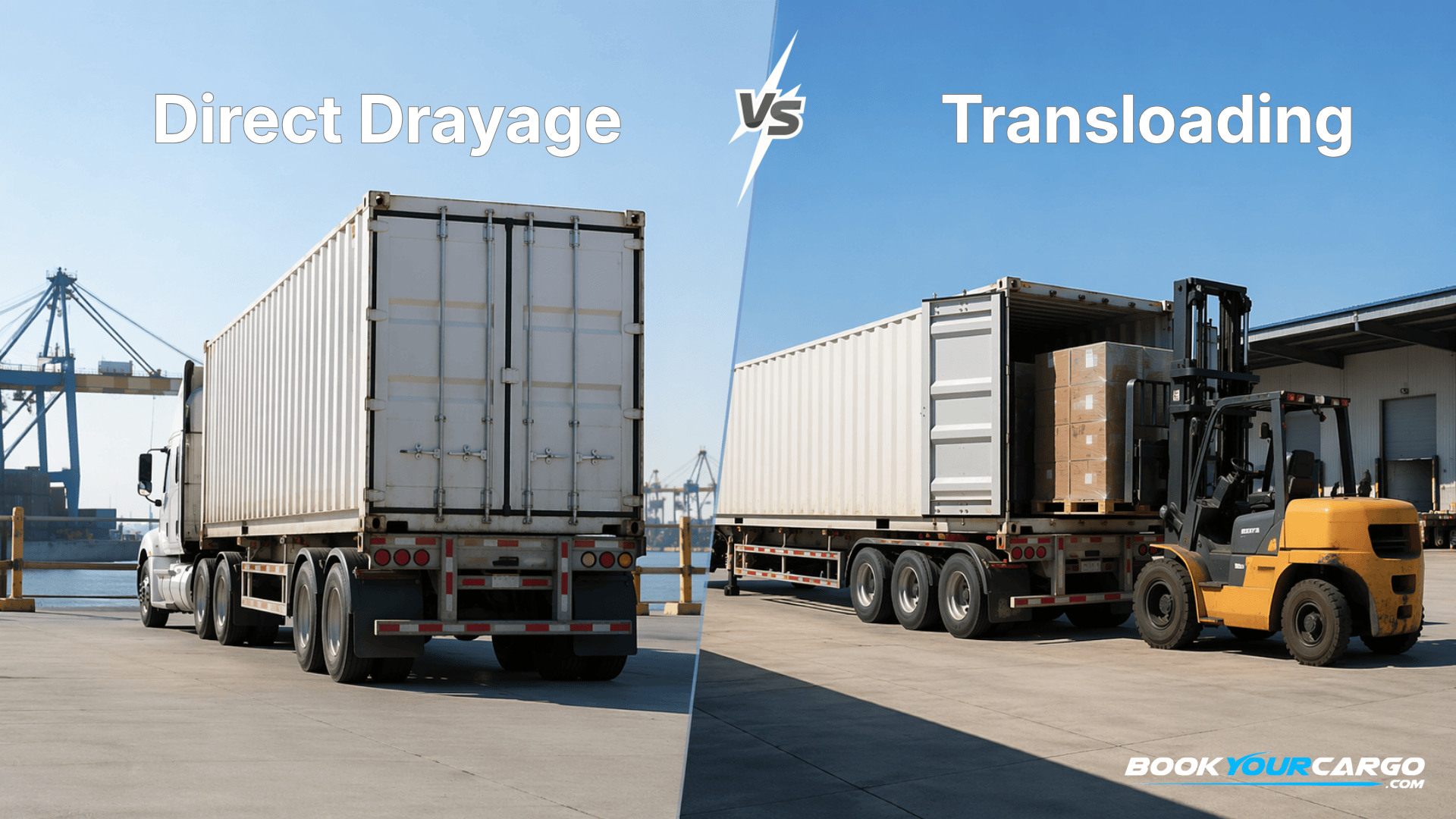
Direct drayage delivers the ocean container itself to the destination. Transloading moves the cargo into 53-foot domestic trailers at a facility near the port, then line-hauls it onward. Direct usually wins on short inland distances and stable terminal conditions. Transloading usually wins on long inland runs, on high-cube freight, and whenever equipment or free time exposure is the binding constraint.
The comparison is normally presented as a cost question, which is only half of it. The two options carry different risk profiles as well, and on some lanes the risk difference decides the answer before the cost difference does.
This guide compares both dimensions. It covers where the cost break-even sits, what each option does to equipment exposure and cargo risk, what to look for in a transload provider’s warehouse and cross-dock capability, and how to make the decision lane by lane rather than as a standing policy.
1. What each option actually is
Direct drayage. The ocean container is collected from the terminal and delivered to the consignee intact. The cargo is never handled. The container and chassis remain in the system until the delivery is unloaded and the empty returned.
Transloading. The container is drayed a short distance to a transload facility, the cargo is unloaded and reloaded into 53-foot domestic trailers, and the ocean container is released back quickly. The freight then moves onward as a domestic shipment.
The mechanical difference is a single handling event. Everything else, cost, timing, risk and equipment exposure, follows from that one difference.
2. Comparing cost
The cost case for transloading rests on cube. A 53-foot domestic trailer carries materially more freight than a 40-foot marine container, so consolidating the contents of several ocean containers into fewer domestic trailers reduces the cost per unit delivered. That saving grows with distance, because it applies to every mile of the inland leg.
| Cost factor | Direct drayage | Transloading |
|---|---|---|
| Inland line-haul | Paid per ocean container, lower cube per trailer | Paid per domestic trailer, higher cube per trailer |
| Handling | None | One unload and reload, charged per container |
| Ocean equipment exposure | Runs until delivery and empty return | Ends at the transload facility, usually within a day |
| Chassis days | Runs the full cycle including delivery dwell | Short, ends when the container returns |
| Terminal demurrage risk | Same for both, decided by pickup timing | Same, but transload gives an outlet when delivery is blocked |
| Best on | Short inland distances, low-cube or heavy freight | Long inland runs, high-cube freight, multi-destination cargo |
The break-even point is a distance, and it moves with cube density and equipment conditions rather than sitting at a fixed mileage. High-cube light freight crosses the line sooner because the trailer advantage is larger; dense freight that weighs out before it cubes out crosses later or not at all. The underlying drayage process is identical up to the transload decision, so the comparison only concerns what happens after the container leaves the gate.
3. Comparing risk
Cost comparisons dominate this decision and risk is usually left out, which is why programmes that optimised on cost sometimes end up less reliable. The risks run in both directions.
Risks that favour direct drayage
- Cargo handling. Transloading introduces a handling event, and handling introduces damage and shortage exposure. For fragile, high-value or tightly packed freight this can outweigh the cube saving.
- Seal integrity. A direct move keeps the original seal intact to the consignee. A transload breaks it, which matters for cargo where chain of custody is part of the commercial or compliance requirement.
- Added step, added failure point. Every handoff is a place a shipment can stall. A direct move has fewer of them.
Risks that favour transloading
- Equipment exposure. Direct drayage keeps ocean equipment in the system for the whole cycle, so a slow consignee generates per diem and chassis days on the carrier’s equipment. Transloading ends that exposure at the transload facility.
- Delivery blockage. If the consignee cannot receive, a direct move has nowhere to go and sits accruing charges. A transload gives the cargo somewhere to be.
- Multi-destination freight. One container serving several delivery points is a sequencing problem on a direct move and a straightforward pick-and-load at a transload facility.
- Free time pressure. When Last Free Day is close and no delivery slot exists, moving the container to a transload facility clears the terminal and stops demurrage immediately.
Compare on total landed cost and on what happens when something goes wrong, not on rate alone. Direct drayage is usually right for short inland distances, dense freight, sealed-integrity cargo and reliable consignees. Transloading is usually right for long inland runs, high-cube freight, multi-destination cargo and any lane where the consignee cannot receive predictably. When both look close on cost, the tiebreaker is which one fails better.
4. What to look for in a transload provider
If transloading wins on a lane, the facility doing the work becomes part of your supply chain rather than a subcontractor. Six capabilities are worth verifying before committing volume.
| Capability | What to verify |
|---|---|
| Proximity to the terminal | Close enough to receive the container the same day it is pulled, which is what protects free time |
| Dock capacity and cross-dock capability | Enough doors to handle your peak arrival pattern, and the ability to cross-dock rather than store where speed matters |
| Same-day turn capability | Whether a container can be stripped and the equipment returned the same day, since that is where the equipment saving comes from |
| Storage alongside cross-dock | Short-term storage for freight that cannot move onward immediately, so a delayed outbound does not block a dock |
| Inventory and piece-level visibility | Whether the facility reports at piece level or only confirms receipt, which determines whether shortages are found here or at the consignee |
| Cargo-specific handling | Food-grade, temperature-controlled, hazmat or high-value handling where the cargo requires it, with the credentials to match |
The capability most often overlooked is same-day turn. A transload that holds the ocean container overnight has given back a share of the equipment saving that justified the decision. Transloading and warehousing arranged together are what make same-day turn achievable when the outbound trailer is not yet ready.
5. Making the decision lane by lane
The most common mistake is adopting one option as a standing policy. Both are right somewhere in most import programmes, and the decision belongs at lane level.
| Lane characteristic | Points to | Why |
|---|---|---|
| Destination inside the port region | Direct drayage | No inland leg to amortise the handling cost |
| Destination well inland by truck | Transloading | Cube advantage applies to every mile |
| High-cube light freight | Transloading | Largest trailer advantage |
| Dense freight that weighs out | Direct drayage | No cube advantage to capture |
| Consignee receives reliably and fast | Direct drayage | Equipment exposure stays short |
| Consignee receiving is unpredictable | Transloading | Ends equipment exposure regardless of the consignee |
| One container, several delivery points | Transloading | Splitting at a facility beats sequencing on a chassis |
| Sealed integrity required | Direct drayage | Transloading breaks the original seal |
| Fragile or high-value cargo | Direct drayage | Avoids an additional handling event |
| Continuing inland by rail | Neither; use rail drayage | Different structure; the move is a ramp delivery |
Cargo continuing inland by rail rather than truck sits outside this comparison entirely, since it moves under rail drayage at the destination ramp with its own free time rules.
6. How BookYourCargo handles both
BookYourCargo is a national drayage company with vetted carrier capacity at every major U.S. and Canadian port and rail ramp, and both options run inside the same workflow rather than through separate providers.
- Lane-level modelling. The direct versus transload comparison run on inland distance, cube density, consignee reliability and equipment exposure rather than as a standing preference.
- Transload capacity near the terminal. Facilities close enough to receive containers the same day they are pulled, which is what protects free time and delivers the equipment saving.
- Same-day turn where the lane requires it. Stripping and returning the ocean container quickly rather than holding it overnight and giving back the saving.
- Transload as an escape valve. Where a consignee cannot receive before Last Free Day, moving the cargo out of the ocean container ends demurrage and equipment exposure together.
- One provider across both. The terminal pickup, the transload and the onward move coordinated together through port drayage and national drayage coverage.
Inc. 5000-recognised, BBB A+ rated, IANA Member, NCBFAA Member, and WOSB-certified through the U.S. Small Business Administration.
Frequently Asked Questions
On cost, the transload case rests on cube: a 53-foot domestic trailer carries materially more freight than a 40-foot marine container, so the saving applies to every mile of the inland leg and grows with distance. Against that sits one handling charge per container. Direct drayage avoids the handling cost but keeps ocean equipment in the system for the whole cycle.
On risk the trade runs both ways. Transloading adds a handling event and breaks the original seal, which matters for fragile, high-value or chain-of-custody cargo. Direct drayage leaves you exposed when the consignee cannot receive, because the container has nowhere to go while per diem and chassis days accrue. When cost is close, decide on which option fails better for that lane.
On long inland runs, on high-cube light freight where the trailer advantage is largest, on containers serving several delivery points, and on any lane where consignee receiving is unpredictable. It also wins tactically whenever Last Free Day is approaching and no delivery slot exists, because moving the cargo out of the ocean container clears the terminal and stops demurrage immediately.
Direct drayage wins on short inland distances, on dense freight that weighs out before it cubes out, on cargo where the original seal must stay intact, and where the consignee receives quickly and reliably.
Six things. Proximity to the terminal, close enough to receive the container the same day it is pulled. Dock capacity sized to your peak arrival pattern, with genuine cross-dock capability rather than storage only. Same-day turn capability, so the ocean container goes back quickly.
Then short-term storage alongside cross-dock so a delayed outbound does not block a door, piece-level inventory visibility so shortages are found at the facility rather than at the consignee, and cargo-specific handling with matching credentials where the freight is food-grade, temperature-controlled, hazmat or high-value. Same-day turn is the one most often overlooked, because a facility holding the container overnight gives back the equipment saving that justified transloading.
Transloading is moving cargo from one transport unit into another without storing it in between. In container logistics it usually means unloading an ocean container at a facility near the port and reloading the freight into 53-foot domestic trailers for the inland leg.
The purpose is to gain cube efficiency on the inland move and to release the ocean container and chassis early, which ends per diem and chassis exposure well before the freight reaches its destination.
They are different operations, not alternatives. Drayage is the short-haul truck move of the container between the terminal and a nearby facility. Transloading is the handling step where cargo shifts out of the ocean container into domestic equipment.
A transload move includes drayage, since the container still has to be brought from the terminal to the transload facility. The genuine either-or comparison is between direct drayage to the consignee and drayage plus transload followed by a domestic line-haul.
