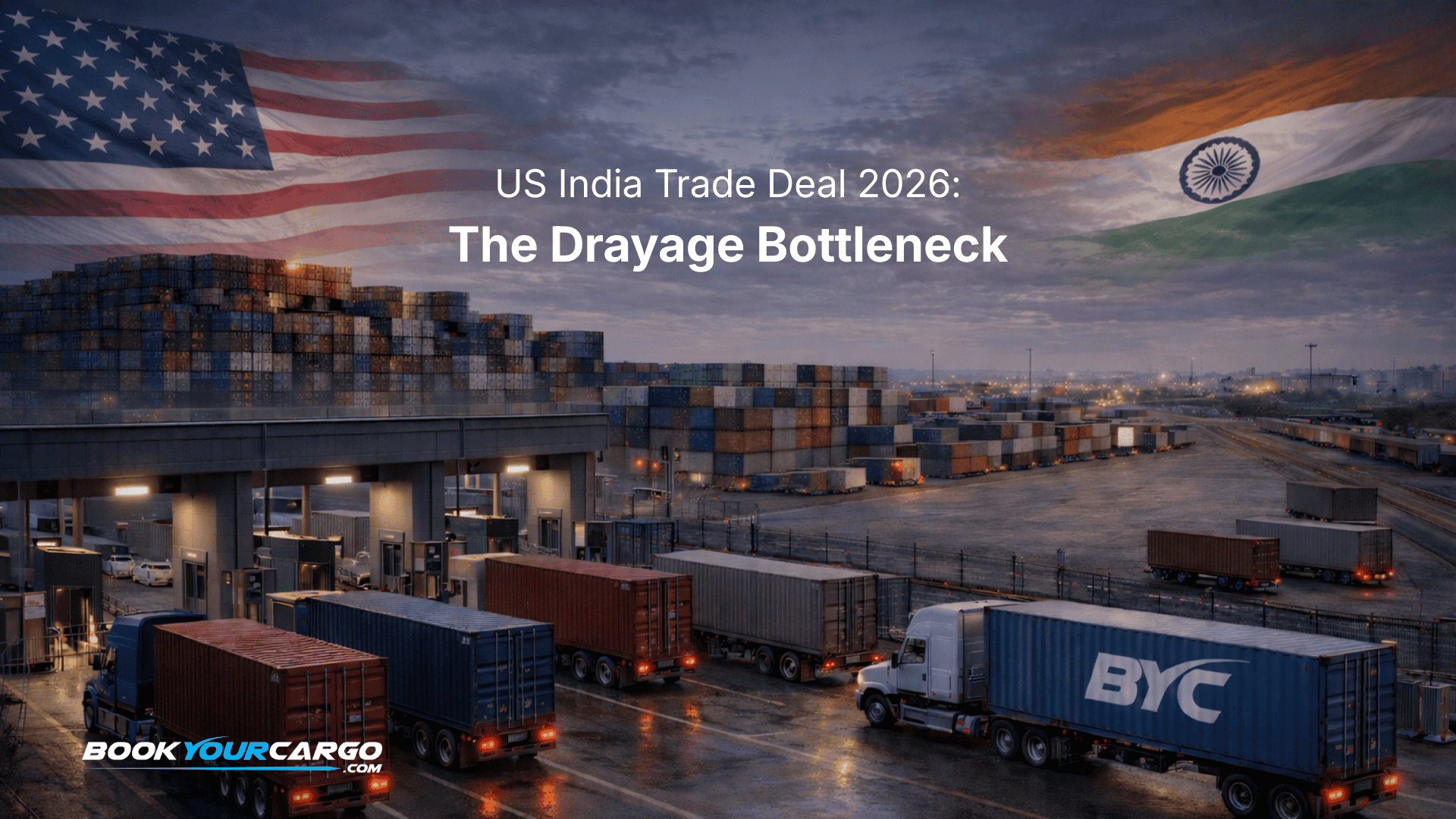
The US-India Trade Deal of 2026 has been finalized, dropping reciprocal tariffs on Indian goods to approximately 18 percent and establishing a framework for India to absorb 500 billion dollars in American exports over the next five years. Macroeconomists and trade ministers are celebrating the policy optimism, projecting bilateral trade to shatter previous ceilings. However, supply chain execution does not operate on political signatures; it operates on physical thresholds.
The prevailing narrative assumes that because transpacific and transatlantic ocean networks possess the vessel capacity to absorb this bidirectional volume, the supply chain is secure. This is a fundamental miscalculation. The real execution risk of the 2026 trade agreement is not ocean capacity, but localized drayage density thresholds at major US gateways. As trade shifts from diversified global sourcing to concentrated bilateral corridors, the resulting volume clustering creates an import and export bottleneck that remains largely unmodeled by forwarders and NVOCCs. The vulnerability lies inland.
The Anatomy of Volume Clustering vs Volume Growth
Volume growth is distributed. Volume clustering is concentrated. When a specific bilateral trade lane experiences a sudden regulatory catalyst, the resulting cargo does not disperse evenly across the North American port landscape. It funnels aggressively into specific infrastructure nodes tailored for those trade lanes and commodity types.
On the import side, Indian apparel, pharmaceuticals, and specialized engineering goods index heavily toward specific US East Coast and Gulf gateways. A sudden 15 percent sequential increase in inbound targeted volume overwhelms terminal peel piles and local warehousing capacity. On the export side, American agricultural and energy outbound shipments cluster around specialized West Coast and Gulf rail corridors. When a single gateway experiences this simultaneous bidirectional surge, the congestion multiplier effect takes over, breaking the mathematical models of linear growth. Terminals that function efficiently at 80 percent utilization can reach gridlock at 85 percent. This volume clustering turns predictable drayage operations into high risk variables for both inbound and outbound freight.
Why Drayage Does Not Scale Linearly
Logistics modeling often treats drayage as an elastic commodity. The assumption is that if import or export container volume increases, truck capacity will naturally scale to meet it. In reality, drayage scales on a nonlinear curve dictated strictly by asset velocity.
When localized volume clustering hits a port, intersection congestion outside the terminal gates increases dramatically. Terminal turn times degrade from an optimal 60 minutes to 150 minutes or more. In this scenario, a drayage driver who previously completed four inbound or outbound turns per day can now only complete two. Without a single truck leaving the market, the effective local drayage capacity is reduced by half. The physical number of chassis and drivers remains constant, but the velocity of those assets plummets. Applying historical linear growth models to post trade deal volume projections severely underestimates the bidirectional inland routing stress forwarders will face.
Appointment Density Thresholds for Imports and Exports
Marine terminals manage yard inventory through rigid appointment systems designed to throttle gate flow to match internal lift capacity. As bilateral trade volumes surge, the demand for import pickup and export drop off appointments quickly exceeds the daily allocation limit of the terminal.
For imports, appointment density saturation means containers sit idle on the terminal floor. Dispatchers are forced into fragmented scheduling, pushing container retrievals into subsequent days and degrading the lift capacity the appointment system was built to protect. For exports, appointment scarcity means loaded outbound containers cannot gate in before the vessel cutoff, resulting in rolled bookings. If a forwarder has not modeled appointment saturation into their transit time expectations for both inbound and outbound legs, their inland execution strategy will fail upon contact with peak volume.
Warehouse Receiving Constraints and Street Dwell
On the import side, the immediate downstream effect of volume clustering is warehouse receiving saturation. As inbound containers flood a specific region, local distribution centers quickly reach their maximum cross dock and put away capacities.
When a warehouse cannot accept live unloads due to dock congestion, drayage providers are forced to drop loaded containers in the yard. This practice ties up the underlying chassis for extended periods, creating severe street dwell. As more chassis become trapped under unloaded import containers at local warehouses, the available chassis pool for new import retrievals evaporates. This creates an artificial equipment shortage at the port, stalling the entire inbound supply chain even if the ocean terminal itself remains fluid.
ERD Compression Dynamics
While imports face warehouse constraints, the critical variable for US exporters moving goods to India is the Early Return Date. When terminal yard density spikes due to incoming import surges, terminal operators defend their footprint by compressing the outbound receiving window.
A standard five-day receiving window for an outbound vessel can be compressed to three days, or even 48 hours, with zero advance notice. ERD compression dynamics force exporters to hold loaded containers outside the port, requiring intermediate staging yards, dual transaction coordination, and extended chassis utilization. If a drayage provider lacks the operational footprint to securely stage these outbound containers, exporters face catastrophic delays. The export targets of the trade deal rely entirely on the ability to navigate these volatile, compressed receiving windows.
Free Time Erosion and Margin Volatility
The direct financial consequence of both import warehouse delays and export ERD compression is severe free time erosion. Ocean carriers dictate strict free time limits for both equipment usage and terminal storage. As drayage velocity slows across the board, the buffer between container availability and free time expiration vanishes.
For imports, the inability to secure pickup appointments or chassis leads directly to terminal demurrage. For exports, the inability to gate in due to ERD compression leads to equipment detention charges. These penalties represent extreme margin volatility. A bidirectional shipment modeled for a 12 percent profit margin can instantly become a net loss if it incurs four days of terminal demurrage on the inbound leg and three days of chassis detention on the outbound leg. Inland execution is the primary mechanism for margin protection in concentrated trade lanes.
Rail Ramp Secondary Congestion
Coastal ports inevitably shift their volume clustering inland via the rail network. As US-India bidirectional trade volumes move through the Midwest via Interior Point Intermodal routing, the congestion transfers directly to inland rail hubs.
Unlike marine terminals, which have some degree of geographic elasticity, inland rail ramps operate within strict municipal footprints. Rail ramp lift capacity is finite. When inbound unit trains arrive with clustered import volumes, the resulting rail ramp overflow leads to grounded containers and massive chassis pool imbalances. Simultaneously, outbound export volumes fight for limited well-car space to reach the coastal ports. Drayage providers must navigate highly congested, poorly configured inland facilities, turning predictable rail deliveries into multi day recovery operations for both importers and exporters.
Commodity Mix and Inspection Probability
The US-India bilateral trade profile introduces highly specific inspection risks that severely disrupt drayage fluidity. High volume Indian imports such as specialized chemicals, pharmaceuticals, and agricultural commodities carry a statistically higher probability of Customs and Border Protection holds or FDA examinations. Conversely, US agricultural exports face stringent USDA inspection protocols before outbound clearance.
When an inbound or outbound container is flagged for a localized exam, it must be drayed to a centralized examination station. This ties up the underlying chassis for days or weeks, removing it from the active pool. As bidirectional inspection volumes rise in tandem with trade growth, chassis pool imbalances worsen, creating secondary shortages even for cleared cargo. Operational modeling must account for this specific commodity mix and its historical inspection probability to accurately forecast asset availability.
The Forwarder Risk Modeling Framework
To navigate the bidirectional inland risks generated by the 2026 trade agreement, forwarders and NVOCCs must adopt a disciplined operational modeling framework. Relying on baseline ocean transit data is a guaranteed path to margin loss. The modeling checklist must include:
- Gateway Distribution Analysis: Map both incoming and outgoing bilateral volume against specific port infrastructure to identify localized stress points.
- Appointment Saturation Modeling: Track terminal turn times and appointment availability indices to project realistic container retrieval and drop off timelines.
- Warehouse Capacity Indexing: Monitor the receiving fluidity and chassis street dwell metrics of destination import distribution centers.
- Chassis Availability Stress Testing: Evaluate the depth of local chassis pools, factoring in the specific dwell times associated with high inspection commodities and centralized examination stations.
- Rail Ramp Density Forecasting: Monitor inbound and outbound train manifests against the known lift capacity and grounding rules of target inland rail ramps.
- ERD Volatility Tracking: Analyze historical ERD compression patterns at preferred export terminals to build necessary staging buffers into supply chain timelines.
The Requirement for a Structured National Drayage Layer
You cannot model away physical constraints without a corresponding execution layer. As the US-India Trade Deal forces bidirectional volume clustering across the network, legacy fragmented drayage procurement will fail. Relying on local, siloed trucking operators leaves forwarders exposed to extreme localized volatility on both the import and export sides.
Absorbing this risk requires a structured national drayage layer. Orchestrating capacity across multiple markets allows logistics providers to dynamically route around gateway congestion, secure appointments programmatically, and manage chassis pools with enterprise visibility. Partnering with Book Your Cargo provides the execution infrastructure required to stabilize these complex inland moves.
By centralizing visibility and deploying national drayage services, forwarders can shift from reactive firefighting to proactive multi-market orchestration. Book Your Cargo serves as the definitive modeling and orchestration layer capable of absorbing volume clustering risk, neutralizing the bottleneck before it impacts the cargo owner.
Key Takeaways
The US-India Trade Deal of 2026 will accelerate bidirectional container volume, creating severe drayage execution risks at concentrated US gateways. While ocean capacity can absorb the overall growth, localized volume clustering leads to nonlinear inland bottlenecks for both imports and exports. Key execution risks include marine terminal appointment density thresholds, import warehouse receiving constraints causing chassis street dwell, Export Early Return Date compression, and rail ramp overflow. To protect margins against demurrage and detention volatility, forwarders must move beyond ocean transit modeling and utilize a structured national drayage layer to orchestrate inland capacity, secure terminal appointments, and manage equipment velocity efficiently.
Frequently Asked Questions
Conclusion
Trade policy creates opportunity, but inland execution protects the margin. The US India Trade Deal of 2026 represents a historic realignment of global sourcing, yet the success of these newly established bidirectional trade corridors will ultimately be decided at the terminal gates and inland rail ramps. Forwarders and NVOCCs can no longer afford to treat drayage as an afterthought or a localized commodity.
Absorbing the risk of volume clustering requires a systems-driven approach that equally weighs the friction of inbound warehouse saturation and outbound terminal congestion. As a structured national drayage company, BYC provides the orchestration layer necessary to navigate this complexity. By prioritizing appointment management, ERD tracking, free time protection, and multi-gateway orchestration, BYC invites the logistics industry to rethink its inland modeling discipline and secure its supply chain against the bottlenecks of tomorrow.
Ready to Navigate US-India Trade Drayage Bottlenecks?
BYC's structured national drayage layer gives forwarders the orchestration, visibility, and multi-market capacity needed to absorb volume clustering risk. See how Book Your Cargo can protect your margins and stabilize inland execution across the USA and Canada.
Get Started Today