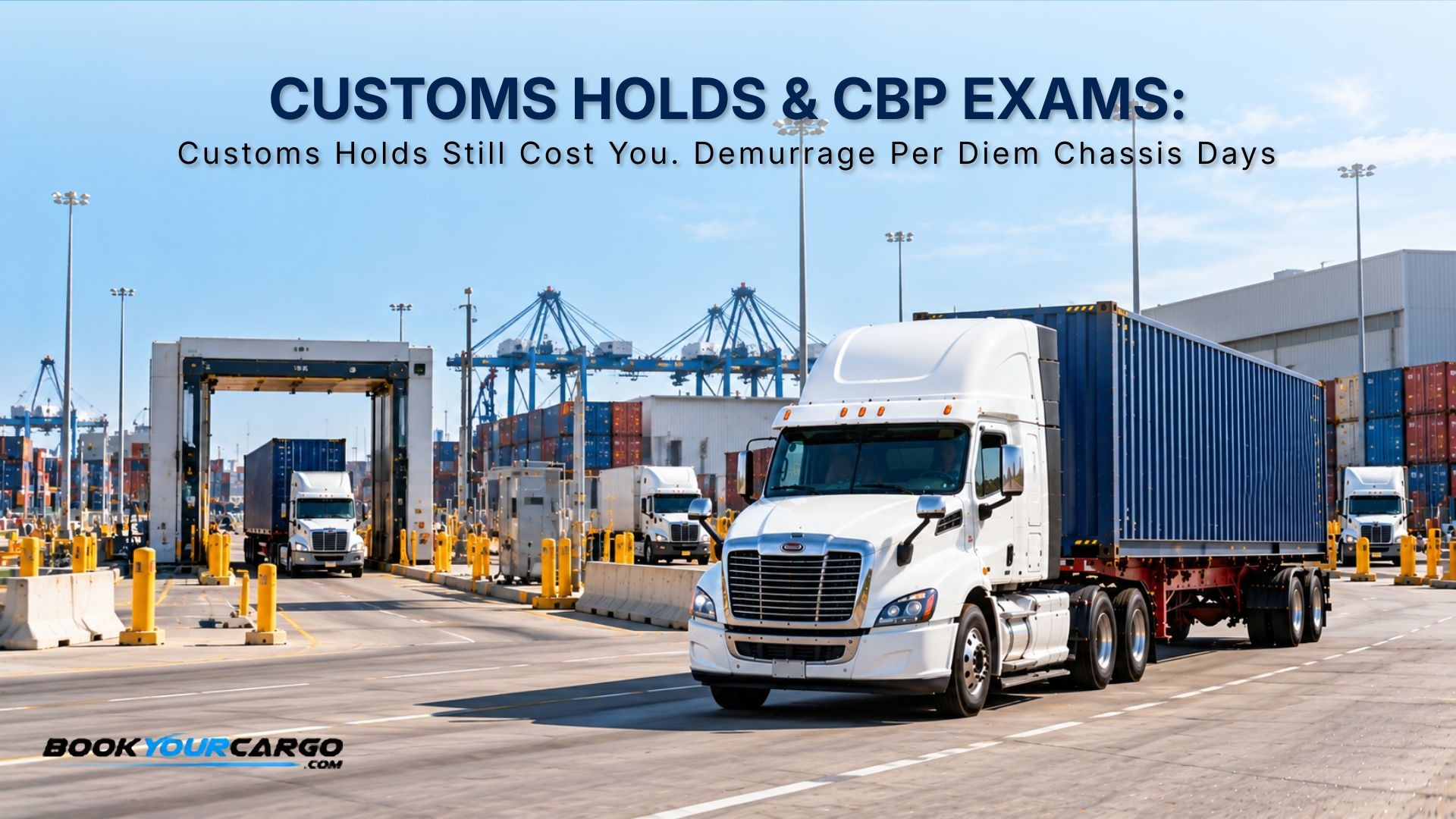
A customs hold stops a container from being released even though it has been discharged, grounded and shows as available at the terminal. An exam is what happens when a hold escalates into a physical inspection. Neither stops the free time clock, which is why a hold is the most common reason a container sits past Last Free Day with nobody realising until the charges appear.
Most guidance on customs holds is written for the entry side, aimed at brokers and compliance teams. This one is written for the freight side, because the part that costs money is not the inspection itself. It is the drayage, the dwell and the equipment exposure that accumulate around it while the container waits.
This guide covers the difference between a hold and an exam, the hold types you will actually see, how exams escalate and what each one does to your timeline, the extra drayage legs an intensive exam creates, and what to do the moment a hold appears.
A container under a hold is physically present and commercially frozen, and every clock keeps running. Terminal demurrage accrues, and once the box leaves the gate container per diem and chassis days accrue too. The importer pays for a delay nobody in the supply chain caused and nobody can shorten. The only controllable variable is how early you know, which is why hold status should be monitored per container rather than checked at dispatch.
1. Hold versus exam: they are not the same thing
The terms get used interchangeably and they describe different stages. A hold is a pause. An exam is an inspection. Every exam begins with a hold, but most holds never become an exam.
When a hold is placed, U.S. Customs and Border Protection or another government agency stops the shipment before release and notifies the broker and importer electronically. From there the hold either clears once additional information is supplied, such as commercial invoices, packing lists or certificates relevant to the commodity, or it escalates into a physical examination.
That distinction matters operationally, because a documentary hold can often be resolved in hours by someone sending a file, while an exam adds days and creates extra freight moves. Knowing which one you are dealing with determines whether you wait or whether you start planning around it.
2. The hold types you will see
Holds originate from different places and behave differently. The five that appear most often on containerised imports:
| Hold type | What triggers it | How it usually resolves |
|---|---|---|
| Manifest hold | A discrepancy or omission in the carrier manifest data filed before arrival | Corrected manifest data, often quickly once identified |
| Commercial enforcement hold | Concerns around trade compliance, valuation, classification or admissibility | Documentation and broker engagement; can escalate to exam |
| Statistical validation hold | Data on the entry that does not reconcile, such as quantity or weight inconsistencies | Corrected entry data |
| Contraband Enforcement Team hold | Security and contraband targeting | Frequently escalates directly to a physical exam |
| Partner government agency hold | A separate agency with jurisdiction over the commodity, such as food or agricultural products | Agency review, sampling or its own inspection process |
Partner government agency holds deserve separate planning attention because they run on the agency timeline rather than the CBP one, and for perishable or temperature-controlled cargo the interaction between an agency review and the cold chain is its own problem.
3. The three exam types and how they escalate
Not all freight can be physically inspected, so a percentage is selected through targeting. Where an exam is ordered, it takes one of three forms, and an exam can be escalated from one level to the next at any point. It is also possible for a single shipment to be selected more than once.
Non-intrusive inspection
Also called an NII or VACIS exam, this is an X-ray scan of the whole container. The seal is not broken and the container does not need to be unpacked. It is the most common exam type on ocean freight and the least disruptive, typically adding hours to about a day.
One feature catches importers out: a non-intrusive exam is generally ordered at the first port of call based on the carrier manifest rather than being tied to the customs entry. That means it can be selected before the entry is even filed, and a shipment cleared through an NII exam can still be selected for a further exam once the entry is made.
Tailgate exam
Here the seal is broken, the doors are opened and officers inspect what is visible or open a small number of cartons. It happens at the cargo terminal rather than requiring a transfer, and on ocean freight it commonly adds several days depending on port traffic. If officers are satisfied the container is resealed and released. If not, it escalates.
Intensive exam
The most disruptive by a wide margin. The container is transferred to a Centralized Examination Station or a customs bonded facility, where it is devanned and the contents examined hands-on. Depending on the port and the queue at the examination station, this can run from around a day to a fortnight.
The intensive exam is where the freight cost concentrates, and it is the reason this is a drayage problem rather than purely a customs one.
4. Why an intensive exam is a freight problem
An intensive exam does not simply pause a container. It inserts additional freight moves into a sequence that was planned without them.
- A drayage leg to the examination station. The container has to be moved from the terminal to the examination facility, which is a dispatched move requiring a truck, a chassis and frequently an appointment.
- Dwell at the station. The container queues for inspection. Examination station capacity is finite and queues lengthen during peak periods, which is exactly when free time is tightest.
- Devanning and reloading. The cargo is unloaded for inspection and reloaded afterwards, which introduces handling exposure on fragile or tightly packed freight and breaks the original seal.
- A second drayage leg. After release the container moves again, either back to the terminal or onward to the consignee, depending on how the release is structured.
- Clocks running throughout. Terminal demurrage accrues while the container is on the terminal, and once it leaves the gate for the examination station the container per diem and chassis day clocks start and keep running through the whole process, which is the compounding effect described in the drayage process.
- The importer carries all of it. Exam-related charges, the additional freight legs, the storage and the equipment exposure sit with the cargo interest regardless of the outcome of the inspection.
5. In-bond moves and foreign trade zones
Two related situations produce the same symptom, a container that will not release, for entirely different reasons.
In-bond movement
Cargo moving under bond travels under customs control to an inland port of entry or another port rather than being entered where it lands. The in-bond movement has to be correctly established before the container will release, and an incomplete or incorrect filing looks identical to a hold from the terminal side. The container sits, free time runs, and the cause is documentation rather than inspection.
Foreign trade zone admission
Cargo destined for a foreign trade zone is admitted rather than entered, which changes the documentation and the release path. FTZ-bound containers are moved under their own procedures, and a provider unfamiliar with them will treat the move as a standard delivery and discover the difference at the gate.
In both cases the practical requirement is the same: the drayage provider needs to know before dispatch which path the container is taking, because the paperwork determines whether the truck can move it at all.
6. What to do when a hold appears
Holds are not preventable in any reliable sense. Targeting is not disclosed and a clean compliance record does not exempt a shipment. What is controllable is the response.
- Identify the hold type immediately. A documentary hold and a contraband targeting hold call for completely different responses and have completely different timelines. Treating them the same wastes the hours that matter most.
- Escalate through the broker at once. Where additional documentation will clear the hold, the elapsed time is almost entirely the time it takes someone to notice and respond.
- Recalculate Last Free Day against the realistic release date. If the hold is likely to outlast free time, the decision point is now rather than on the day the clock expires.
- Plan a pre-pull for the moment of release. Where the consignee cannot receive immediately after a delayed release, moving the container to a yard converts terminal exposure into cheaper controlled dwell rather than extending it, supported by warehousing capacity held for exactly this purpose.
- Document the hold period contemporaneously. Record when the hold was placed and lifted and which containers were affected. Relief on charges is not automatic and depends on the terminal, the carrier and the applicable terms, but a contemporaneous record supports a materially stronger case than a reconstruction weeks later.
- Check the invoice against the rules. Federal requirements govern what a demurrage and detention invoice must contain and how quickly it must be issued, and an invoice failing either test can eliminate the obligation to pay it.
7. Reducing hold exposure across a programme
Individual holds are random. Programme-level exposure is not, and four disciplines reduce it.
| Discipline | Why it reduces exposure |
|---|---|
| File the entry before arrival | An entry filed ahead of discharge can clear before the container grounds, so a hold appears while free time is still intact rather than after it has been consumed |
| Keep commodity documentation ready | Most documentary holds clear on production of invoices, packing lists or commodity certificates; having them assembled turns days into hours |
| Monitor hold status per container, continuously | A hold found at the terminal gate has already cost a wasted trip, an appointment slot and a day of free time |
| Hold yard capacity as a standing option | Delayed releases and blocked deliveries both resolve into the same answer, and the option is only useful if it exists before it is needed |
The third is the one most programmes get wrong, because hold status is usually checked at the point of dispatch rather than watched. Real-time container tracking that carries hold status alongside free time and equipment position is what converts a hold from a surprise into a planning input.
8. How BookYourCargo handles held containers
BookYourCargo is a national drayage company with vetted carrier capacity at every major U.S. and Canadian port and rail ramp. On held containers the operating model is built to avoid wasted dispatches and to be ready the moment a release lands.
- Hold status monitored before dispatch. Customs, partner agency, steamship line and terminal holds tracked per container, so a truck is never sent to a container that is not free to move.
- Examination station legs handled as planned moves. Where an intensive exam is ordered, the transfer to the examination facility and the onward move after release are dispatched as scheduled legs rather than improvised, including the appointment and equipment each requires.
- Release-triggered dispatch. Capacity queued against the expected release rather than requested afterwards, so a container that clears late in the day still moves.
- Pre-pull and yard options. Where a delayed release collides with a consignee who cannot receive, transloading and yard capacity end the exposure instead of extending it.
- Hold periods documented. Placement and release times recorded with affected containers identified, so a charge arising from a period nobody could move cargo can be challenged with evidence rather than argument.
Coverage spans port drayage, rail drayage and national drayage, with execution on the drayage technology platform. Inc. 5000-recognised, BBB A+ rated, IANA Member, NCBFAA Member, and WOSB-certified through the U.S. Small Business Administration.
Frequently asked questions
A customs hold is a pause placed on a shipment by U.S. Customs and Border Protection or another government agency before release. The container can be discharged, grounded and showing as available at the terminal while remaining commercially frozen, and the broker and importer are notified electronically.
A hold either clears once additional information is supplied, such as commercial invoices, packing lists or commodity certificates, or it escalates into a physical examination. Critically, a hold does not stop the terminal free time clock, which is why holds are the most common reason a container sits past Last Free Day.
A hold is a pause; an exam is a physical inspection. Every exam begins with a hold, but most holds never become an exam because they resolve on documentation.
The distinction is operational rather than semantic. A documentary hold can often be cleared in hours by supplying a file, while an exam adds days and creates additional freight moves. Knowing which you are dealing with determines whether you wait or start planning around it.
Three, in escalating order. A non-intrusive inspection, also called an NII or VACIS exam, is an X-ray scan of the whole container with the seal left intact, typically adding hours to about a day. A tailgate exam breaks the seal and opens the doors for a visual inspection at the terminal, commonly adding several days on ocean freight.
An intensive exam transfers the container to a Centralized Examination Station or customs bonded facility where it is devanned and inspected hands-on, which can run from around a day to a fortnight depending on the port and queue. An exam can be escalated between levels at any point, and a single shipment can be selected more than once.
No. Terminal demurrage continues to accrue while the container sits under a hold, and once the box leaves the gate for an examination station, container per diem and chassis day charges begin and run through the whole inspection process.
The importer carries all of it. Relief is not automatic and depends on the terminal, the ocean carrier and the applicable terms, so document the hold placement and release times contemporaneously rather than reconstructing them from memory when the invoice arrives.
Because the exam inserts additional freight moves into a sequence planned without them. The container is drayed from the terminal to the examination station, queues there, is devanned and reloaded, and then moves again after release, either back to the terminal or onward to the consignee.
Each of those legs needs a truck, a chassis and frequently an appointment, and the demurrage, per diem and chassis clocks run throughout. The inspection is a small part of the total; the freight and dwell around it are the rest.
Identify the hold type first, because a documentary hold and a targeting hold call for different responses on different timelines. Escalate through your broker immediately, since on documentary holds the elapsed time is largely the time taken to notice and respond.
Then recalculate Last Free Day against a realistic release date rather than an optimistic one, plan a pre-pull for the moment of release if the consignee cannot receive immediately, and record the hold placement and release times with affected containers identified.
Know about the hold before the terminal does the telling
Holds are not preventable and targeting is not disclosed, so the variable an importer actually controls is how early the hold is known and how ready the response is. A hold discovered at the terminal gate has already cost a wasted trip, an appointment and a day of free time. The same hold seen three days earlier is usually a phone call.
If you want to talk to BYC about how held containers are handled across your programme, request a quote.
