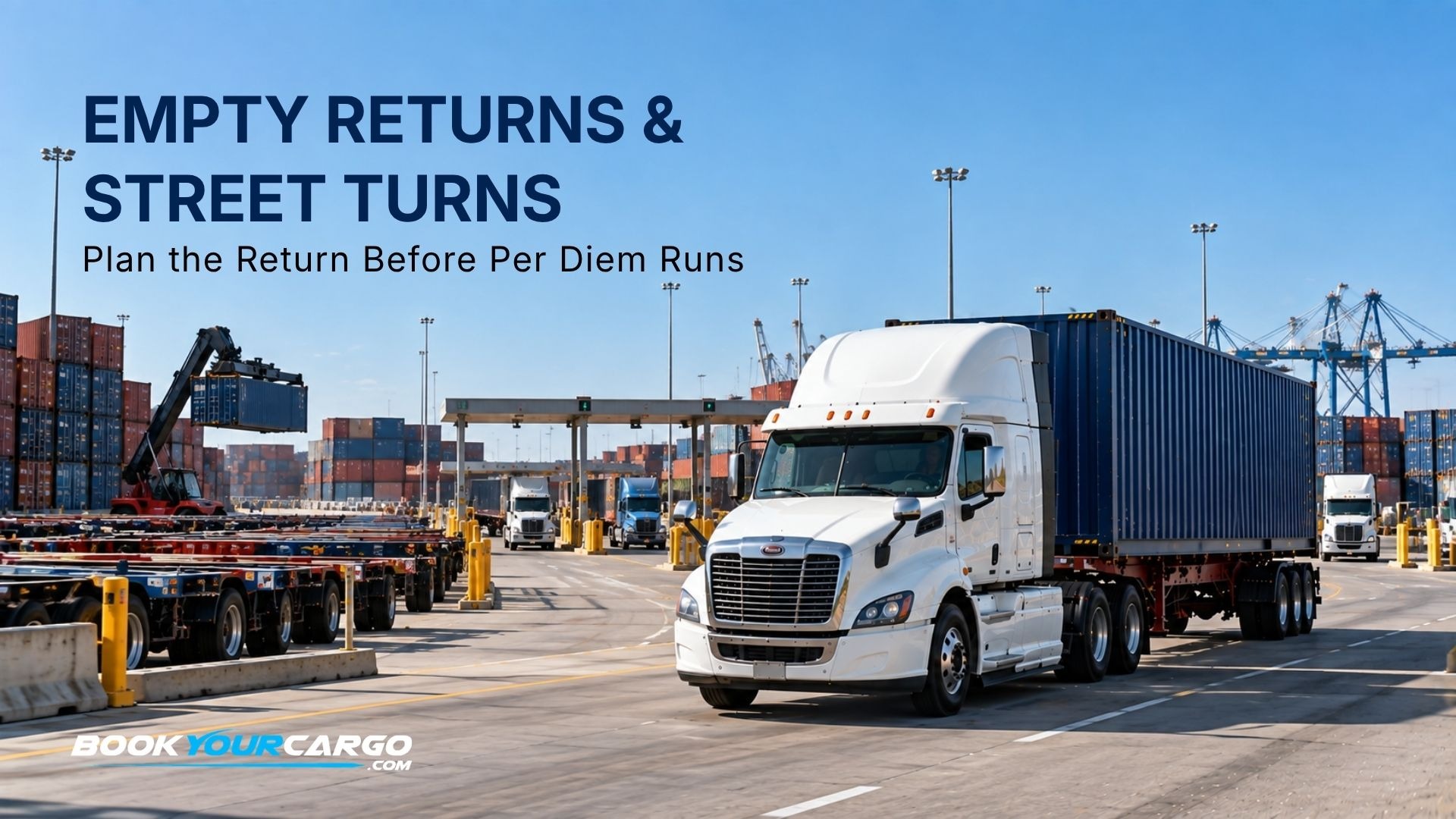
A container move is not finished when the cargo is delivered. The equipment still has to go back, and the return leg has its own deadline, its own congestion, and its own billing clock that has been running since the loaded container left the terminal gate. Importers put real effort into getting boxes out and then lose the savings on the way back in, because the return is treated as an afterthought rather than as half the move.
The imbalance is structural. Every import container becomes an empty that has to be returned to a location the ocean carrier approves, at a time the terminal or depot will accept it, and none of those variables are under the shipper’s control. Return locations change with vessel schedules and yard space. Depots fill after heavy vessel weeks. A driver turned away at a return makes a second trip the shipper pays for while per diem keeps accruing. This guide covers how the equipment clock works, why returns fail, how street turns and dual transactions eliminate moves entirely, and what record protects you when the charge was never avoidable.
Per diem, also called container detention, is the daily charge an ocean carrier assesses on its equipment once the allotted free days expire. The clock generally starts when the loaded container leaves the terminal gate and stops only when the empty is returned to an approved location, rates are commonly tiered so the daily charge escalates the longer equipment stays out, and charges typically continue accruing on weekends even when terminals are closed and return is impossible. Returns fail for reasons outside the shipper’s control: ocean carriers redirect empty returns between terminals and depots based on yard space and vessel schedules, so an approved return location can change after the loaded move, and a driver refused at the gate produces a second trip while charges continue. A street turn is the reuse of an import empty for an export load without returning it to the terminal, which eliminates both the empty return move and the empty pickup move; it requires authorization from the ocean carrier, and the carrier typically uses the street turn approval date to stop the import per diem clock and start the export clock. A dual transaction pairs an empty return with a loaded pickup in a single terminal visit. BookYourCargo is a national drayage company that manages empty return execution, street turn coordination, and per diem exposure across every major U.S. and Canadian port and rail ramp.
What this guide helps you control
- The equipment clock, including when it starts, how it escalates, and when it does not stop.
- Return refusals and dry runs, which cost twice and are largely preventable.
- Street turns, which remove two moves from the cycle when timing allows.
- The live unload versus drop and pick decision and what it does to equipment exposure.
- The documentation that supports a per diem dispute when a return was genuinely impossible.
1. How the equipment clock actually runs
Per diem is the least examined and most consequential clock in container drayage, and three of its properties account for most of the surprise on invoices.
- It starts at gate out, not at delivery. The clock generally begins when the loaded container leaves the terminal, which means it is already running during transit, during unloading, and during any wait for a return appointment. Free days are consumed by the whole cycle, not just by the time cargo sits at a facility.
- Rates are commonly tiered. The daily charge frequently escalates the longer equipment remains out, so exposure does not grow linearly. A container that runs a week past free time can cost considerably more than seven times a single day.
- It does not pause for closures. Charges typically continue to accrue on weekends and holidays even when terminals are closed and return is physically impossible, which is one of the most common sources of charges shippers consider unfair and pay anyway.
- It runs alongside other clocks. Terminal demurrage, rail storage at inland ramps, and chassis days all run on their own schedules and can overlap with per diem on the same container, which is why a single delay compounds rather than adds, a dynamic covered across rail drayage and terminal operations.
The practical consequence is that per diem exposure is set by decisions made before the container ever leaves the terminal: how quickly the consignee can receive, whether the return location has been confirmed, and whether the drayage plan treats the return as a scheduled event or an afterthought.
2. Why empty returns get refused
Return refusal is the most expensive routine failure in drayage, because it costs a wasted trip, a second trip, and the accruing charges in between. The causes are almost entirely outside the shipper’s control, which is precisely why they have to be managed rather than assumed away.
- Return locations change. Ocean carriers redirect empty returns between terminals and depots based on available yard space and vessel schedules, so the location that was valid when the loaded container was picked up may not be valid when the empty is ready.
- Depots fill after heavy vessel weeks. When a terminal or depot reaches capacity it stops accepting, and every carrier in the market discovers this at roughly the same time, which compounds the problem across a whole port.
- Restrictions vary by carrier and equipment type. Acceptance can differ by ocean carrier, container size, and equipment condition, so a return that is accepted for one box is refused for another on the same day at the same gate.
- Appointments may be unavailable for returns. At appointment-driven gateways the return transaction needs a slot in the same way a pickup does, and slot scarcity applies to both directions.
3. Street turns: removing two moves from the cycle
A street turn is the reuse of an import empty for an export load without first returning it to the terminal or rail yard. Instead of the normal sequence, where an import container is delivered, returned empty, and a separate empty is collected for an export booking, the same container moves from the import consignee to the export shipper.
Why it is worth pursuing
The economics are straightforward: the street turn eliminates two drayage moves, the empty return and the empty pickup, along with the associated gate transactions and empty miles. It also shortens the period the equipment is out of the system. For programs with both import and export volume in the same market, it is one of the few genuinely structural cost reductions available in drayage rather than a marginal efficiency.
What it requires
Street turns are not a unilateral decision. They require authorization from the ocean carrier that owns the container, and depending on the arrangement, approval relating to the chassis as well. Carriers operate defined request processes for this, and the approval matters for billing as much as for permission: carriers typically use the street turn request or approval date to stop the import per diem clock and start the export clock, which means the authorization date is a financial event and not merely an administrative one.
Why it does not always work
Timing is the binding constraint. The import empty has to become available in the window when the export booking needs it, in the right size and type, with the right carrier, in the same market. Where those align the saving is real; where they do not, forcing a street turn creates dwell that costs more than the moves it saves. The practical approach is to identify street turn candidates systematically across import and export volume rather than to attempt them opportunistically on individual containers.
4. Dual transactions, drop and pick, and yard staging
Where a street turn is not available, three other structural choices govern how much equipment exposure a program carries.
- Dual transactions. A single terminal visit that returns an empty and collects a loaded container, which halves gate trips on paired volume and reduces the time equipment spends in the system. It depends on the empty being accepted at the same terminal on the same appointment, so it requires planning rather than improvisation, and it becomes more valuable exactly when returns are restricted elsewhere.
- Live unload versus drop and pick. A live unload keeps the driver waiting but returns the equipment quickly. A drop and pick releases the driver but leaves the container and chassis at the facility accruing charges until collection. The general rule is that reliable, fast unloading favors live unload, while unpredictable dock scheduling usually favors drop and pick even after the equipment charges.
- Yard staging when returns close. When a depot stops accepting, holding empties in a secured yard rather than at the consignee frees the customer’s doors while the return window is monitored, and it also produces a documented record of the restriction, supported by transload and warehousing capacity where cargo needs to come out of the box entirely.
- Transload to end the exposure. For cargo continuing inland by truck, moving it into domestic equipment ends the ocean equipment clock at the transload rather than at the final destination, which is frequently the largest single reduction available on long inland moves, as covered in the guidance on what happens after ocean freight arrives.
5. Documenting a return that was not possible
Ocean carriers generally bill per diem regardless of whether the delay was the shipper’s fault, so the protection is evidence rather than argument. Disputes are notoriously difficult to win after the fact and considerably more winnable when the record was built as events occurred.
- Log every return attempt. The date, time, location, and outcome of each attempt, including refusals, with the reason given at the gate where one is provided.
- Capture restriction notices. Carrier or terminal communications restricting returns, closing depots, or redirecting locations, preserved with their timestamps rather than summarized later.
- Record appointment unavailability. Where a return required an appointment and none was available, evidence of the attempts and the absence of slots during the charged period.
- Note closures and disruptions. Terminal closures, weather suspensions, and operational stoppages overlapping the charged period, since these establish that return was impossible rather than merely inconvenient.
- Check the invoice against the rules. Federal requirements govern what a demurrage or detention invoice must contain and how quickly it must be issued, and non-compliance can eliminate the obligation to pay, which is set out in detail in the guide to demurrage and detention invoice requirements.
6. Empty return and reuse checklist
A working sequence for the return half of every container move.
| Risk | What it costs if unmanaged | Action |
|---|---|---|
| Return location assumed | Dry run, second trip, continued per diem | Confirm the approved return location before the loaded move and reconfirm before dispatch |
| Depot full after peak vessel weeks | Equipment stranded with charges accruing | Hold yard capacity as a buffer and monitor return windows |
| Street turn opportunity missed | Two avoidable moves and unnecessary empty miles | Screen import empties against export bookings systematically, request carrier authorization early |
| No dual transaction planning | Two gate trips where one would serve | Pair returns with pickups on the same appointment where the terminal permits |
| Wrong unload structure | Equipment sitting at a facility that cannot receive promptly | Match live unload or drop and pick to actual dock reliability, not habit |
| Long inland move on ocean equipment | Ocean equipment clock running across the full inland leg | Transload into domestic equipment to end the exposure at the transload point |
| Restriction undocumented | Charges paid for a return that was impossible | Log attempts, refusals, notices, and closures contemporaneously |
7. How BookYourCargo manages the return half
BookYourCargo is a national drayage company with vetted carrier capacity across every major U.S. and Canadian port and rail ramp, and the empty return is planned as a scheduled leg rather than handled as the tail end of a delivery.
- Return availability tracked by carrier and terminal. Approved return locations and restrictions monitored so a return is confirmed before dispatch rather than discovered at the gate, and changes are caught while they can still be planned around.
- Street turn screening. Import empties matched against export bookings across a customer’s volume in the same market, with carrier authorization requested early enough that the approval date works in the customer’s favor on the per diem clock.
- Dual transactions where the terminal permits. Returns paired with loaded pickups on a single appointment to reduce gate trips and shorten the time equipment is in the system.
- Yard, transload, and warehousing alternatives. Capacity to hold empties when depots close and to move cargo out of ocean equipment when an inland leg would otherwise carry the clock the whole way.
- Contemporaneous documentation. Return attempts, refusals, restriction notices, and closures captured at shipment level through API and EDI integration on the BYC drayage technology platform, so a disputable charge is supportable rather than arguable, backed by live visibility.
Coverage spans port drayage, rail drayage, and national drayage, with first-party rate context published monthly in the BYC Drayage Index going back to 2022. Inc. 5000-recognized, BBB A+ rated, IANA Member, NCBFAA Member, and WOSB-certified through the U.S. Small Business Administration.
Frequently asked questions about empty returns and street turns
Plan the return before you plan the delivery
The empty leg is where container programs quietly lose the savings they earned on the loaded one, and almost every expensive version of it traces back to a return location nobody confirmed or a reuse opportunity nobody screened for. Both are planning problems rather than rate problems. If you want to talk to BYC about per diem exposure and empty return execution across your program, request a quote.
