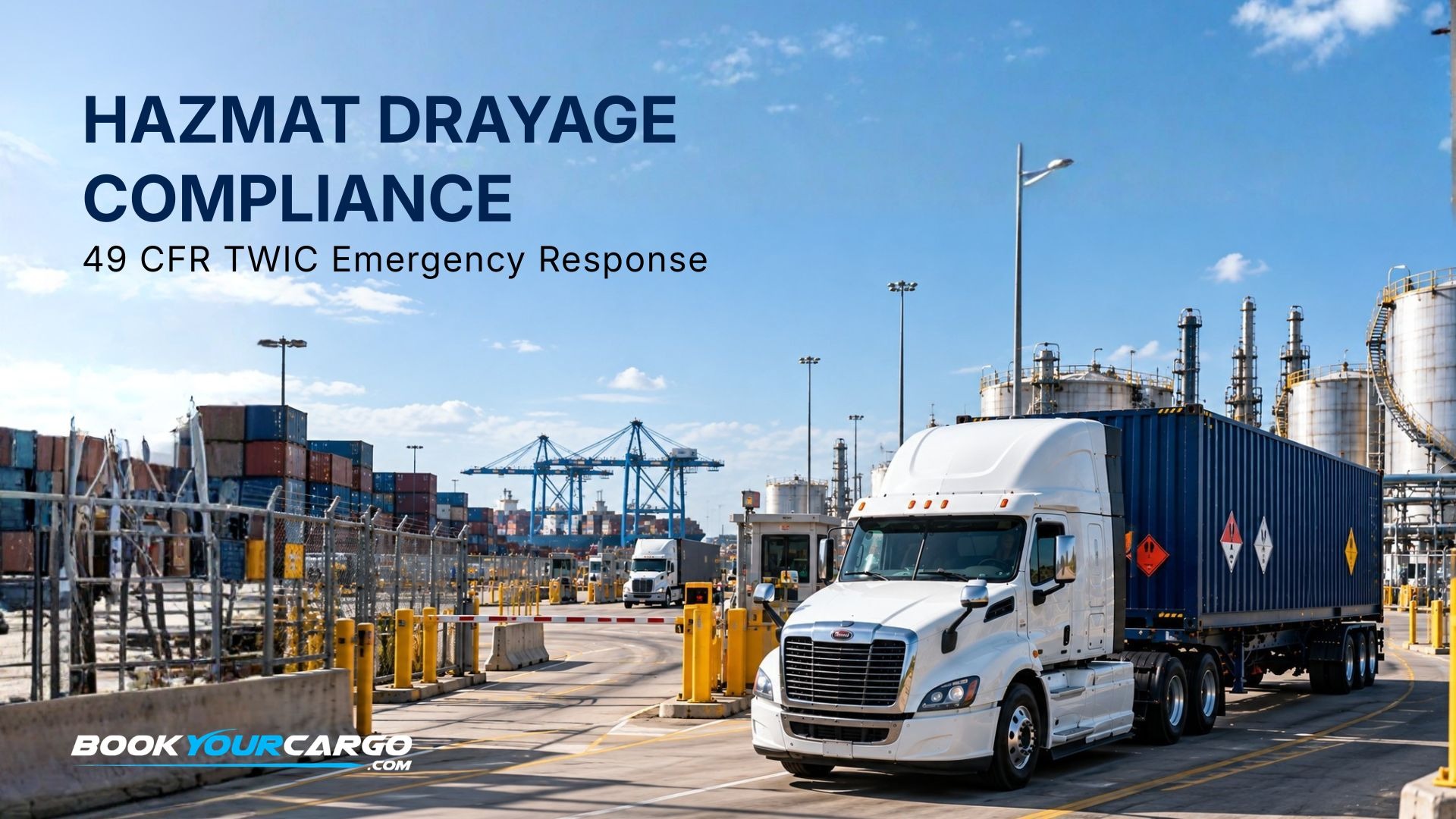
Most drayage problems surface as delay. Hazmat problems surface as refusal. A driver without the right endorsement is turned away at the gate, a container with placards that do not match its shipping papers does not move, and in both cases the container stays where it is while free time runs and the shipper starts paying for a compliance failure that took thirty seconds to detect and days to resolve.
Chemical and hazardous materials freight moves in volume through U.S. container gateways, concentrated most heavily around the Gulf petrochemical complex but present at every major port, and it is governed by a framework that does not exist for ordinary cargo. This guide covers what actually has to be in place before a placarded container moves: the classification and placarding rules under 49 CFR, the driver credentials required at the gate, shipping paper and emergency response requirements, when a security plan is mandatory, and the practical failure points that turn a compliant shipment into a stranded one.
This guide is general operational information about regulatory requirements. It is not legal or compliance advice, and shippers should confirm requirements for their specific commodities and lanes against the current edition of 49 CFR and with qualified advisors.
Hazmat container drayage is the movement of containers carrying materials classified as hazardous under U.S. Department of Transportation regulations at 49 CFR Parts 171 through 180, administered by PHMSA, covering nine hazard classes including flammable liquids, compressed gases, corrosives, oxidizers, and toxic materials. Under 49 CFR 172.504(a), a freight container or transport vehicle containing any quantity of hazardous material must be placarded on each side and each end, meaning four-sided placarding, with an exception at 172.504(c) for shipments containing less than 454 kilograms, or 1,001 pounds, aggregate gross weight of Table 2 materials. Drivers transporting hazardous materials in quantities requiring placarding must hold a hazardous materials endorsement on their commercial driver license, obtained after a Transportation Security Administration background check and knowledge test, plus a tank vehicle endorsement or the combined endorsement for tank container work, and a Transportation Worker Identification Credential for access to federal marine terminals. Shipping papers must include emergency response information under 49 CFR Part 172 Subpart G, with an emergency response telephone number monitored at all times while the shipment is in transit, and certain materials require a transportation security plan under Subpart I. BookYourCargo is a national drayage company that handles hazmat and chemical container freight across every major U.S. and Canadian port and rail ramp.
What this guide helps you control
- Whether the container in front of you actually requires placarding, and which placards.
- The credentials a driver must hold before arriving at the gate, and how to confirm them in advance.
- Shipping paper and emergency response requirements that travel with the shipment.
- When a written transportation security plan is required rather than optional.
- The failure points that strand a placarded container and start the free time clock working against you.
1. Classification and the placarding threshold
Everything downstream follows from classification. The Department of Transportation classifies hazardous materials into nine hazard classes under 49 CFR, and the class determines the placard, the handling, the documentation, and in some cases the routing.
The four-sided rule
Under 49 CFR 172.504(a), each bulk packaging, freight container, unit load device, transport vehicle, or rail car containing any quantity of a hazardous material must be placarded on each side and each end with the placards specified in the regulation. In practice this is the four-sided placarding requirement, and a container arriving at a gate with placards missing from one face is as non-compliant as one with none.
The 1,001-pound exception, and how it is misread
Section 172.504(c) provides an exception from placarding for shipments containing less than 454 kilograms, or 1,001 pounds, aggregate gross weight of Table 2 materials. The word that causes the most trouble is aggregate. The threshold is the total weight of all hazardous materials and their packaging loaded on a single transport vehicle, not the weight of a single commodity. FMCSA guidance illustrates the point directly: a vehicle carrying 1,500 pounds of Class 3 material and 50 pounds of Class 8 material must be placarded for both classes, because the aggregate crosses the threshold even though the Class 8 quantity alone would not.
The DANGEROUS placard option
Where a freight container or vehicle contains non-bulk packages in two or more categories of hazardous materials requiring different Table 2 placards, section 172.504(b) permits a DANGEROUS placard in place of the separate placards otherwise specified. This is a genuine simplification for mixed loads, and it is subject to conditions in the regulation, so it should be applied against the current text rather than from memory.
2. The credentials that decide whether the driver gets through the gate
Hazmat drayage fails at the gate more often than anywhere else, and almost always because a credential was assumed rather than confirmed. Three are non-negotiable for placarded container work at a marine terminal.
- Hazardous materials endorsement. A driver transporting hazardous materials in quantities requiring placarding must hold a hazardous materials endorsement on their commercial driver license. The endorsement requires a Transportation Security Administration background check and a written knowledge test, so it cannot be arranged quickly when a gap is discovered.
- Tank vehicle endorsement for tank containers. Drivers handling ISO tank containers additionally need a tank vehicle endorsement, or the combined endorsement covering both hazardous materials and tank operations. A driver qualified for a placarded dry container is not automatically qualified for a tank move.
- Transportation Worker Identification Credential. Access to federal marine terminals requires a TWIC, issued by TSA following a background check. Without it the driver does not enter the terminal at all, regardless of the cargo.
- Training beyond the endorsement. FMCSA notes that compliance with CDL tank vehicle or hazardous materials endorsement requirements may satisfy some hazmat training requirements, but that the hazmat employer must determine the extent to which it does, and additional specialized training may be required based on job function and the specific materials handled.
The practical requirement for a shipper: confirm that credentials are verified across whatever capacity is dispatched to your containers, not just in principle but for the specific move. A drayage provider running hazmat work should be able to state how credential currency is checked and how a non-qualified dispatch is prevented, which is the kind of operational governance question set out in the analysis of what the best drayage companies do differently.
3. Shipping papers and emergency response information
Documentation is where hazmat compliance becomes a shared obligation between shipper and carrier, and where a mismatch stops the move.
- Papers must match the placards. Shipping papers that are incomplete, illegible, or inconsistent with the container’s placards are a compliance problem, and a carrier is entitled to refuse the move until corrected documentation is provided. The description, class, identification number, and packing group all have to align with what is on the container.
- Emergency response information must accompany the shipment. Under 49 CFR Part 172 Subpart G, emergency response information must appear on the shipping paper or in a separate document maintained with it, covering the immediate hazards, response actions, and precautions relevant to the material.
- The emergency response telephone number must be monitored. FMCSA is explicit that the emergency response telephone number must be monitored at all times while the shipment is in transit. A number that rings unanswered is a compliance failure, not a formality, and this is a shipper obligation that carriers cannot cure.
- The ocean leg has its own framework. Containerized hazmat arriving by sea is governed on the water by the International Maritime Dangerous Goods Code, and the documentation that satisfied the ocean leg is not automatically what the domestic highway move requires. The two frameworks overlap but are not identical.
4. When a transportation security plan is required
Beyond safety compliance, 49 CFR Part 172 Subpart I requires a written transportation security plan for specified hazardous materials, and the applicability thresholds are commodity and quantity specific rather than universal.
The regulation applies to persons who offer for transportation in commerce, or transport in commerce, materials including any quantity of a Division 1.1, 1.2, or 1.3 material, a quantity of Division 1.4, 1.5, or 1.6 material requiring placarding, and large bulk quantities of certain Division 2.1 and 2.2 materials, among others. For this purpose the regulation defines large bulk quantity as greater than 3,000 kilograms, about 6,614 pounds, for solids, or 3,000 liters, about 792 gallons, for liquids and gases in a single packaging such as a cargo tank, portable tank, or other bulk container.
A conforming plan addresses personnel security, unauthorized access, and en route security. The practical consequence for a drayage program is that where a security plan applies, it governs how the move is planned and executed rather than sitting in a file, and a shipper moving materials in these categories should confirm that their provider operates under a plan that covers the work.
5. Where hazmat drayage actually goes wrong
The regulations are knowable. The failures are operational, and they repeat.
- Credential assumed, not confirmed. The single most common failure. A driver arrives without the endorsement the load requires, is refused at the gate, and the container stays on terminal while a qualified replacement is arranged, with free time running throughout.
- Placarding mismatch discovered at the gate. Placards that do not match the papers, or a load that crossed the aggregate threshold without anyone recalculating, stop the move at the point of inspection.
- Terminal-specific hazmat procedures ignored. Hazmat containers are frequently held in designated areas with their own gate processing and appointment requirements, which means the standard pickup process does not apply and a provider unfamiliar with the terminal loses time discovering that.
- Weight overlooked alongside hazard. Chemical freight is often dense as well as hazardous, so a container can require both hazmat compliance and overweight handling with a tri-axle or specialized chassis and permitting, as covered in the guidance on overweight and out-of-gauge drayage.
- Free time consumed by the compliance failure. Every hour lost to a credential or documentation problem is an hour against the free time clock, and the resulting demurrage is entirely avoidable, which is the preventive discipline covered in No-Surprises Drayage.
6. Pre-dispatch checklist for a placarded container
A working sequence to run before a hazmat container is dispatched, not after it is refused.
| Check | What to confirm |
|---|---|
| Classification | Hazard class, identification number, and packing group confirmed against the current edition of 49 CFR for the specific commodity |
| Placarding requirement | Aggregate gross weight of all hazardous materials and packaging on the vehicle calculated against the 454 kilogram, 1,001 pound Table 2 threshold |
| Placards affixed | Correct placards for the hazard class present on each side and each end, matching the shipping papers exactly |
| Driver credentials | Current hazardous materials endorsement, tank endorsement where the load is a tank container, and a valid TWIC for terminal access |
| Shipping papers | Complete, legible, consistent with the placards, and accompanied by emergency response information per Part 172 Subpart G |
| Emergency contact | Emergency response telephone number active and monitored for the full duration the shipment is in transit |
| Security plan applicability | Whether the commodity and quantity trigger a written transportation security plan under Part 172 Subpart I |
| Terminal procedure | Terminal-specific hazmat gate processing, designated storage area, and appointment requirements confirmed for that facility |
| Weight and equipment | Whether the loaded container also requires overweight handling, tri-axle equipment, or permitting alongside hazmat compliance |
7. How BookYourCargo handles hazmat and chemical freight
BookYourCargo is a national drayage company with vetted carrier capacity across every major U.S. and Canadian port and rail ramp, including capacity credentialed for hazardous materials work. On chemical and hazmat freight the operating model is built around confirming compliance before dispatch rather than discovering a gap at the gate:
- Credential verification across dispatched capacity. Hazardous materials endorsements, tank endorsements where applicable, and TWIC currency confirmed for the capacity assigned to a placarded move, so a non-qualified dispatch does not reach the gate.
- Pre-dispatch compliance review. Classification, aggregate weight against the placarding threshold, placard-to-paper consistency, and emergency response documentation checked before the container is scheduled.
- Terminal-specific hazmat execution. Familiarity with designated hazmat areas, gate processing, and appointment requirements that differ from standard container pickup at each facility.
- Combined hazmat and heavy handling. Where chemical freight is also dense, overweight and tri-axle capability with permitting alongside hazmat compliance, so a single container does not require two providers.
- Visibility and exception handling. Live tracking with API and EDI integration on the BYC drayage technology platform, so a compliance exception surfaces with time to correct it rather than after free time has run, supported by real-time visibility.
Coverage spans port drayage, rail drayage, and national drayage, with first-party rate context published monthly in the BYC Drayage Index going back to 2022. Inc. 5000-recognized, BBB A+ rated, IANA Member, NCBFAA Member, and WOSB-certified through the U.S. Small Business Administration.
Frequently asked questions about hazmat container drayage
Confirm compliance before dispatch, not at the gate
Hazmat drayage does not reward optimism. The credentials, the placards, and the paperwork are either right before the container is scheduled or they are discovered wrong by an inspector, and the second outcome costs a day and a demurrage exposure that the shipper absorbs. If you move chemical or hazardous materials containers and want to talk to BYC about how your freight would execute, request a quote.
