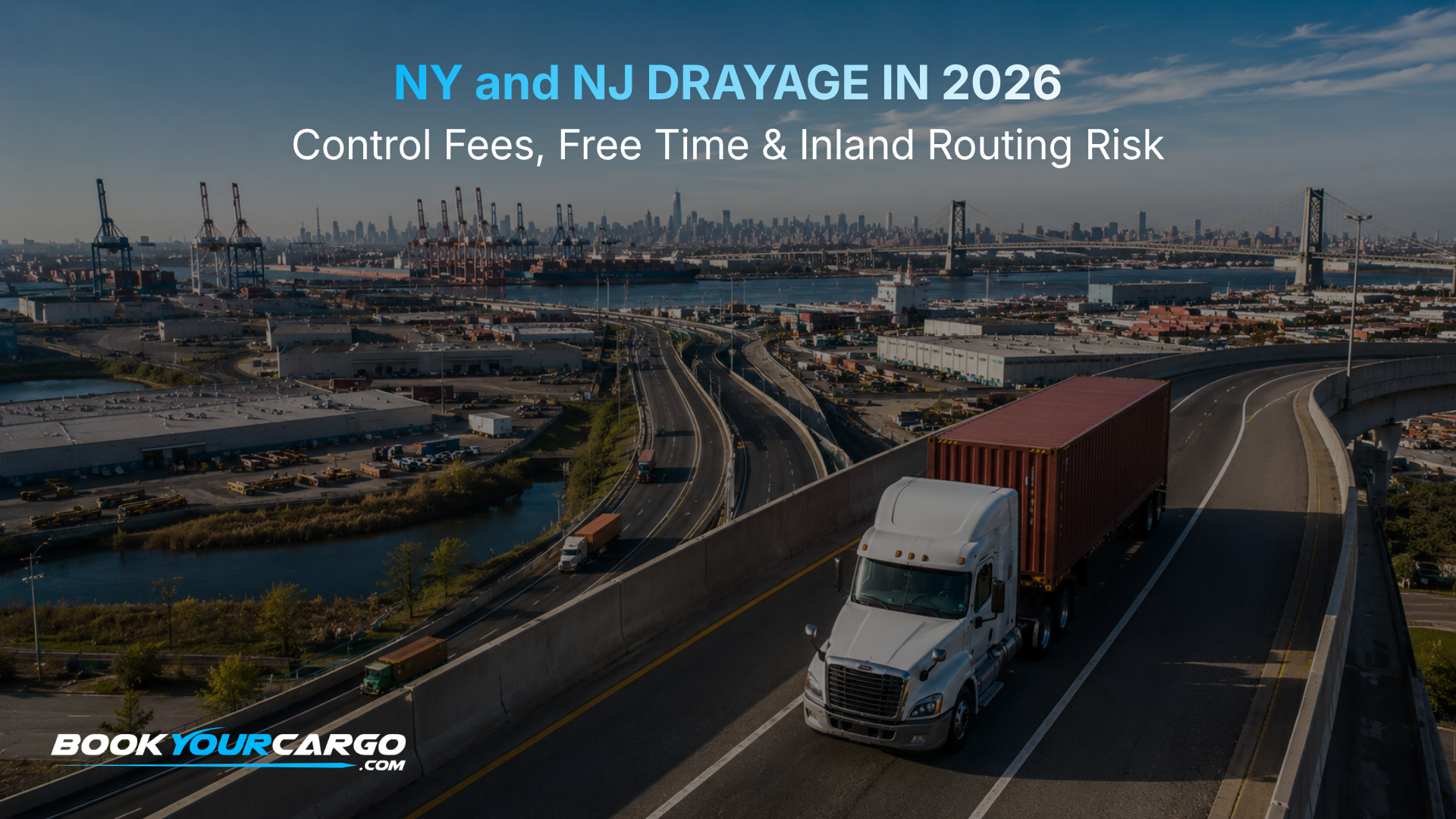
Drayage at the Port of New York and New Jersey is where the Northeast landed cost is either protected or quietly lost. The complex sits inside the most concentrated consumer market in North America, which means short transit distances on the back end, but it also means tight terminal windows, multi-state operating constraints, toll exposure, and the per-laden-container Cargo Facility Charge that no other U.S. port assesses. A small misalignment on appointment timing, chassis availability, hold management, or free time can take what should have been a clean container move and turn it into a stack of demurrage, detention, per diem, and toll surprises.
This guide is built for the operational reality of the Port of New York and New Jersey in 2026. It walks through the terminals, the fee stack including the Cargo Facility Charge, the chassis environment, the free time pressure points, the New Jersey clean truck framework, and the capacity factors that are reshaping how reliable an East Coast drayage move actually is right now. If you are an importer, freight forwarder, or NVOCC moving containers through PANYNJ this year, the goal is to give you what you need to avoid surprise costs and missed appointments, not just describe how the port works.
Drayage at the Port of New York and New Jersey is the short-haul truck movement of ocean containers between the marine terminals of the PANYNJ complex and nearby warehouses, transload yards, or inland rail ramps. Operated by the Port Authority of New York and New Jersey, the complex is the largest container port on the U.S. East Coast and the third largest in the United States, with six terminals and public berths handling all major cargo types. In 2026, the cost and timing of any NY and NJ drayage move is shaped by five operational layers: terminal appointment behavior, the per-laden-TEU Cargo Facility Charge, chassis pool conditions, toll and bridge exposure, and the labor and capacity environment shaped by the six-year ILA-USMX master contract running through September 2030.
What this guide helps you control
- Surprise costs from the PANYNJ fee stack, including the Cargo Facility Charge, chassis per diem, demurrage exposure, and toll and bridge fees on inland delivery.
- Missed terminal appointments at APM, Maher, PNCT, GCT Bayonne, GCT NY, or any of the other PANYNJ facilities, where each operator runs its own appointment system.
- Chassis exposure inside the Pool of Pools and IEP environment that serves the NY and NJ complex.
- Free time loss caused by steamship line holds, customs holds, or terminal congestion that goes unmonitored until LFD.
- Capacity and routing volatility from Red Sea and Hormuz disruption, the FMCSA non-domiciled CDL rule, and shifting carrier alliance string behavior at the East Coast.
1. The Port of New York and New Jersey, in operational terms
The Port Authority of New York and New Jersey operates the largest container port complex on the U.S. East Coast, spanning marine terminals in Newark, Elizabeth, Bayonne, Staten Island, and Brooklyn, plus the supporting rail and roadway network that connects them to the inland Northeast. PANYNJ reports six terminals and public berths handling containers, Ro-Ro, bulk, breakbulk, and project cargo, with the largest portion of container volume concentrated in the Newark and Elizabeth terminal cluster on the New Jersey side.
Two facts shape the operating environment for drayage. First, the complex serves the most concentrated consumer market in North America, with short transit distances to Northern and Central New Jersey, the New York metropolitan area, Long Island, the Hudson Valley, eastern Pennsylvania, and southwestern Connecticut. Second, PANYNJ is a multi-state operating environment with different toll regimes, different bridge and tunnel access rules, and different clean truck regulatory frameworks across the two states, all of which shape how a drayage move actually executes.
The ILA-USMX six-year master contract signed in March 2025, retroactive to October 1, 2024 and running through September 30, 2030, has restored labor predictability across all East and Gulf Coast ports. PANYNJ is operating in a multi-year window of labor peace. See next port cycle drayage analysis for the broader cycle context.
2. Marine terminals at the Port of New York and New Jersey
PANYNJ operates six marine terminals and public berths, with container volume concentrated across the major facilities listed below. Each terminal sets its own appointment release windows, gate behavior, chassis acceptance rules, and weekend schedule, which is why a move at one PANYNJ facility can have completely different pickup characteristics from a move at another on the same day.
| Facility | Location | Operator and operational notes |
|---|---|---|
| APM Terminals Elizabeth | Elizabeth, NJ | APM Terminals, Maersk Group. Major container facility in the Elizabeth-Port Authority Marine Terminal cluster. |
| Maher Terminals | Elizabeth, NJ | Maher Terminals LLC. The largest single container terminal at PANYNJ by acreage and throughput. |
| Port Newark Container Terminal (PNCT) | Newark, NJ | PNCT, Ports America affiliate, operating under a long-term lease through 2050. 272 acres with active berth and yard expansion underway. |
| GCT Bayonne | Bayonne, NJ (Port Jersey) | Global Container Terminals. Modern, automated-assist terminal serving the Bayonne side of the harbor. |
| GCT New York (Howland Hook) | Staten Island, NY | Global Container Terminals. Only major container terminal on the New York side of the harbor, with expansion in progress. |
| Red Hook Container Terminal | Brooklyn, NY | Smaller container and breakbulk facility. Part of the broader Brooklyn Marine Terminal that is being transformed under a 2024 city, state, and PANYNJ agreement. |
Why this matters: a drayage provider that does not model terminal-specific behavior at each PANYNJ facility will burn free time on moves that should have been clean. The concentration of container volume in Newark and Elizabeth means that gate conditions in the I-78 corridor on any given day disproportionately drive overall complex throughput. Strong port drayage execution depends on knowing each facility as its own operating environment.
3. The Port of New York and New Jersey drayage fee stack
A drayage rate at PANYNJ stacks a different mix of port-specific surcharges than the West Coast. There is no PierPass-style Traffic Mitigation Fee in the Northeast, but the complex does carry the Cargo Facility Charge, toll and bridge exposure on the inland delivery leg, and chassis dynamics shaped by the Pool of Pools structure. The table below reflects what importers should expect to see on a clean PANYNJ drayage invoice in 2026.
| Fee layer | Who sets it | What importers should know in 2026 |
|---|---|---|
| Base drayage rate | Drayage carrier | Driver, tractor, fuel surcharge, and base move. Varies by lane density, container size, live unload versus drop pull, and whether the lane crosses into New York City or remains in New Jersey. |
| Cargo Facility Charge (CFC) | Port Authority of New York and New Jersey | Per-laden-TEU charge funding PANYNJ intermodal, rail, and roadway capacity. The 2025 rate was $14.05 per laden TEU across four project components, up 3.5% over 2024. It rises again for 2026 as the Port Street Corridor Improvement recovery phases in. Charged on laden containers only since 2019, adjusted every January. |
| Chassis usage fee | Chassis pool or IEP | Daily per-diem charge based on chassis-in to chassis-out time. PANYNJ operates under a Pool of Pools framework among the major IEPs, with chassis choice rights for cargo interests under the Ocean Shipping Reform Act. |
| Toll and bridge exposure | Toll authorities and PANYNJ | Drayage moves crossing into New York City or across the Bayonne Bridge, Goethals, Outerbridge, or Holland and Lincoln Tunnels carry toll exposure that does not exist on inland-NJ moves. Often material on per-move economics. |
| Pre-pull or off-dock yard | Drayage carrier and yard operator | Optional fee that prevents worse fees downstream. A pre-pull to a Northern NJ yard before LFD often costs less than a single day of terminal demurrage. |
| Demurrage and per diem | Steamship line and terminal | Per-day penalty charges set by the steamship line and terminal that begin once free time expires. Rates are tiered and escalate the longer a container sits, commonly starting around $150 to $250 per container per day and climbing past $300 to $400+ per day in later tiers. This is the single largest avoidable cost in PANYNJ drayage, and on a multi-day hold it compounds fast. |
| Fuel surcharge | Drayage carrier | Indexed to Northeast or national diesel pricing depending on carrier methodology. |
For the deeper play on managing the demurrage and detention layer specifically, see No-Surprises Drayage: how to stop demurrage costs forming.
4. Chassis pools and equipment dynamics at NY and NJ
Chassis is the most underestimated cost driver in NY and NJ drayage, as it is at every major U.S. port. PANYNJ operates under a Pool of Pools framework among the major Intermodal Equipment Providers, with TRAC Intermodal, Direct ChassisLink (DCLI), and FlexiVan among the principal IEPs. Three structural facts to anchor decisions:
- Chassis choice rights apply. Under the Ocean Shipping Reform Act, motor carriers and shippers can select the IEP that supplies the chassis when the cargo interest pays. Exercising chassis choice at PANYNJ requires upstream coordination and a carrier who actually manages the IEP relationship.
- Chassis availability varies by terminal and by day. PANYNJ chassis pools generally run with reasonable equipment availability, but tight cycles do occur during peak weeks, weather disruptions, and unusual vessel arrival concentration. Single-source dependence on one IEP at one terminal is a risk concentrate.
- Chassis dwell drives chassis cost. Every additional day a container sits on a chassis is a per-diem day. Pre-pulls to off-dock yards in Northern or Central NJ convert chassis dwell into yard dwell, which is often dramatically cheaper.
A drayage provider that treats chassis as a yes or no question pays for that posture on the invoice. Strong operators treat chassis as a planning variable across the lifecycle of the move.
5. Free time, ERD, and LFD at PANYNJ
Free time is the period in which a container can sit at the terminal after discharge before demurrage begins. ERD, the Earliest Return Date, controls when an empty container can be returned for an export booking. LFD, the Last Free Day, is the deadline before terminal demurrage starts forming. These three windows govern almost every avoidable cost in import drayage at NY and NJ.
Free time at PANYNJ is set by the steamship line and the terminal, not the Port Authority itself, and varies by carrier, contract, and lane. Published free time often ranges from four to seven calendar days, but operational free time is typically shorter once appointment availability, holds, and weather are factored in. Winter weather closures and Nor'easter events are a more frequent operational risk in the Northeast than on the West Coast, which compresses free time without warning.
BYC manages ERD, LFD, and free-time windows automatically through the drayage platform. Alerts surface before the window closes, not after. See Real-Time Drayage Tracking: Why Visibility Is Now a Non-Negotiable for Importers.
6. Clean truck and regulatory environment at PANYNJ
PANYNJ does not assess a Clean Truck Fund Rate equivalent to the San Pedro Bay structure. Drayage truck environmental compliance at PANYNJ is shaped by Port Authority programs and New Jersey state regulations rather than by a fee-per-loaded-container mechanism. The current rules that matter for importers, forwarders, and NVOCCs in 2026:
- PANYNJ has historically operated a Clean Truck Program with truck registration, emission standards, and truck-replacement support programs targeted at older drayage tractors. Drayage providers operating at PANYNJ are expected to meet the current emission standards established by the Port Authority.
- New Jersey state regulations, including the Advanced Clean Trucks rule, are shaping the longer-term path toward zero-emission heavy-duty vehicles in the state. The pace and timing differ from California, but the direction is the same.
- FMCSA compliance, safety ratings, and credentialing standards apply uniformly across the federal framework. The FMCSA non-domiciled CDL rule took effect March 16, 2026, tightening driver credentialing standards in the Northeast as it has nationwide. The rule is currently subject to legal challenge, so treat its capacity impact as a live planning variable rather than a fixed condition.
The practical lever importers have is selecting drayage providers who participate in PANYNJ's truck programs compliantly and who maintain modern, compliant equipment across their dispatched capacity, not just their owned tractors.
7. Three capacity pressures shaping PANYNJ in 2026
7a. ILA labor peace through September 2030
The single largest 2026 capacity story at PANYNJ is what is not happening. The six-year ILA-USMX master contract ratified in February 2025 and signed in March 2025 provides labor predictability through September 30, 2030 across all East and Gulf Coast ports, including PANYNJ. The 2024 three-day strike risk that disrupted East Coast supply chains is no longer hanging over the planning horizon. For importers and forwarders running East Coast routings, this is a meaningful planning input: contract drayage volumes at PANYNJ can be structured with multi-year confidence on the labor side.
7b. Routing volatility from Red Sea and Hormuz disruption
The Red Sea and Strait of Hormuz disruption is affecting global vessel routing, schedule reliability, and fuel volatility across multiple trade lanes. For PANYNJ, the practical risk in 2026 is less about a clean shift in cargo volume and more about reduced predictability of vessel arrival behavior. Asia-Europe rotations routed around the Cape of Good Hope and shifting carrier alliance strings have produced different vessel arrival patterns at the East Coast than in 2024 baseline conditions. Treat this as a planning variable, not a fixed assumption.
7c. FMCSA non-domiciled CDL rule and Northeast capacity
The FMCSA non-domiciled CDL rule, effective March 16, 2026 and now restricting eligibility to a narrow set of visa categories, may reduce available drayage capacity in markets that rely heavily on non-domiciled CDL holders. The rule faces active litigation that could alter or delay enforcement, so the size of the capacity effect is not yet settled. For PANYNJ specifically, treat this as a capacity planning variable. Importers and forwarders working with smaller or unvetted carrier networks have more exposure than those working with a vetted national network that already validates driver credentialing as part of standard onboarding.
8. Cost control checklist for NY and NJ drayage
A practical importer-side scoreboard. Each line is a place where money is most often lost on PANYNJ drayage moves, and the action that prevents it.
| Risk | What it costs if mismanaged | Action that prevents it |
|---|---|---|
| Free time expiration | Terminal demurrage starting at LFD, escalating per day | Plan pickup against ERD and LFD before the container is on the ground, monitor in real time |
| Chassis dwell | Daily per-diem accumulating until chassis-out | Convert chassis dwell into yard dwell through a pre-pull when delivery is delayed |
| Toll and bridge exposure | Material per-move cost when crossing into NYC or over the Hudson | Route inland-NJ deliveries through NJ where possible, and have toll exposure quoted upfront on cross-river lanes |
| Missed terminal appointment | Lost slot, next-day reschedule, compressed free time | Use a provider with terminal-level appointment intelligence and redundant carrier capacity |
| Weather disruption | Closed gates, compressed free time, missed LFD | Treat Northeast winter as a planning variable, build buffer days into peak season schedules |
| Single-carrier dependence | No-trucks days during volatile capacity cycles | Use a redundant vetted carrier network with coverage at every PANYNJ terminal |
| Manual status chasing | Hours per day lost to email and portal logins | Use API or EDI integration to push milestones directly into your TMS or ERP |
9. Direct drayage versus transloading at NY and NJ
PANYNJ's geographic advantage is the size and density of the consumer market within a short drayage radius. For Northeast destinations, direct ocean container drayage from the terminal to the consignee is usually the cleanest choice, because inland mileage is short and the economics of transloading into a 53-foot domestic trailer do not pencil out below break-even distances. Transloading becomes the better choice in specific scenarios:
- Inland destinations beyond break-even mileage. Above roughly 600 to 800 miles inland (Midwest, Mid-Atlantic, Southeast), transloading at a Northern or Central NJ off-dock yard into a 53-foot domestic trailer often beats direct ocean container drayage on cost per cube delivered.
- Chassis or free time exposure binding the move. If chassis pools are tight or LFD is approaching, transloading at a nearby NJ yard removes the ocean container from the terminal and the chassis pool quickly, eliminating per diem and demurrage exposure even when direct delivery would otherwise be the obvious choice.
- Distribution into multiple destinations. A single ocean container can be transloaded and split across multiple LTL or domestic FTL movements out of one NJ transload yard, which simplifies inventory deployment for retailers and CPG importers serving multiple distribution points.
For the underlying transload service detail, see BYC transloading services. For rail-side inland leg execution, see BYC rail drayage.
10. How a reliable NY and NJ drayage move should execute
For high-volume importers, the practical requirement is one container view across terminal status, holds, ERD, LFD, chassis, and appointment activity, with operational planning that begins from vessel milestones rather than container availability. When those elements come together, drayage execution at PANYNJ becomes predictable instead of reactive.
BookYourCargo is headquartered in West Long Branch, New Jersey, and PANYNJ has been a core operating environment for the team since the company was founded. Execution is supported through the BYC drayage technology platform, which consolidates terminal milestones, ERD and LFD windows, chassis status, and steamship line holds into a single live view, plus a nationwide vetted carrier network with redundant capacity at every PANYNJ terminal. API and EDI integration is included for active customers. For first-party spot-market context across regions, the BYC Drayage Index publishes monthly Northeast rate trends going back to 2022.
Frequently asked questions about Port of NY and NJ drayage
Get NY and NJ drayage moving without the fee stack catching you off guard
Drayage at the Port of New York and New Jersey rewards providers who plan from vessel arrival, monitor every free time and hold window automatically, and absorb capacity volatility through a redundant carrier network across every PANYNJ terminal. If you are a BCO, freight forwarder, or NVOCC moving containers through PANYNJ in 2026, request an instant drayage quote or talk to BYC operations about how your NY and NJ moves would execute on the platform.
