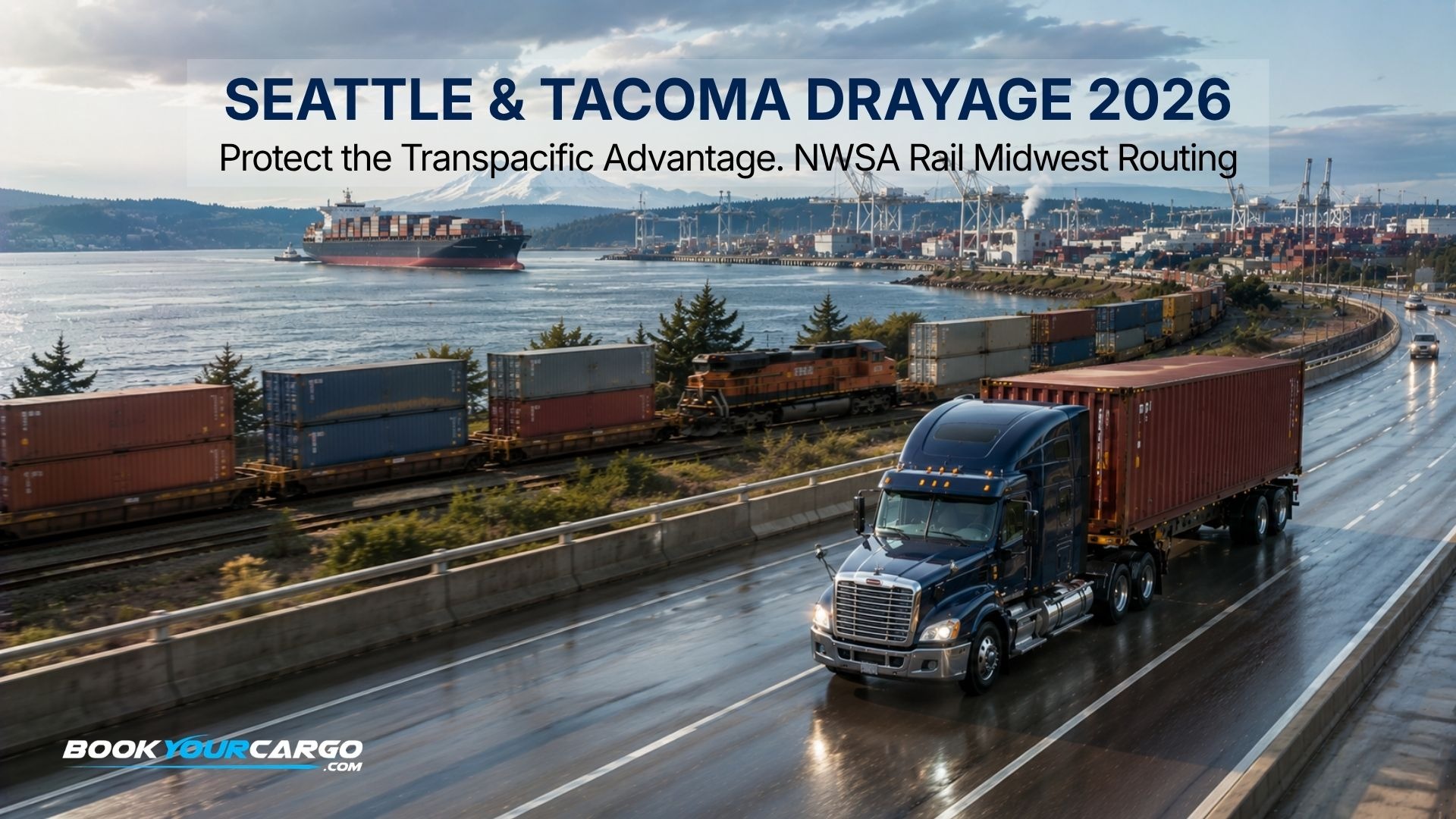
For Transpacific cargo, the Northwest Seaport Alliance holds an advantage no other U.S. gateway can claim: it is the closest point on the mainland to Asia. The seaports of Seattle and Tacoma, combined into a single cargo gateway in 2015, offer the shortest sailing time from the major Asian origin ports, which for time-sensitive Transpacific freight is a structural head start measured in days. Pair that with naturally deep-water harbors, the second-largest concentration of distribution centers on the West Coast, and strong intermodal rail to the Midwest, and the Seattle and Tacoma gateway becomes a serious option for importers who have historically defaulted further south.
This guide is built for the importers and freight forwarders moving Transpacific cargo through the Northwest Seaport Alliance in 2026. It walks through how the two-port alliance structure actually works, why the transit advantage matters for specific cargo, how the Seattle and Tacoma terminals differ for drayage execution, how Pacific Northwest intermodal reaches the Midwest, and the operating disciplines that keep Transpacific freight moving cleanly through the gateway. If you are deciding whether the NWSA fits your Transpacific flow, or already run volume through it, the goal is to give you the drayage playbook for the Puget Sound gateway.
The Northwest Seaport Alliance is a single cargo gateway formed in 2015 by combining the marine cargo operations of the Port of Seattle and the Port of Tacoma in Washington state. It is the sixth-busiest container gateway in the United States and offers the shortest sailing time from Asia of any U.S. mainland port, which is its defining advantage for Transpacific cargo. Drayage moves containers from the Seattle terminals (Terminal 18, Terminal 5, Terminal 30, Terminal 46) and the Tacoma terminals (Husky Terminal, Washington United Terminals, Pierce County Terminal, West Sitcum) to warehouses, distribution centers, and intermodal rail ramps. The gateway connects to the second-largest concentration of distribution centers on the West Coast and provides strong Pacific Northwest to Midwest intermodal rail, including the short Prince Rupert-style Transpacific advantage. For Transpacific importers, the key drayage considerations are the two-port terminal split, the transit-time advantage, and inland rail routing. BookYourCargo is a national drayage company that executes drayage across the Seattle and Tacoma gateway.
What this guide helps you control
- Terminal-specific execution across the Seattle and Tacoma harbors, which operate as one alliance but run distinct terminals.
- How the Transpacific transit advantage translates into a real timing benefit for specific cargo.
- Pacific Northwest to Midwest intermodal routing for cargo bound beyond the regional distribution market.
- Chassis and appointment strategy across a two-port gateway with a North Harbor and a South Harbor.
- Free time and dwell management at a gateway with strong fluidity but real seasonal peaks.
1. How the two-port alliance actually works
The Northwest Seaport Alliance is unusual among U.S. gateways in that it is a genuine merger of two separate ports. In 2015, after years of losing Transpacific market share to nearby British Columbia ports, the Port of Seattle and the Port of Tacoma combined their marine cargo operations into a single port authority, approved by the Federal Maritime Commission and governed jointly by the port commissions of Seattle and Tacoma. The alliance is a separate legal entity from the two ports for contracting and reporting purposes, but it operates the container terminals across both harbors as one commercial gateway.
For an importer, the practical meaning is that the NWSA is one gateway with two geographic halves: the Seattle North Harbor and the Tacoma South Harbor, roughly 30 miles apart on Puget Sound. Ocean carriers call at terminals in both harbors depending on the service, which means a drayage program moving volume across the alliance is often coordinating pickups in two separate harbors with different terminals, different truck guides, and different gate patterns. A drayage provider has to operate cleanly in both, which is the coordination challenge covered in the broader analysis of port drayage.
2. Why the Transpacific transit advantage matters
The single most cited reason to route Transpacific cargo through the Northwest Seaport Alliance is proximity to Asia. Seattle and Tacoma are the closest major container ports on the U.S. mainland to the major Asian origin ports, which gives the gateway the shortest sailing time on Transpacific services. For a great deal of cargo, a day or two of ocean transit is not decisive. But for specific freight, it is:
- Time-sensitive cargo. For goods where speed to market matters, seasonal merchandise, fast-moving consumer goods, or inventory replenishment under tight cycles, the shorter Transpacific transit is a genuine advantage that compounds across a season of sailings.
- Cargo bound for the Pacific Northwest and Midwest. For freight whose final destination is the Pacific Northwest region or the northern Midwest, the combination of shorter ocean transit and efficient inland rail can beat a longer routing through a more southern gateway.
- Alaska and cross-border cargo. The gateway has deep ties to Alaska trade and proximity to the Canadian border, which matters for cargo with those specific destinations.
The transit advantage only converts into a landed-cost advantage if the drayage and inland distribution layer executes cleanly on arrival. A day saved at sea is easily lost to a slow drayage pickup or a missed intermodal connection, which is why the gateway rewards a drayage provider that plans from vessel arrival.
3. The Seattle and Tacoma terminals for drayage execution
The alliance operates container terminals across both harbors, and each behaves as its own operating environment for drayage. A container discharging at a Seattle terminal is a different pickup than one discharging in Tacoma, roughly 30 miles south.
Seattle North Harbor terminals
The Seattle terminals include Terminal 18, the largest container terminal in the Seattle harbor, along with Terminal 5, which has been modernized to handle the largest container vessels, plus Terminal 30 and Terminal 46. Seattle terminals are served by the North Harbor truck guide, with their own gate schedules and appointment behavior.
Tacoma South Harbor terminals
The Tacoma terminals include Husky Terminal, Washington United Terminals, Pierce County Terminal, and West Sitcum Terminal. Tacoma terminals are served by the South Harbor truck guide, and Tacoma is also the anchor for much of the gateway’s intermodal rail activity.
The practical drayage consequence is that a provider serving the NWSA needs vetted carrier capacity in both harbors, with appointment and chassis coordination that reflects each terminal’s behavior. A provider strong only in Seattle leaves an importer exposed on Tacoma volume, and the two harbors do not share a single gate pattern. Chassis start and stop locations, appointment systems, and gate hours all vary, which is exactly the kind of terminal-level detail that separates clean execution from lost free time.
4. Pacific Northwest to Midwest intermodal routing
A large share of cargo landing at the Northwest Seaport Alliance is not destined for the Pacific Northwest regional market at all. It is bound inland, primarily to the Midwest, and the gateway’s intermodal rail is what makes that routing competitive. Containers discharged in the Puget Sound harbors move by rail eastbound to inland markets, most significantly Chicago, the largest inland intermodal hub in North America.
For an importer, this creates the same two-leg intermodal structure that defines any port-to-inland rail move: a short drayage leg at the Puget Sound origin, a long rail leg eastbound, and a rail drayage move at the destination ramp. Much of the gateway’s international intermodal volume moves through the Tacoma terminals, and the efficiency of the origin drayage and rail loading shapes how much of the Transpacific transit advantage survives the inland journey. This is the intermodal discipline covered in the analysis of rail drayage, applied to the Pacific Northwest gateway with the shortest Asia transit.
5. Operating disciplines for Transpacific freight at the gateway
The NWSA is generally a fluid gateway with less congestion than the largest West Coast complex to the south, but Transpacific freight still rewards specific disciplines, particularly around the two-harbor structure and seasonal peaks:
- Plan from vessel arrival across both harbors. Because carriers call at both Seattle and Tacoma depending on the service, a drayage program has to be watching vessel arrivals and capturing appointments in the correct harbor for each vessel, not treating the gateway as a single terminal.
- Coordinate chassis across the two harbors. Chassis start and stop locations differ across the gateway, and a container picked up in one harbor may need to return equipment in a specific location. Managing chassis across the two-harbor geography avoids per diem stacking.
- Protect the transit advantage on arrival. The whole point of the shorter Transpacific transit is speed, so the drayage layer has to be ready to move on arrival rather than letting the container sit, which erodes the advantage the routing was chosen for.
- Manage seasonal peaks and free time. Transpacific volume is seasonal, and while the gateway is generally fluid, peak surges still compress free time. Planning pickups against free time and monitoring holds keeps peak volume moving, which is the discipline of preventing demurrage before it forms covered in
6. Cost control checklist for NWSA Transpacific drayage
A practical scoreboard for importers moving Transpacific cargo through the Seattle and Tacoma gateway. Each line is a place where the transit advantage or landed cost is most often lost, and the action that protects it.
| Risk | What it costs if mismanaged | Action that protects it |
|---|---|---|
| Wrong-harbor dispatch planning | Missed appointments across Seattle and Tacoma | Track vessel calls by harbor, capture appointments in the correct harbor |
| Transit advantage lost on arrival | Days saved at sea wasted at the terminal | Plan drayage from vessel arrival, be ready to move on discharge |
| Chassis mismanaged across two harbors | Per diem stacking on return-location mismatches | Coordinate chassis start and stop locations across the gateway |
| Missed intermodal rail connection | Inland cargo delayed, transit advantage erased | Coordinate origin drayage tightly with rail loading at Tacoma |
| Seasonal peak free time compression | Demurrage during Transpacific peak surges | Plan pickups against free time, monitor holds during peak |
| Single-harbor carrier coverage | Exposure on volume in the other harbor | Use a provider with vetted capacity in both Seattle and Tacoma |
| No visibility across the gateway | Exceptions surfacing late across two harbors | Use live tracking across both harbors and the inland rail leg |
7. How BookYourCargo executes at the Seattle and Tacoma gateway
BookYourCargo is a national drayage company with vetted carrier capacity across the Northwest Seaport Alliance and every major U.S. and Canadian port and rail ramp. For importers moving Transpacific cargo through the Seattle and Tacoma gateway, the operating model is built around the two-harbor structure and the transit advantage:
- Coverage in both harbors. Vetted carrier capacity across the Seattle terminals, including Terminal 18, Terminal 5, Terminal 30, and Terminal 46, and the Tacoma terminals, including Husky Terminal, Washington United Terminals, Pierce County Terminal, and West Sitcum.
- Vessel-arrival planning by harbor. Drayage planning that tracks vessel calls to the correct harbor and captures appointments accordingly, so the Transpacific transit advantage is protected on arrival.
- Intermodal coordination to the Midwest. Coordination of origin drayage with rail loading for cargo bound inland, and destination rail drayage at the inland ramp, so the inland routing keeps the days saved at sea.
- Two-harbor chassis management. Chassis coordination across the gateway’s start and stop locations to avoid per diem stacking on return mismatches.
- Gateway-wide visibility. Live tracking across both harbors and the inland rail leg, with API and EDI integration into the importer or forwarder operating system.
This connects to BYC’s broader national drayage and transloading capabilities, execution runs on the BYC drayage technology platform, and first-party Pacific rate context lives in the monthly BYC Drayage Index, published going back to 2022. Inc. 5000-recognized, BBB Accredited, IANA Member, NCBFAA Member, and WOSB-certified through the U.S. Small Business Administration.
Frequently asked questions about drayage at the Northwest Seaport Alliance
Protect the Transpacific advantage from vessel to final destination
The Northwest Seaport Alliance gives Transpacific cargo the shortest Asia transit on the U.S. mainland, but that advantage only pays off if the drayage layer executes cleanly across two harbors and holds the timing through the inland leg. If you are an importer or freight forwarder moving Transpacific cargo through Seattle and Tacoma in 2026 and want to talk to BYC about how your gateway freight would execute, request a quote.
