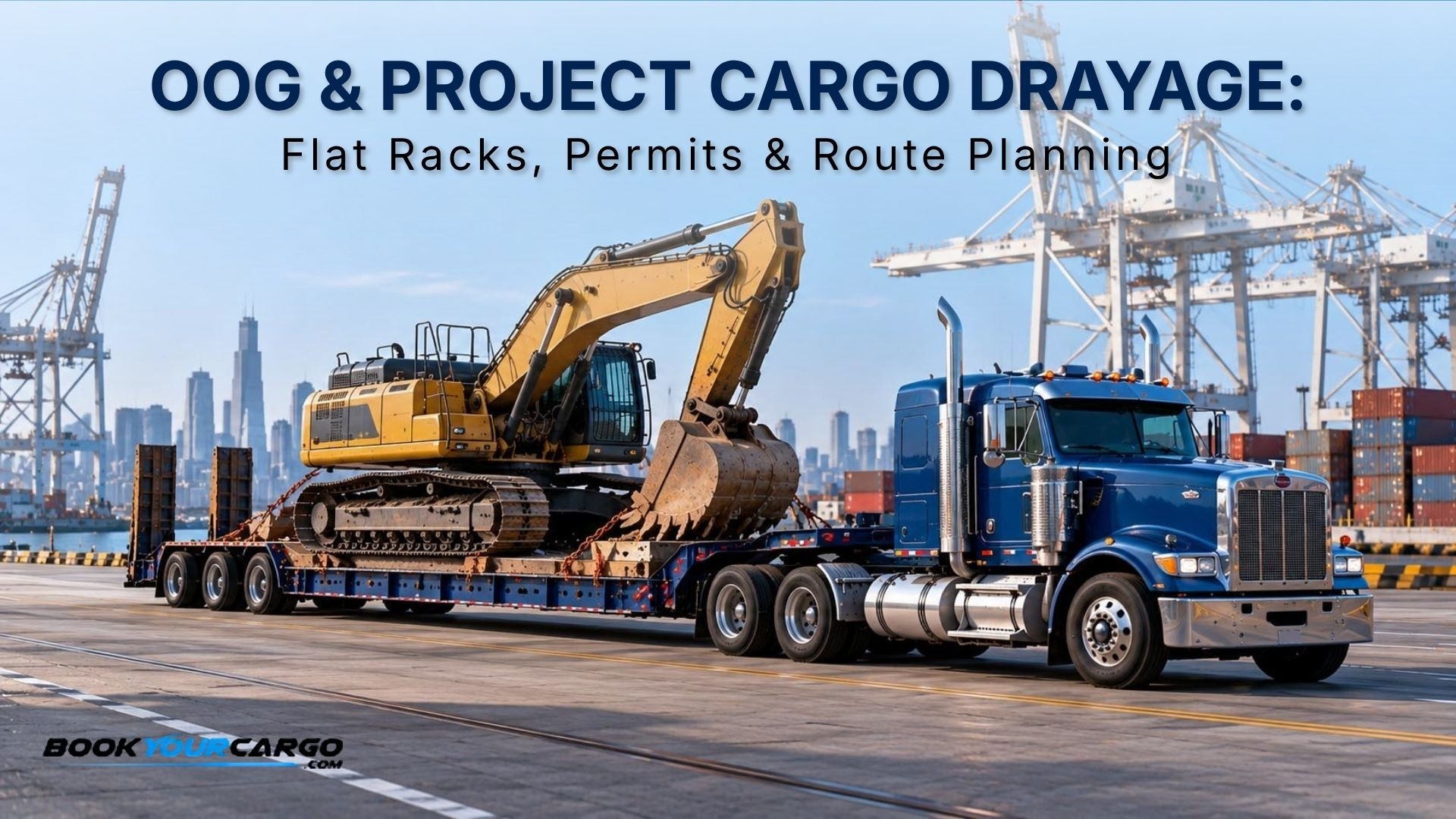
Cargo becomes out-of-gauge when it exceeds the dimensions of the container carrying it, not the weight limit. A piece can sit comfortably inside every federal weight threshold and still be an out-of-gauge move, because the constraint is the shape of the load rather than what it weighs.
That distinction decides almost everything downstream. An overweight container is an equipment and axle problem solved with a tri-axle chassis and a weight permit. An out-of-gauge piece is a clearance problem solved with a route survey, an oversize permit, escort vehicles and in some states a travel-time window. The two problems use different permits, different equipment and different planning horizons, and a programme that treats them as one thing will plan the wrong one.
This guide covers how carriers classify out-of-gauge cargo, what flat racks and open tops actually give you, where the dimensional thresholds sit in federal and state law, when a move needs escorts or a route survey, how curfews constrain delivery windows, and which ports publish genuine project cargo capability.
1. How out-of-gauge cargo is classified
Ocean carriers classify out-of-gauge cargo by which dimension the piece breaks. The categories are not marketing language, they determine how the piece is stowed on the vessel and how many adjacent slots it sterilises, which is why the classification is set at booking rather than discovered at the terminal.
| Classification | Trigger | What it means for the move |
|---|---|---|
| Over-height (OH) | Cargo stands higher than the equipment walls | Open top or flat rack; road clearance becomes the governing constraint |
| Over-width (OW) | Cargo wider than 243.8 cm, the container external width | Flat rack only; triggers oversize width permits and escorts |
| Over-length (OL) | Cargo longer than 1219 cm | Flat rack with end walls lowered and corner castings kept clear |
| Over-width and over-height | Both at once | Maximum sterilised vessel slots and the hardest road permit case |
Those numeric triggers come from ocean carrier special cargo documentation rather than from regulation, and carriers are consistent on them because they derive from the container envelope itself. A standard dry container is 8 feet wide externally, which is where the 243.8 cm over-width threshold comes from.
Measure the piece in all three dimensions plus its packaging, cradle or skid before booking. Cargo is measured as it will travel, not as the drawing shows it, and the cradle is frequently what pushes a legal piece into an over-width classification.
2. What flat racks and open tops actually give you
Out-of-gauge cargo moves on equipment that removes a wall or a roof. The two workhorses are the flat rack and the open top, and they solve different problems.
- Flat rack. A base with a supporting end wall at each end, often collapsible. Because it has no sides and no roof, it accepts cargo that is over-width, over-length or over-height. It is the only option for over-width cargo. End walls can usually be lowered to take over-length pieces, provided the corner castings stay clear.
- Open top. A standard container without a solid roof, closed instead with a reinforced tarpaulin over removable roof bows, with lashing rings inside. It accepts over-height cargo and allows loading by crane from directly overhead, which matters for pieces that cannot be pushed in through a door. A 20-foot open top has a roof opening of roughly 5,338 by 2,230 mm, narrower than the container itself, so the roof opening rather than the internal width is the dimension that governs a crane load.
Payload ratings on this equipment are build-specific and carrier-specific rather than standard. One major carrier publishes a maximum payload of 42,100 kg on its 20-foot flat rack and 49,100 kg on its 40-foot high cube flat rack, while another carrier publishes materially lower figures for leased units and higher figures for its heavy-duty builds. There is no single industry number, so the rating has to be confirmed for the specific unit being booked.
Comparing dry container geometry against the specialised equipment shows why some pieces need it. A standard 20-foot and 40-foot dry container is 8 feet 6 inches high externally, a 40-foot high cube is 9 feet 6 inches, and the door opening on all three is narrower and lower than the internal cross-section. A piece that fits the internal dimensions on paper can still be unable to pass the door.
3. Where the dimensional limits sit in federal law
Federal law sets fewer dimensional limits than most shippers expect, and the gaps are filled by the states.
| Dimension | Federal position | Practical consequence |
|---|---|---|
| Width | 102 inches on the National Network, fixed as both floor and ceiling | States may issue permits above it but cannot set a different baseline |
| Height | No federal limit at all | State limits span 13 feet 6 inches to 14 feet 6 inches |
| Length | Minimum 48 feet for a semitrailer, no federal overall length limit | Overall length is a state question |
The height point is the one that surprises people. There is no federal truck height limit. The Federal Highway Administration publishes only the national range across the states, which runs from 13 feet 6 inches to 14 feet 6 inches. Georgia sets 13 feet 6 inches, while Texas and California both set 14 feet. A piece that clears legally in one state may need a permit the moment it crosses a line, and route planning for an over-height move is therefore a state-sequence exercise rather than a single clearance check.
The federal government does not issue oversize or overweight permits. Permitting is entirely a state function, so a move crossing four states needs four permit determinations, each against that state thresholds, with escort and curfew rules that do not match.
4. When a move needs escorts, a route survey or police
Escort requirements are set state by state, and they scale with how far past legal the piece sits and whether the road is two-lane or divided. Two states publish their thresholds clearly enough to show the pattern.
Texas thresholds
Texas allows 8 feet 6 inches wide and 14 feet high before a permit is required. Above that, escort requirements step up by dimension.
| Condition | Escort requirement |
|---|---|
| Width 14 to 16 feet | One front escort on two-lane roads, or one rear escort on multi-lane |
| Width over 16 feet | Front and rear escorts on all roads |
| Height over 17 feet | Front escort carrying a nonconductive height pole to measure overhead obstructions |
| Height over 18 feet | Front and rear escorts on all roads |
| Length 110 to 125 feet | One front escort on two-lane, or one rear on multi-lane |
| Overhang over 20 feet | Rear escort required |
Exceeding the escort threshold in two dimensions at once triggers both front and rear escorts regardless of road type.
Georgia thresholds and route surveys
Georgia allows 8 feet 6 inches wide and 13 feet 6 inches high, with 100 feet overall length including overhang. Its maximum permittable dimensions are 16 feet wide and 18 feet high.
- Width 12 feet to 16 feet requires front and rear escorts on two-lane roads, rear only on four-lane and limited access.
- Width over 16 feet is determined case by case, and the state may require a police escort with operating blue lights.
- Height of 15 feet 6 inches or greater requires a front escort carrying a height sensor.
A route survey is required for any load over 12 feet wide, over 13 feet 6 inches high, over 100 feet long, or over 100,000 pounds. Loads beyond 15 feet 11 inches wide, 15 feet 5 inches high or 125 feet long must specify exact beginning and ending junctions.
California takes a different structural approach, requiring a single trip permit above 8 feet 6 inches wide, 14 feet high, 80 feet long or 80,000 pounds, and a written route survey for any height greater than 17 feet. Loads above 15 feet wide, 17 feet high or 135 feet long move into a separate variance permit process with its own review.
5. Curfews and travel windows
An oversize permit grants the right to move the piece. It does not grant the right to move it whenever the truck is ready, and the travel window is frequently the binding constraint on a delivery promise.
There is no federal curfew for permit loads, because there is no federal permit. The restrictions are state-level and they are specific. Georgia permits movement from thirty minutes after sunrise to thirty minutes before sunset, bans oversize movement on I-285 around Atlanta between 6 and 9 in the morning and 4 and 6 in the evening on weekdays, prohibits movement in fog, snow or ice, and closes entirely on New Year Day, Memorial Day, Independence Day, Labor Day, Thanksgiving and Christmas. California applies metropolitan curfews to loads exceeding 10 feet wide in the Los Angeles, Sacramento, San Diego and San Francisco areas.
A daylight-only restriction combined with a holiday closure and a metropolitan peak-hour ban can remove more delivery days from a week than the permit takes to obtain. Build the travel calendar before promising a delivery date, not after the permit is issued.
Because the window is narrow, a missed terminal appointment on an out-of-gauge pickup is more expensive than on a standard container. The next available slot has to coincide with a legal travel window, an escort crew and a permit that is still valid, and those four things do not realign quickly.
6. Where out-of-gauge meets overweight
Many project pieces are both oversized and heavy, and the two problems have to be solved separately because they are governed separately. Dimensional relief comes from an oversize permit, escorts and a surveyed route. Weight relief comes from axle configuration, specialised chassis and a weight permit.
A piece that is dimensionally legal but heavy is handled as overweight container drayage, where the governing tests are gross vehicle weight and individual axle group limits rather than clearance. Where a piece breaks both, the permits stack, the equipment has to satisfy both constraints at once, and the route has to clear overhead while also crossing bridges rated for the axle loading.
Overweight and tri-axle drayage capability is therefore a prerequisite for most genuine project work rather than a separate service line, because the heavy and the oversized arrive together.
7. Ports with published project cargo capability
Project cargo capability is a facility question before it is a trucking question. Not every container terminal can lift, lay down and stage an oversized piece, and the ports that can tend to publish the specifics.
| Port | Published capability |
|---|---|
| Port Houston | Describes itself as the largest breakbulk, steel and project cargo complex in North America, across eight facilities including the Turning Basin, Jacintoport and Manchester, with laydown areas adjacent to the general cargo and heavy lift docks and 36 acres of short-term storage at berths 32A and 32B. Handles wind turbine components and blades. |
| Port of New Orleans | More than 13,500 feet of berthing across six dedicated breakbulk terminals, 1.6 million square feet of transit shed, with rail spurs and inland barge access for oversized loads. |
| Port of Baltimore | Heavy lift cranes rated to 200 metric tons, on-dock transit sheds, two Class I railroads with on-dock service, and a local trucking base that includes specialised heavy haulers. |
| PhilaPort, Tioga Marine Terminal | 116 acres with six berths and 3,822 linear feet, a mobile harbour crane rated to 114 short tons, and roughly 734,500 square feet of warehousing across five buildings. |
| Port of Lake Charles | 25 acres of open space at the City Docks for project cargo, over a mile of contiguous berthing, handling wind blades and tower components alongside petrochemical and forest products. |
Houston is the deepest project cargo market in the country, and Port Houston overweight and project cargo moves have their own corridor and permit pattern. On the Atlantic side, Baltimore autos, machinery and breakbulk drayage runs on the heavy lift cranes and on-dock rail rather than on container gantries, which changes how a piece is received and staged.
8. When transloading beats permitting
Not every oversized piece should move as an oversized piece. Where cargo is over-height or over-length because of how it was loaded rather than because of its own geometry, breaking it down and reloading can turn one permitted move with escorts into two legal moves with neither.
Transloading is the right call when the piece can be separated without damage or recertification, when the destination sits in a state with a low height limit, when the route crosses several states with mismatched escort rules, or when the travel window is too narrow to deliver on time. It is the wrong call when the piece is a single indivisible unit, when disassembly voids a warranty or requires a manufacturer technician, or when the handling risk exceeds the permit cost.
The honest test is whether the piece is genuinely indivisible. Carriers and permitting authorities both treat indivisibility as the justification for oversize relief, and a load that could reasonably be broken down is a weaker permit case than one that could not.
9. What to confirm before booking an out-of-gauge move
- Measured dimensions of the piece as it will travel, including cradle, skid and packaging, in all three axes.
- Weight and the weight distribution across the base, because an oversized piece is frequently also an axle problem.
- Equipment type and the specific payload rating of the unit offered, confirmed rather than assumed from a published range.
- Every state the route crosses, with that state height limit, escort thresholds, route survey trigger and curfew.
- Whether the destination can receive and offload the piece, including crane or forklift capacity and site access.
- Permit lead time per state, and whether any state requires exact junction-level routing.
- Escort crew availability on the intended travel dates, since escorts and permits are booked separately.
Visibility matters more on these moves than on standard containers, because a single missed window cascades. Real-time container tracking on a permitted move is the difference between rebooking an escort crew a day ahead and discovering the problem at the gate.
Frequently Asked Questions
Out-of-gauge cargo exceeds the dimensions of the container carrying it, while overweight cargo exceeds a legal weight threshold. They are separate problems with separate solutions. Out-of-gauge is a clearance problem addressed with an oversize permit, a surveyed route and escort vehicles. Overweight is a load distribution problem addressed with specialised chassis, axle configuration and a weight permit.
A piece can be one, the other, or both. Where it is both, the permits stack and the route has to clear overhead obstructions while also crossing bridges rated for the axle loading, which is a materially harder planning problem than either constraint alone.
Ocean carriers classify cargo as out-of-gauge when it breaks the container envelope in any direction. Over-width means wider than 243.8 cm, which is the external width of a standard container. Over-length means longer than 1219 cm. Over-height means the cargo stands higher than the equipment walls. Cargo that is both over-width and over-height sterilises the most vessel slots and is the hardest road permit case.
The measurement that matters is the piece as it will actually travel, including its cradle, skid and packaging. A cradle is frequently what pushes an otherwise legal piece into an over-width classification, which is why the measurement should be taken before booking rather than at the terminal.
There is no federal truck height limit. The Federal Highway Administration publishes only the range across the states, which runs from 13 feet 6 inches to 14 feet 6 inches. Georgia sets 13 feet 6 inches, while Texas and California both set 14 feet.
This makes over-height routing a state-sequence exercise rather than a single clearance check. A load that travels legally in one state can require a permit the moment it crosses into the next, so the height determination has to be made against every state on the route.
The states do. The federal government does not issue oversize or overweight permits at all, and the Federal Highway Administration states plainly that permitting is a state option. Federal regulation fixes the 102-inch width baseline on the National Network and expressly preserves state authority to permit above it.
The practical consequence is that a move crossing four states needs four separate permit determinations, each against that state own thresholds, with escort requirements and curfew rules that do not match from one state to the next.
It depends on the state and on how far past legal the piece sits. In Texas, a width of 14 to 16 feet requires one escort, over 16 feet requires front and rear escorts on all roads, and a height over 17 feet requires a front escort carrying a nonconductive height pole. In Georgia, width over 16 feet is assessed case by case and may require a police escort with operating blue lights, and a height of 15 feet 6 inches or more requires a front escort with a height sensor.
Route surveys follow the same state-by-state pattern. Georgia requires one for any load over 12 feet wide, over 13 feet 6 inches high, over 100 feet long or over 100,000 pounds. California requires a written route survey for any height greater than 17 feet.
Transload when the piece can be separated without damage or recertification, when the destination sits in a state with a low height limit, when the route crosses several states with mismatched escort rules, or when the legal travel window is too narrow to deliver on time. In those conditions two legal moves are usually cleaner than one permitted move with escorts.
Permit the move when the piece is a single indivisible unit, when disassembly would void a warranty or require a manufacturer technician, or when the handling risk of breaking it down exceeds the cost and complexity of permitting. Indivisibility is also the justification permitting authorities expect, so a genuinely indivisible piece is a stronger permit case.
