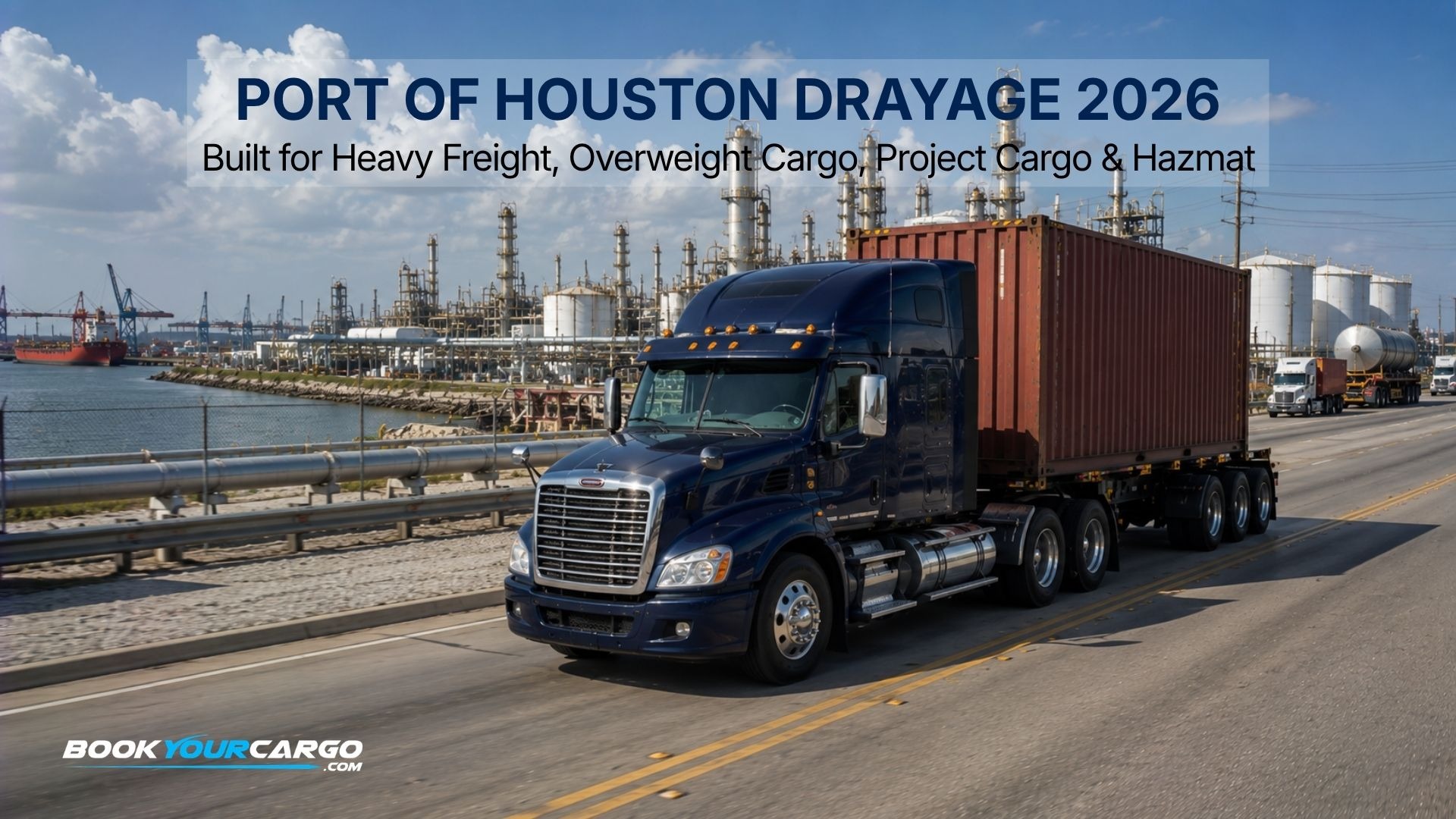
The Port of Houston is not a retail port that happens to handle some industrial freight. It is an industrial gateway that happens to handle retail freight. Houston sits at the center of the largest petrochemical complex in the United States, moves more waterborne tonnage than any other U.S. port, and has been the fastest-growing major container port in the country over the past decade, compounding container volume at roughly 7.2 percent a year, about twice the rate of the next-fastest port. What makes Houston distinctive for a drayage program is not just the volume. It is the nature of the cargo: resin and plastics for export, project and heavy-lift pieces for energy infrastructure, overweight containers loaded to Gulf industrial density, and chemical and hazmat freight that most retail-oriented drayage networks are not built to handle.
This guide is built for the energy, petrochemical, project cargo, and heavy-freight importers and exporters moving through Houston in 2026. It walks through why Houston freight is heavier and more specialized than the typical containerized import, how overweight and tri-axle drayage actually works at the Gulf, how resin export logistics shape the outbound flow, the permitting and corridor realities of moving heavy containers out of Barbours Cut and Bayport, and the operating disciplines that keep specialized Gulf freight moving. If you are running energy, project, or overweight cargo through Houston, the goal is to give you the drayage playbook that matches the weight and complexity of what you actually ship.
The Port of Houston is the largest petrochemical gateway in the United States and the busiest U.S. port by waterborne tonnage, handling containerized cargo through two terminals: Barbours Cut Container Terminal and Bayport Container Terminal. Houston drayage is distinctive because a large share of its freight is heavier and more specialized than typical retail imports: resin and plastics for export, project and heavy-lift cargo for the energy sector, overweight containers loaded to industrial density, and chemical and hazmat freight. Moving this cargo requires tri-axle and specialized chassis, overweight permitting for Texas highways, corridor knowledge of routes like State Highway 146 and State Highway 225, and carriers credentialed for hazmat and heavy haul. For energy, petrochemical, and project cargo shippers, the key drayage capabilities are overweight and tri-axle equipment, resin export coordination, and hazmat-certified capacity. BookYourCargo is a national drayage company that handles overweight, project, and specialized Gulf freight at the Port of Houston.
What this guide helps you control
- Overweight container drayage from Barbours Cut and Bayport, where Gulf industrial cargo routinely exceeds standard weight limits.
- Resin and plastics export logistics, where Houston is a global hub and the outbound flow has its own timing and packaging realities.
- Project and heavy-lift cargo movement for energy infrastructure that standard container drayage cannot handle.
- Overweight permitting and corridor routing on Texas highways, including the freight corridors serving the port.
- Hazmat and chemical freight handling that requires credentialed carriers and specialized equipment.
1. Why Houston freight is heavier and more specialized
Most containerized import gateways are dominated by consumer goods: furniture, apparel, electronics, household products. Houston handles plenty of that, and its retail import volume is growing, but the port’s identity is anchored in industry. The Houston Ship Channel is lined with the largest petrochemical complex in the nation, and the cargo profile reflects it. Three characteristics make Houston drayage different from a retail-oriented port:
- Weight. Industrial and petrochemical cargo is dense. Resin, chemicals, machinery, steel, and project components load containers to weights that routinely exceed standard over-the-road limits, which means overweight and tri-axle drayage is a core capability at Houston, not an occasional exception.
- Specialization. Project and heavy-lift cargo for energy infrastructure, out-of-gauge pieces, hazmat and chemical freight, and flat-rack and open-top loads all move through Houston in volume, and each requires equipment and carrier credentials that standard dry-van drayage does not.
- Export orientation. Unlike import-dominated retail gateways, Houston has a massive export flow, particularly resin and plastics, which means the drayage program has to manage loaded exports to the terminal against vessel cut-offs, not just imports off the vessel.
The practical consequence is that a drayage provider serving Houston has to be built for weight and specialization from the ground up. This is the capability set covered in the analysis of overweight and out-of-gauge drayage, applied to the most industrial container gateway in the country.
2. The Houston container terminals and freight corridors
Port Houston operates two dedicated container terminals along the Houston Ship Channel, both of which handle the overweight and specialized freight that defines the Gulf. The terminals connect to the industrial hinterland through a specific set of freight corridors that shape every drayage move.
- Barbours Cut Container Terminal. Located at Morgan’s Point, Barbours Cut opened in 1977 as the first container terminal in Texas and remains a premier Gulf container facility, with 300 acres of container yard, six berths, and 29 truck gates. Port Houston is investing $650 million in Barbours Cut improvements between 2023 and 2027.
- Bayport Container Terminal. Located in Pasadena, Bayport opened in 2006 and has expanded steadily, with new wharf capacity and rubber-tired gantry cranes added through 2025 and 2026 to support Houston’s record container growth.
- State Highway 146 and State Highway 225. These are the key freight corridors connecting Barbours Cut and Bayport to regional distribution centers, petrochemical facilities, and inland markets. Corridor knowledge matters more for overweight loads, where routing is constrained by bridge and axle-weight limits.
The completion of the Port-led segments of the Houston Ship Channel Expansion, known as Project 11, removed longstanding nighttime vessel movement restrictions and improved transit flexibility, supporting the port’s continued growth. For the drayage layer, the terminals’ gate efficiency and the corridor network are what determine how cleanly heavy freight moves, which connects to the broader discipline of port drayage execution.
3. How overweight and tri-axle drayage works at the Gulf
Overweight drayage is the defining Houston capability. A standard container move assumes the loaded container plus chassis stays within legal over-the-road gross weight limits. Gulf industrial cargo routinely does not, which means the move requires specialized equipment and permitting that standard drayage does not carry.
Tri-axle and specialized chassis
A tri-axle chassis adds a third axle to distribute the load across more points, raising the legal weight the combination can carry on the highway. For heavy Gulf containers, tri-axle chassis are frequently the difference between a legal single move and having to partially unload the container. Specialized chassis, including those configured for heavy or out-of-gauge loads, extend the capability further. A Houston drayage provider without a tri-axle and specialized chassis fleet simply cannot move a large share of the port’s freight legally.
Overweight permitting
Moving an overweight container on Texas highways requires permits, and the permit defines the legal route, which is constrained by bridge ratings and axle-weight limits along the corridor. Permitting is not a formality; the wrong route on an overweight load is a legal and safety problem. Strong Houston drayage providers handle overweight permitting as part of the service and know which corridors and routes accept which weights.
4. Resin and plastics export logistics
Houston is one of the world’s major hubs for resin and plastics export, and this shapes the drayage program in a way that import-dominated ports never encounter. The petrochemical complex along the ship channel produces resin in enormous volume, much of it destined for export markets, and moving that resin from packaging facilities to the terminal is a drayage flow in its own right.
Resin export drayage has specific characteristics. The cargo is dense, so overweight and tri-axle equipment often applies. The flow is outbound to the terminal against vessel cut-off times, so the timing discipline is the mirror image of import drayage: instead of racing the free time clock off the vessel, the program is racing the export receiving deadline and Earliest Return Date window to the terminal. And resin is frequently transloaded from bulk or bagged form into containers at packaging facilities, which means the drayage provider is often coordinating with transload and packaging operations. This is where a transload-integrated drayage operation matters, because the resin export flow connects packaging, transload, and terminal delivery into one sequence.
5. Project cargo, heavy-lift, and hazmat freight
Beyond overweight containers and resin, Houston moves cargo that pushes past standard containerized logistics entirely.
- Project and heavy-lift cargo. Energy infrastructure generates oversized, over-height, and over-length pieces that move on flat-rack, open-top, or breakbulk equipment. These moves require route surveys, specialized trailers, and often escorts, and they are planned individually rather than dispatched as routine drayage.
- Out-of-gauge containers. Cargo that exceeds the internal dimensions of a standard container moves on flat-rack or open-top equipment, which changes securing, routing, and permitting requirements compared to a standard box.
- Hazmat and chemical freight. The petrochemical complex generates significant hazmat volume, which requires carriers with hazmat authority, drivers with hazmat endorsements, proper placarding and documentation, and emergency response planning. A drayage provider moving Houston chemical freight has to be credentialed for it, not just willing to try.
The common thread across all three is that Houston rewards a drayage provider built for complexity. A carrier network that can only move standard dry containers leaves a large share of Houston freight unserved, which is why specialized capability is a core requirement at the Gulf rather than a premium add-on.
6. Cost and compliance checklist for Houston specialized drayage
A practical scoreboard for energy, petrochemical, and project cargo shippers moving freight through the Port of Houston. Each line is a place where specialized Gulf freight most often runs into cost or compliance trouble, and the action that prevents it.
| Risk | What it costs if mismanaged | Action that prevents it |
|---|---|---|
| Overweight container on standard chassis | Illegal move, partial unload, or refused dispatch | Verify weight before dispatch, match to tri-axle or specialized chassis |
| Wrong route on overweight permit | Legal and safety exposure, fines, delay | Use a provider that handles permitting and knows corridor weight limits |
| Resin export missing the cut-off | Rolled cargo, missed vessel, storage | Plan export drayage against receiving deadline and ERD window |
| Hazmat without proper credentials | Refused load, compliance violation, liability | Use hazmat-certified carriers with endorsed drivers and documentation |
| Project cargo dispatched as routine drayage | Failed move, damage, safety incident | Plan heavy-lift and out-of-gauge moves individually with route surveys |
| No specialized equipment availability | Freight stranded when tri-axle or flat-rack is needed | Use a provider with a genuine tri-axle and specialized chassis fleet |
| No visibility across a mixed heavy program | Exceptions surfacing late on complex freight | Use live tracking across imports, resin exports, and project moves |
7. How BookYourCargo handles specialized Gulf freight at Houston
BookYourCargo is a national drayage company with vetted carrier capacity at the Port of Houston and across every major U.S. and Canadian port and rail ramp. For energy, petrochemical, project cargo, and heavy-freight shippers, the operating model is built around the weight and specialization that Houston freight demands:
- Overweight and tri-axle drayage. Access to tri-axle and specialized chassis for heavy Gulf containers out of Barbours Cut and Bayport, with overweight permitting handled as part of the service.
- Resin export coordination. Drayage that manages the outbound resin and plastics flow against export receiving deadlines, integrated with transload and packaging operations where the cargo requires it.
- Project, heavy-lift, and out-of-gauge capability. Specialized equipment and individually planned moves for energy infrastructure cargo that standard drayage cannot handle.
- Hazmat-credentialed capacity. Carriers with hazmat authority, endorsed drivers, and proper documentation for the chemical and petrochemical freight that defines the Gulf.
- Mixed-program visibility. Live tracking across imports, resin exports, and specialized moves, with API and EDI integration into the shipper or forwarder operating system.
This connects to BYC’s broader overweight and tri-axle drayage and national drayage capabilities, execution runs on the BYC drayage technology platform, and first-party Gulf rate context lives in the monthly BYC Drayage Index, published going back to 2022. Inc. 5000-recognized, BBB Accredited, IANA Member, NCBFAA Member, and WOSB-certified through the U.S. Small Business Administration.
Frequently asked questions about drayage at the Port of Houston
Move heavy Gulf freight with a drayage company built for the weight
Houston freight is heavier, more specialized, and more export-oriented than the typical containerized import, and it rewards a drayage company built for overweight, project, and hazmat cargo rather than one that treats specialized freight as an exception. If you are an energy, petrochemical, project cargo, or heavy-freight shipper moving through the Port of Houston in 2026 and want to talk to BYC about how your specialized Gulf freight would execute, request a quote.
