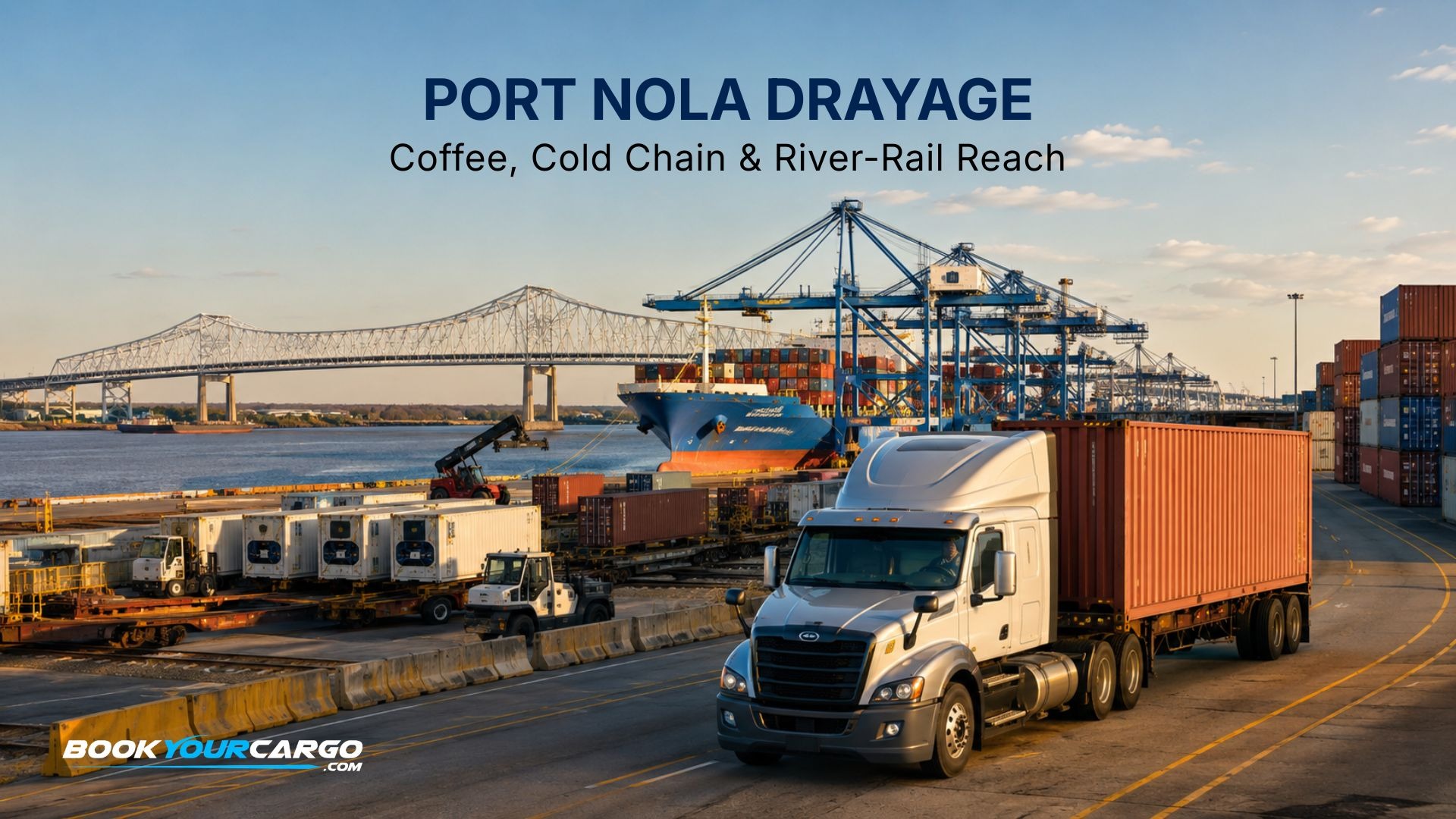
On August 17, 2026, the U.S. Army Corps of Engineers granted the federal permit authorizing construction of the Louisiana International Terminal, a $1.8 billion project described by the Port of New Orleans as the nation’s only new greenfield container port currently under development and the first new container terminal on the Gulf Coast in nearly twenty years. For shippers who have written New Orleans off as a small container gateway, that permit is a reason to look again, and to understand why the port has been constrained in the first place.
New Orleans has never been short on connectivity. It is the only container port in Louisiana; it sits on the Lower Mississippi with access to roughly 14,500 miles of inland waterways, and it is served by six Class I railroads, more than any other Gulf gateway. What it has lacked is the ability to take the largest ships, because its container terminal sits upriver of a bridge with an air-draft restriction. This guide covers the port as it operates today, the cargo mix that makes its drayage genuinely distinctive, the constraint that has capped it, what the new terminal changes and on what timeline, and the disciplines that govern container drayage on the Lower Mississippi.
The Port of New Orleans, known as Port NOLA, is the only container port in Louisiana and a diverse general cargo gateway on the Lower Mississippi River. Container operations run through the Napoleon Avenue Container Terminal complex, which has an annual capacity of about 1 million TEUs with eight gantry cranes, served by terminal operators including New Orleans Terminal and Ports America, with the Mississippi River Intermodal Terminal adjacent for container transfer. Port facilities include roughly 40 berths and more than 3.1 million square feet of covered storage. Containerized cargo includes coffee, plastics, apparel, food products, and consumer merchandise, alongside breakbulk steel, non-ferrous metals, rubber, wood, and paper. Refrigerated cargo moves through the Henry Clay Avenue Refrigerated Terminal and Jourdan Road facilities, with more than 900 refrigerated plugs available and dockside blast freezers capable of freezing meat products to 0 degrees Fahrenheit within 24 hours. The Napoleon Avenue terminal sits upriver of the Crescent City Connection bridge, whose air-draft restriction limits vessel size. The Louisiana International Terminal, a $1.8 billion project in Violet, St. Bernard Parish, received its federal permit in August 2026 and would sit downriver of the bridge, removing that restriction. BookYourCargo is a national drayage company operating at New Orleans and across every major U.S. and Canadian port and rail ramp.
What this guide helps you control
- Whether New Orleans fits your lane today, given the current vessel size constraint.
- Cargo-specific handling for coffee, breakbulk, and refrigerated freight, which dominate the port’s mix.
- Multimodal routing across six Class I railroads, barge, and highway from a single gateway.
- What the Louisiana International Terminal changes, and on what realistic timeline.
- Hurricane and river-condition contingency specific to a Lower Mississippi gateway.
1. The connectivity case: six railroads and 14,500 miles of waterway
New Orleans occupies a position no other U.S. container gateway holds. The convergence is genuine rather than promotional:
- Six Class I railroads. Port NOLA is served by six Class I railroads, which is more than any other Gulf gateway and gives inland-bound cargo carriers choice that single-railroad or dual-railroad ports cannot match. The Port also works with the New Orleans Public Belt Railroad, which in May 2026 announced a technology partnership with the port focused on planning and routing oversized cargo through the rail network.
- Roughly 14,500 miles of inland waterways. The Mississippi River system connects the port by barge to the agricultural and industrial interior, which is a mode most container gateways simply do not have. Barge is slow but inexpensive and high-capacity, and for the right commodity it changes the inland cost structure.
- Four interstate systems. Highway access supports regional distribution and the truck legs that connect barge and rail movements to final destinations.
- Only container port in Louisiana. For Louisiana and lower Mississippi Valley cargo, New Orleans is the local gateway rather than one option among several, which shortens the inland leg materially compared with routing through more distant Gulf or East Coast ports, a routing calculation covered in the analysis of the next port cycle.
For a drayage program, multimodality is the defining feature. A container arriving at New Orleans can leave by truck, by rail on any of six networks, or by barge, and the drayage layer is what connects the terminal to whichever mode the cargo takes.
2. The container and cargo facilities today
Port NOLA is a diverse general cargo port rather than a container-only gateway, and its facilities reflect that. Overall, the port includes roughly 40 berths, about 20 million square feet of cargo-handling area, and more than 3.1 million square feet of covered storage.
- Napoleon Avenue Container Terminal. The port’s container complex is a modern deep-draft facility, with an annual capacity of approximately 1 million TEUs and eight gantry cranes. Terminal operators including New Orleans Terminal and Ports America provide stevedoring and transloading services.
- Mississippi River Intermodal Terminal. A container transfer facility adjacent to the Napoleon Avenue complex, which shortens the connection between the container terminal and rail.
- Refrigerated terminals. Perishable cargo moves in breakbulk or containerized form through two dockside refrigerated warehouses at Henry Clay Avenue and Jourdan Road, operated by New Orleans Cold Storage. Dockside blast freezers can freeze meat products to 0 degrees Fahrenheit within 24 hours, and more than 900 refrigerated plugs are available across the port’s facilities.
- Breakbulk facilities. Located upriver, downriver, and on the Inner Harbor, handling the steel, non-ferrous metals, rubber, wood, and paper that form a significant share of the port’s volume.
The mixed profile matters operationally. A provider serving New Orleans has to handle standard containers, refrigerated freight, and breakbulk pieces, which is a broader equipment and handling requirement than a container-only gateway imposes, and closer to the port drayage model BYC runs at other mixed-cargo gateways.
3. The cargo mix: coffee, cold chain, and breakbulk
New Orleans handles containerized coffee, plastics, apparel, food products, and consumer merchandise, alongside breakbulk steel, non-ferrous metals, rubber, wood, and paper. Three of these shape drayage more than the others.
Coffee
Green coffee is a signature New Orleans commodity, and it comes with handling requirements closer to dried fruit and nuts than to general merchandise. Green coffee is moisture-sensitive and travels in dry containers, so container cleanliness and dryness matter; condensation during transit and dwell is a genuine cargo risk, and the freight typically moves from the terminal to bonded or licensed warehousing rather than direct to a consumer distribution center. A drayage provider handling coffee is coordinating with warehouse receiving schedules and inventory systems, not simply delivering a box.
Refrigerated and frozen
With more than 900 refrigerated plugs and dockside blast freezing, New Orleans handles meaningful perishable and frozen volume, particularly protein. The drayage disciplines are the ones that govern any cold chain move: continuous power from terminal plug through the drayage leg on a gen-set, temperature monitoring and documentation, and prompt movement into refrigerated storage. The advantage here is that the cold storage sits dockside, which shortens the exposure window considerably.
Breakbulk and project pieces
Steel, metals, rubber, wood, and paper move as pieces and bundles rather than containers, which requires flatbed, step-deck, and specialized trailer capability plus commodity-appropriate securement. A carrier network limited to chassis cannot serve a significant portion of this port’s volume, and oversized moves benefit from the rail routing coordination the port and the Public Belt Railroad have been developing.
4. The bridge constraint and the Louisiana International Terminal
The single fact that has shaped New Orleans container strategy is geographic. The Napoleon Avenue Container Terminal sits upriver of the Crescent City Connection bridge, and the bridge imposes an air-draft restriction on vessels calling the terminal. As container ships have grown, that restriction has increasingly capped the size of vessels the port can serve, with Port NOLA leadership noting that ships calling the current terminal carry on the order of 7,000 containers.
What the new terminal is
The Louisiana International Terminal is a $1.8 billion project planned for Violet, in St. Bernard Parish, roughly 17 to 18 miles downriver of the bridge, which removes the air-draft restriction entirely and provides naturally deep water with direct Gulf access. It is being developed as a public-private partnership: Louisiana International Terminal Holdings LLC, the joint venture expected to operate the terminal, was formally incorporated in March 2026 with Port NOLA, Ports America, and Terminal Investment Limited as partners. The design is intended to handle two ultra-large container vessels simultaneously, with the port indicating capability for vessels far larger than those the current terminal can accept, and to connect to six Class I railroads, four interstate systems, and the inland waterway network.
What it means on a realistic timeline
The August 2026 federal permit authorizes construction rather than completing it. Construction is anticipated to begin as early as 2026, with exact dates subject to final planning and community engagement, and operational readiness has been projected within a five- to seven-year window. For a shipper planning current-year freight, the practical position is that New Orleans remains the gateway it is today, with the vessel size constraint intact, while the new terminal is a medium-term structural change worth factoring into multi-year network planning rather than a near-term routing option.
5. Hurricane and river contingency on the Lower Mississippi
New Orleans carries the Gulf risk profile, and the 2026 season has already illustrated it: both named Atlantic storms to date formed in the Gulf, and one made landfall in St. Bernard Parish, the same parish where the new terminal is planned. A New Orleans drayage program needs contingency built in rather than added later.
- Tropical closures follow the standard sequence. Operations restrict, vessel movements suspend, terminals secure equipment, and gates close, with the pre-landfall window being the only period in which cargo can still be pulled. Priority containers should be identified before a system is named.
- Inland flooding is a distinct risk. Tropical rainfall damage extends well beyond the coast, and river-adjacent corridors can be affected even when the terminal itself reopens quickly.
- River conditions matter here uniquely. Because barge is a genuine mode at New Orleans, high water, low water, and ice on the upper river system can affect inland movements in ways that do not apply at a coastal-only gateway.
- Free time during closures should be documented. Relief is never automatic and depends on terminal, carrier, contract terms, and the applicable rules, but closure periods and affected containers recorded contemporaneously support a materially stronger claim, which is the discipline covered in No-Surprises Drayage.
6. Cost and execution checklist for New Orleans drayage
A practical scoreboard for importers, exporters, and forwarders moving cargo through Port NOLA.
| Risk | What it costs if unmanaged | Action that prevents it |
|---|---|---|
| Equipment mismatched to mixed cargo | Breakbulk or reefer freight a container-only carrier cannot move | Confirm dry, reefer, and flatbed capability before award |
| Moisture damage on coffee | High-value moisture-sensitive cargo compromised | Supply clean, dry, sound containers and move promptly to warehousing |
| Cold chain gap on protein | Temperature excursion and rejected delivery | Verify gen-set function, monitor temperature, use the dockside cold storage advantage |
| Mode chosen by habit | Paying truck rates where rail or barge would serve | Evaluate six-railroad and barge options against the destination per lane |
| Vessel size assumption | Routing planned around capability the current terminal does not have | Plan against today’s bridge constraint, treat the new terminal as multi-year |
| No tropical contingency | Cargo committed to the full recovery cycle | Rank priority containers and arrange alternate coverage before the season |
| Closure periods undocumented | Demurrage accepted for a period nobody could move cargo | Record suspension and reopening times and affected containers as events happen |
7. How BookYourCargo executes at Port NOLA
BookYourCargo is a national drayage company with vetted carrier capacity at New Orleans and across every major U.S. and Canadian port and rail ramp, which matters at a mixed-cargo, multimodal gateway where one program can span three equipment types and three modes.
- Mixed-equipment coverage. Dry container capacity for coffee and consumer goods, reefer-capable equipment with gen-sets for protein and perishables, and flatbed and step-deck capability for steel, metals, and breakbulk.
- Multimodal coordination. Drayage connecting the Napoleon Avenue complex and the Mississippi River Intermodal Terminal to six Class I railroads, barge operations, and highway distribution, with destination rail drayage handled at the inland ramp.
- Cargo-specific handling. Clean, dry, sound containers for moisture-sensitive coffee, continuous cold chain and temperature documentation for refrigerated freight, and commodity-appropriate securement for breakbulk, with transload and warehousing support.
- Gulf contingency. Priority-ranked pre-landfall execution during tropical events, alternate gateway coverage across the Gulf and East Coast, and closure documentation to support free time relief.
- Full visibility. Live tracking from vessel discharge through delivery with API and EDI integration, delivered on the BYC drayage technology platform.
Delivered through BYC’s national drayage network, with first-party Gulf rate context published monthly in the BYC Drayage Index going back to 2022. Inc. 5000-recognized, BBB A+ rated, IANA Member, NCBFAA Member, and WOSB-certified through the U.S. Small Business Administration.
Frequently asked questions about drayage at the Port of New Orleans
Use the gateway for what it actually is
New Orleans is not a scaled-down version of a larger container port. It is a multimodal general cargo gateway with a distinctive cargo book, unmatched inland connectivity, a real vessel size constraint today, and a permitted project that will change that constraint over the coming years. Shippers who route to it deliberately, matching cargo and mode to what the port does well, get more from it than shippers who evaluate it on TEU volume alone. If you move freight through Port NOLA and want to talk to BYC about how your cargo would execute, request a quote.
