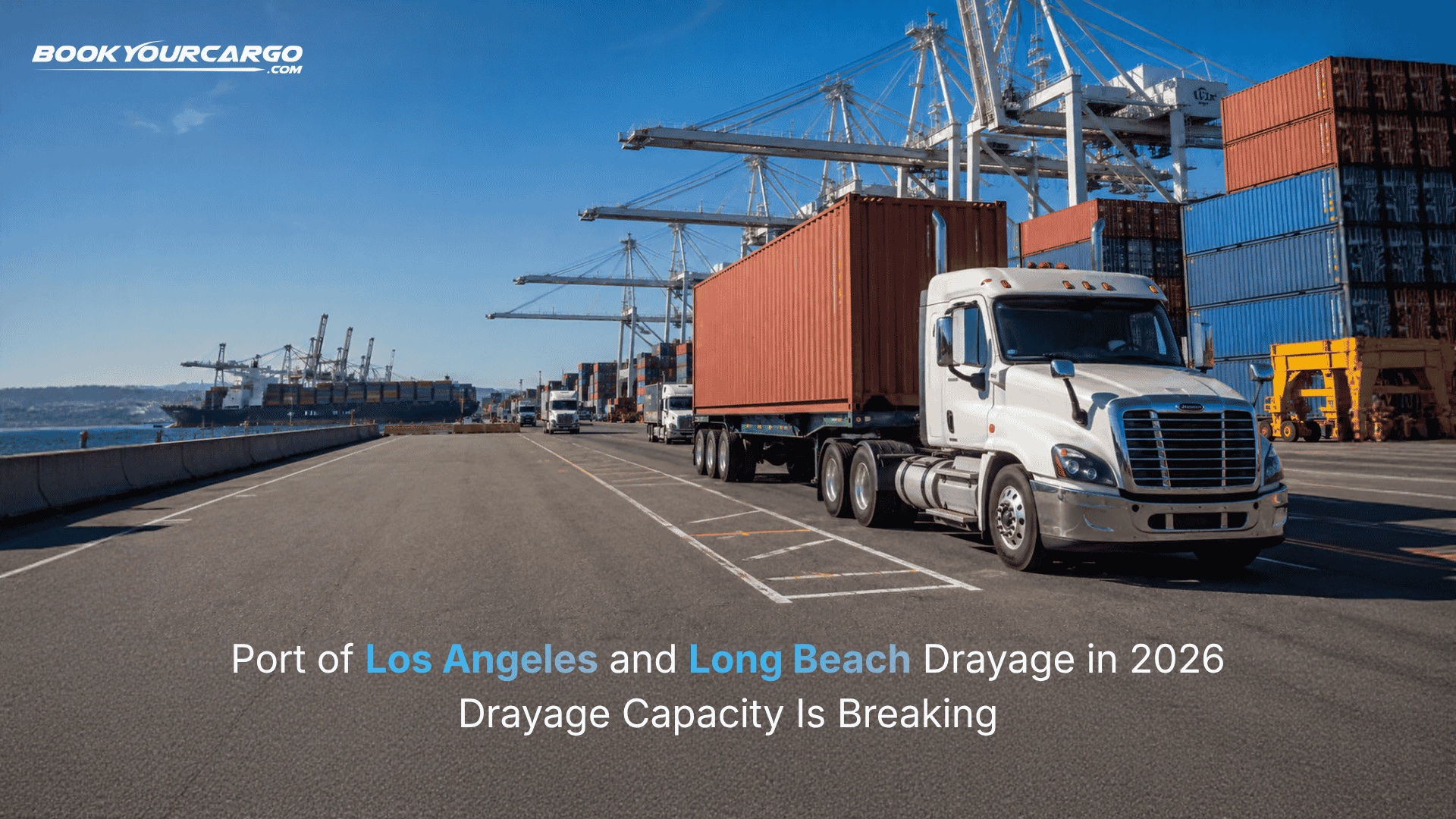
Drayage at the Ports of Los Angeles and Long Beach is the short-haul truck movement of ocean containers between the thirteen marine terminals of the San Pedro Bay complex and nearby warehouses, transload yards or inland rail ramps. In 2026, what a move costs is driven by terminal congestion, appointment availability, chassis days, whether the consignee can receive live, and the distance to the delivery point.
Two fees are specific to these ports: the PierPass Traffic Mitigation Fee, which funds extended gate hours, and the Clean Truck Fund Rate, which applies when a conventional drayage truck hauls the container. On top of those sit chassis days, fuel surcharge, and any demurrage or per diem that forms after free time expires.
The single most important operational change this year: chassis operations moved from the Pool of Pools to a new neutral pool structure effective July 1, 2026, which alters availability, billing and equipment collection points across the complex.
Drayage at the Ports of Los Angeles and Long Beach is where landed cost is either protected or quietly lost. A small misalignment on appointment timing, chassis availability, hold management or free time can turn what should have been a clean container move into a stack of demurrage, detention and per diem charges that nobody priced into the booking.
This guide is built for the operational reality of the San Pedro Bay complex as it stands in September 2026. It covers what a move actually costs, the fee stack behind the rate, all thirteen terminals and how they differ, the free time and hold pressure points that create most avoidable spend, the chassis structure that changed in July, and the capacity risks reshaping reliability. If you move containers through LA or Long Beach, the goal is to give you what you need to avoid surprise costs and missed appointments, not simply to describe how the complex works.
1. What drives drayage cost at the Port of Los Angeles and Long Beach
Cost questions are the most common thing importers ask about San Pedro Bay, and the honest answer is that a drayage rate is shaped by distance, equipment, timing and terminal conditions rather than being a fixed number. Two containers moving the same twenty miles on the same day can price very differently depending on which terminal they sit at, whether the consignee can receive live, and how much chassis time the move consumes.
The table below sets out what actually moves the number for each common move type at San Pedro Bay, and the lever that controls it. Understanding these drivers is more useful than a static figure, because the drivers are what you can influence.
| Move type | What drives the cost | The lever you control |
|---|---|---|
| Local, inside the LA basin Carson, Wilmington, Compton, Long Beach |
Terminal congestion, live unload versus drop and pick, appointment availability | Secure appointments early; choose drop and pick where dock reliability is poor |
| Inland Empire Ontario, Fontana, Mira Loma, Moreno Valley |
Round-trip driver time, chassis days, I-710 and SR-60 congestion | Model chassis exposure before booking; evaluate transloading on repeat volume |
| Greater Los Angeles County | Distance from terminal, delivery window flexibility | Widen receiving windows where possible to improve capacity access |
| Overweight and tri-axle | Specialised chassis, overweight permit, route restrictions | Confirm loaded weight before dispatch rather than at the terminal gate |
| Reefer and temperature controlled | Genset, plug-in time, priority handling | Plan plug availability and prioritise these containers in the pickup queue |
| Hazmat and placarded | Endorsed driver, documentation, terminal hazmat procedure | Verify driver credentials and placarding before the truck is dispatched |
| Pre-pull to off-dock yard | Yard storage duration | Usually cheaper than terminal demurrage when the consignee cannot receive before LFD |
| Long inland runs Phoenix, Las Vegas and beyond |
Priced as line haul rather than drayage | Transload usually wins; model against break-even mileage |
Because these variables move week to week with vessel bunching, chassis conditions and gate behaviour, lane-specific pricing is returned on request rather than published as a static figure. For a specific origin and destination, request a drayage quote and every fee is itemised upfront. For regional spot-market direction over time, the BYC Drayage Index publishes monthly rate trends going back to 2022.
2. The LA and Long Beach drayage fee stack
A drayage rate at San Pedro Bay is never a single number. It is a stack of base trucking, port-specific surcharges, equipment charges and exposure to penalty fees. Knowing what sits in that stack is the first step to controlling it.
| Fee layer | Who sets it | What importers should know in 2026 |
|---|---|---|
| Base drayage rate | Drayage carrier | Driver, tractor and base move. Varies by lane density, container size, and live unload versus drop pull. |
| PierPass Traffic Mitigation Fee | PierPass under WCMTOA | Flat per-container fee funding extended terminal gate hours, charged on non-exempt loaded import and export containers at a published per-TEU rate with a higher rate for FEU and other non-TEU sizes. Reviewed and adjusted annually each August, so confirm the current schedule at booking. |
| Clean Truck Fund Rate | Port of LA and Port of Long Beach | Cargo owners pay a published per-container rate when the move is hauled by a conventional drayage truck, with a higher rate for containers larger than one TEU. Zero-emission trucks are exempt. Eligible low-NOx trucks have a temporary exemption to December 31, 2027. Each port collects its own rate. |
| Chassis usage | Chassis pool or equipment provider | Daily charge from equipment out to equipment in. The largest quiet cost line, and it changed structurally in July 2026. |
| Chassis split | Carrier and equipment provider | Charged when container and chassis sit at different locations, requiring a separate trip. |
| Alameda Corridor fee | Alameda Corridor Transportation Authority | Applies to containers moving via the Alameda Corridor rail line to downtown Los Angeles intermodal yards. |
| Pre-pull or off-dock yard | Carrier and yard operator | Optional fee that prevents worse fees downstream. Usually cheaper than a single day of terminal demurrage. |
| Demurrage and per diem | Terminal and steamship line | Per-day penalties beginning once free time expires. The single largest avoidable cost in San Pedro Bay drayage. |
| Fuel surcharge | Drayage carrier | Indexed to California ULSD pricing, structurally above the national average due to CARB fuel blend requirements. |
The penalty layer is the one importers most often accept without challenge, and it is the one with the most room to push back. Federal rules govern what a demurrage and detention invoice must contain and how quickly it must be issued, and an invoice that fails either test can eliminate the obligation to pay it. Upstream of any dispute, demurrage prevention is an operational discipline rather than an accounting one, decided by when the container is planned rather than when the charge appears.
3. All thirteen terminals at Los Angeles and Long Beach
The San Pedro Bay complex is served by thirteen container terminal facilities across the two ports. Each sets its own appointment release windows, chassis acceptance rules, dual-transaction policies and weekend gate schedule, which is why a Port of LA move and a Port of Long Beach move can behave completely differently on the same day. Knowing which terminal your container has grounded at is the first planning input, not a detail.
| Port | Terminal | Operator | Drayage note |
|---|---|---|---|
| Los Angeles | APM Terminals (Pier 400) | APM Terminals | Largest LA facility; heavy volume drives appointment scarcity at peak |
| Los Angeles | Fenix Marine Services (Pier 300) | Fenix Marine Services | Adjacent to Pier 400; separate appointment system |
| Los Angeles | Everport Terminal Services | Everport | Transpacific services; check dual-transaction eligibility |
| Los Angeles | TraPac LA | TraPac LLC | Automated yard operations affect turn-time patterns |
| Los Angeles | Yusen Terminals (YTI) | Yusen Terminals LLC | Own gate schedule; confirm weekend availability |
| Los Angeles | West Basin Container Terminal (CSP) | China Shipping berth group | Berth-group naming varies; confirm facility before dispatch |
| Los Angeles | West Basin Container Terminal (TiL) | Terminal Investment Limited | Separate berth group at the same facility |
| Long Beach | Long Beach Container Terminal (Pier E) | LBCT LLC | Highly automated; distinct appointment behaviour |
| Long Beach | Total Terminals International (Pier T) | TTI | Large Long Beach facility; plan appointments early |
| Long Beach | International Transportation Service (Pier G) | ITS | Own gate and chassis acceptance rules |
| Long Beach | Pacific Container Terminal (Pier J) | SSA Marine | Check dual-transaction policy before planning empty return |
| Long Beach | SSA Terminals (Pier A) | SSA Marine | Separate SSA facility from Pier J; do not assume shared rules |
| Long Beach | Matson Terminal (Pier C) | SSA Marine / Matson services | Service-specific; confirm vessel assignment |
A drayage provider that does not model terminal behaviour hour by hour will burn free time on moves that should have been clean. Reliable port drayage at San Pedro Bay depends on treating each terminal as its own operating environment rather than a uniform pickup point.
One development worth tracking: the Port of Long Beach has been building a Universal Trucking Appointment System intended to let motor carriers schedule across all six of its marine terminals, with the expectation of eventually extending across the complex. Until that is fully live, appointment management remains a terminal-by-terminal exercise, and a provider watching one portal will miss slots that a provider monitoring all thirteen will capture.
4. Free time, Last Free Day and how demurrage actually forms
Free time is the period a container can sit at the terminal after discharge before demurrage begins. The Last Free Day (LFD) is the deadline before those charges start. The Earliest Return Date (ERD) controls when an empty can be returned against an export booking. These three windows govern almost every avoidable cost in import drayage at San Pedro Bay.
Published free time at the complex typically runs four to seven calendar days, set by the steamship line rather than the port. Usable free time is shorter. Once appointment availability, terminal congestion, weekend gate patterns and any holds are counted, a shipper working with published free time of five days may have three genuinely workable days. A shipper who treated free time as five business days in 2018 is operating in a materially tighter environment now.
The second clock most importers miss
Container per diem runs alongside terminal demurrage and is charged by the steamship line on the equipment itself until the empty is returned. It does not stop when the container leaves the terminal. A box that clears the gate cleanly and then waits three days at a consignee has stopped accruing demurrage but is still accruing per diem, and at San Pedro Bay the chassis day runs alongside both. Monitoring only the clock that triggers first is how importers get surprised by an invoice they thought they had avoided.
Where the consignee cannot receive before LFD, a pre-pull to an off-dock yard is usually the cheapest defence available. It converts terminal demurrage exposure into controlled yard dwell at a fraction of the daily cost, and it removes the container from the terminal before the clock runs out. Catching that window depends on real-time container tracking that carries hold status, free time and equipment position together, because an exposure spotted on the invoice is an exposure spotted too late.
5. Customs and steamship line holds at San Pedro Bay
A hold is the most common reason a container sits through its Last Free Day with nobody realising until the charges appear. The container is physically on the ground and visibly available, but it is not legally or commercially free to move. Free time keeps running throughout.
- Customs holds. U.S. Customs and Border Protection may place a container under examination, which routes it to a centralised examination station. Exam queues at San Pedro Bay can run several days at peak, and the free time clock does not pause while the container waits.
- Steamship line holds. Applied for unpaid freight, missing documentation, or outstanding charges on other containers in the same account. These usually clear quickly once identified, which is exactly why early detection matters.
- Terminal holds. Applied for outstanding terminal charges or operational reasons specific to the facility.
- Bonded and in-bond movements. Containers moving under bond from San Pedro Bay carry their own documentation requirements, and an in-bond move that is not correctly established will not release.
The practical defence is monitoring hold status per container continuously rather than checking at dispatch. A hold discovered at the terminal gate has already cost a wasted trip, a burned appointment slot and a day of free time. A hold discovered three days earlier is usually just a phone call.
6. Chassis at San Pedro Bay and what changed in July 2026
Chassis is the most underestimated cost driver in LA and Long Beach drayage. Importers see a clean base rate and then ask why the invoice carries a per-diem stack. The answer is usually chassis days.
Chassis at San Pedro Bay are supplied by third-party intermodal equipment providers rather than by the ocean carriers, which exited equipment provision more than a decade ago. Under the Ocean Shipping Reform Act, motor carriers and shippers can exercise chassis choice and select the provider supplying the equipment when the cargo interest pays, though exercising that choice requires upstream coordination and a carrier who actively manages the provider relationship.
The July 2026 pool transition
Chassis operations in San Pedro Bay changed structure effective July 1, 2026, moving away from the long-standing Pool of Pools arrangement to a new neutral pool structure. The Pool of Pools had operated as a shared gray pool among the major equipment providers, allowing broad interoperability across terminals in the complex.
For a drayage program the consequences are practical rather than theoretical:
- Availability assumptions need rechecking. Equipment reliably obtainable under the prior arrangement may now be sourced differently, and availability can vary by terminal during the transition.
- Billing and equipment locations may differ. Chassis days are charged from equipment out to equipment in, so a change in where equipment is collected or returned changes the cost of an identical move.
- Provider knowledge matters more than usual. A provider tracking pool changes as they happen routes around friction that a provider working from prior practice simply absorbs and passes on.
7. Clean Truck Program rules and the Port Drayage Truck Registry
The San Pedro Bay Clean Air Action Plan targets 100 percent zero-emission drayage trucks by 2035, funded primarily through the Clean Truck Fund Rate. The rules that matter operationally in 2026:
- Every drayage truck calling at a San Pedro Bay terminal must be enrolled in the Port Drayage Truck Registry. A non-registered truck does not enter the terminal, which makes registry status a prerequisite rather than paperwork.
- The Clean Truck Fund Rate is charged per loaded container when hauled by a conventional drayage truck, at a published per-TEU rate with a higher rate for larger containers. Each port collects its own rate.
- Zero-emission trucks are permanently exempt. Eligible low-NOx trucks have a temporary exemption expiring December 31, 2027.
- Both ports continue releasing voucher and incentive funding through CALSTART and the California HVIP program, with rounds open through 2026.
A point on the state-level picture, because the two frameworks are frequently conflated. Port access is governed by the ports' own Clean Truck Program and truck registry. The California Air Resources Board Advanced Clean Fleets High Priority and Drayage requirements sit separately, and CARB has stated those requirements are currently not being enforced while related rulemaking continues. That does not remove port-access obligations, and importers should verify the current CARB position rather than plan capacity against a mandate not presently in force.
Importers cannot opt out of the Clean Truck Fund Rate, because it is a tariff charge on loaded containers passing through the terminal. The lever importers do have is selecting providers with registry-compliant capacity across the complex.
8. Overweight, hazmat and bonded containers at San Pedro Bay
Not every container moving out of LA and Long Beach is a standard dry box, and the exceptions carry their own equipment, permitting and credential requirements.
Overweight containers
Heavy boxes leave the San Pedro Bay terminals on overweight and tri-axle drayage equipment, and loads above standard highway limits require a permit defining a compliant route constrained by bridge and axle ratings. Long Beach also operates designated overweight corridor arrangements for specific short movements near the harbour. California weight enforcement is strict, so the loaded weight should be confirmed before dispatch and matched to equipment rather than discovered at the gate.
Hazmat and placarded containers
Placarded containers require a driver holding a hazardous materials endorsement, correct four-sided placarding matching the shipping papers, and emergency response information travelling with the shipment. Terminals frequently handle hazmat containers in designated areas with their own gate procedures, so the standard pickup process does not apply and an unfamiliar carrier loses time discovering that.
Bonded and in-bond moves
Containers moving under bond from San Pedro Bay to an inland destination or another port require the in-bond movement to be correctly established before the container will release. This is a documentation dependency rather than an equipment one, and it is a common source of unexplained delay when handled late.
9. Transloading versus direct drayage from Los Angeles and Long Beach
San Pedro Bay is the highest-leverage transloading region in the United States. Off-dock facilities in Carson, Wilmington, Compton, Mira Loma and the Inland Empire West can receive ocean containers within hours of pickup, unload, and reload freight into 53-foot domestic trailers for inland distribution. Two questions decide whether transloading wins.
Is the inland destination beyond break-even mileage? Above roughly 1,500 to 1,800 miles inland, transloading beats direct drayage on cost per cube delivered, because a 53-foot domestic trailer carries materially more freight than a 40-foot marine container. This is why a Phoenix or Las Vegas destination is normally priced as line haul after a transload rather than as a drayage move.
Is chassis or free time exposure the binding constraint? When chassis supply is tight or LFD is approaching, moving cargo out of the ocean container at an off-dock yard ends chassis and demurrage exposure quickly, even where direct delivery would otherwise be the obvious choice.
Both questions resolve at the same place: an off-dock transloading facility close enough to the terminal to receive the container the same day it is pulled. Containers continuing inland by rail rather than by truck instead move under rail drayage at the destination ramp, which shifts the cost structure again.
10. Three capacity pressures reshaping San Pedro Bay in 2026
The FMCSA non-domiciled CDL rule
The FMCSA non-domiciled CDL rule tightened driver credentialing after its March 16, 2026 effective date and is projected to remove a substantial number of drivers from the U.S. CDL pool. Non-domiciled holders have been concentrated in port drayage at LA and Long Beach, Oakland and the New York metro area, so the drayage capacity effect is not evenly distributed. It lands hardest in exactly the lanes import-heavy supply chains rely on, and hardest of all on the small operators who make up most of the drayage fleet, many running one to five trucks with no compliance team to absorb rapid documentation requirements.
Red Sea and Hormuz routing disruption
Routing disruption continues to influence bunker markets, vessel routing and service reliability across trade lanes. For San Pedro Bay the practical risk is reduced predictability rather than a clean shift in volume. Longer rerouted transits and shifting carrier scheduling translate into less predictable arrival behaviour at the gate, putting more pressure on appointment, chassis and free time planning.
Carrier alliance restructuring
Alliance restructuring through 2025 and 2026 has produced different vessel arrival patterns, terminal allocations and berthing windows for many trade lanes. A shipper running clean drayage out of one terminal twelve months ago may now encounter a different operator entirely for the same service. Providers tied to one or two terminals are exposed, while national drayage coverage absorbs a reallocation without the shipper having to renegotiate capacity mid-season.
11. Cost control checklist for LA and Long Beach drayage
A practical importer-side scoreboard. Each line is where money is most often lost on San Pedro Bay moves, and the action that prevents it. Taken together they also form the working definition of the best drayage company in Los Angeles and Long Beach, which is not the cheapest quote but the operation that closes each of these gaps before it costs anything.
| Risk | What it costs if mismanaged | Action that prevents it |
|---|---|---|
| Free time expiration | Terminal demurrage from LFD, escalating daily | Plan pickup against vessel discharge and LFD before the container grounds |
| Undetected hold | Container stuck through LFD with no warning | Monitor customs, line and terminal holds continuously, not at dispatch |
| Chassis dwell | Daily charges accruing until equipment return | Convert chassis dwell into yard dwell with a pre-pull when delivery is delayed |
| Chassis pool change | Unexpected billing or collection point changes after July 2026 | Reconfirm current chassis arrangements rather than assuming continuity |
| Missed terminal appointment | Lost slot, next-day reschedule, compressed free time | Monitor appointment release across all thirteen terminals |
| Non-registered truck | Refused at gate, burned appointment, rebooking cost | Confirm carriers operate Port Drayage Truck Registry equipment |
| Empty return restriction | Per diem on equipment that cannot be returned | Track return availability by carrier and terminal before dispatch |
| Wrong routing decision | Overpaying on cube for distant inland destinations | Model inland mileage and chassis exposure before booking |
| Single-carrier dependence | No-truck days during volatile capacity cycles | Use redundant vetted capacity at every San Pedro Bay terminal |
| Manual status chasing | Hours per day lost to portals and email | Push milestones directly into your TMS or ERP via API or EDI |
Frequently asked questions
Get LA and Long Beach drayage moving without the fee stack catching you off guard
San Pedro Bay drayage is too operationally dense to manage with a transactional dispatch model. The complex rewards providers who plan from vessel arrival, monitor every free time and hold window automatically, and absorb capacity volatility through a redundant carrier network.
Request an instant drayage quote or talk to BYC operations about how your LA and Long Beach moves would execute on the platform.
