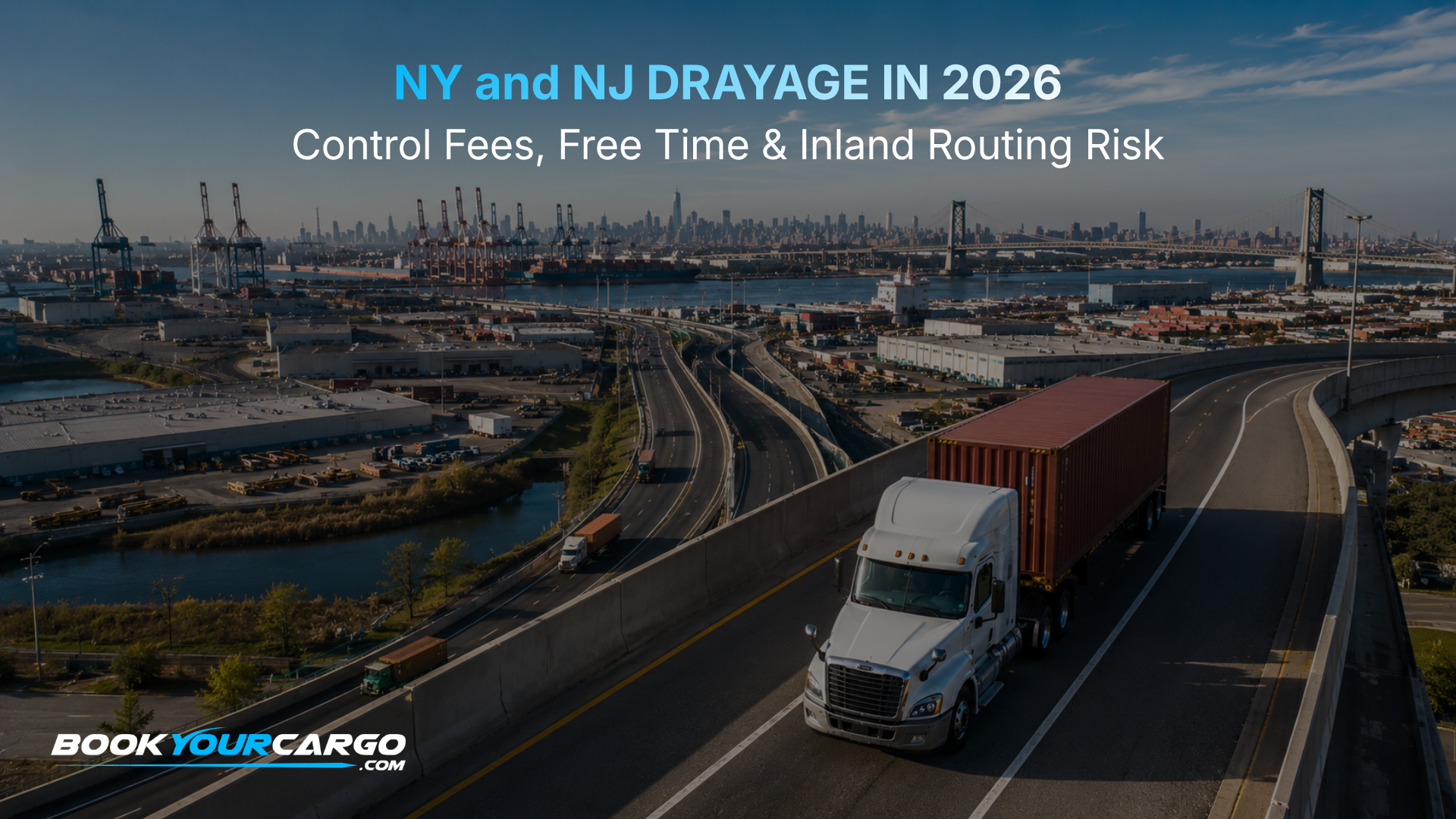
Drayage at the Port of New York and New Jersey is the short-haul truck movement of ocean containers between the six marine terminals of the harbour and nearby warehouses, deconsolidation facilities or inland rail ramps. The port is the busiest container gateway on the U.S. East Coast and has handled record volumes in recent years, and its six terminals sit across two states with separate gate systems, separate chassis arrangements and separate empty return rules.
What makes New York and New Jersey different from any other U.S. gateway is not scale alone. It is that a single container frequently carries freight for many consignees. The harbour handles a heavy share of consolidated NVOCC and co-loaded cargo, which means one delayed container does not affect one customer. It affects every house bill inside it.
Drayage here is where landed cost is either protected or quietly lost. A misread appointment window, an undetected customs hold, or an empty return that gets refused at the gate turns a clean container move into a stack of demurrage, per diem and chassis charges that nobody priced into the booking, and on consolidated freight that stack is multiplied across every house bill on the manifest.
This guide is written for the importers, freight forwarders and NVOCCs moving containers through Port Newark, Port Elizabeth, Bayonne, Staten Island and Brooklyn in 2026. It covers the six terminals and how they differ, what actually drives cost, how the appointment system governs pickup, the free time and hold pressure points that create most avoidable spend, how chassis works in the harbour, and what changes when the container is consolidated rather than single-consignee.
1. The six container terminals at the Port of New York and New Jersey
The harbour is administered by the Port Authority of New York and New Jersey, but the container terminals are run by separate operators, each with its own gate schedule, appointment behaviour, chassis acceptance rules and empty return policy. Knowing which terminal your container has grounded at is the first planning input, not a detail.
| Terminal | Location | Operator | Drayage note |
|---|---|---|---|
| APM Terminals Elizabeth | Elizabeth, NJ | APM Terminals | High-throughput facility; appointment scarcity at peak |
| Maher Terminals | Port Elizabeth, NJ | Maher Terminals | One of the largest operators in the harbour by volume |
| Port Newark Container Terminal (PNCT) | Newark, NJ | PNCT | Direct I-95 and NJ Turnpike access; own gate system |
| Port Liberty Bayonne (formerly GCT Bayonne) | Bayonne, NJ | Port Liberty | Deep-water berths; rebranded from GCT, both names still in use |
| Port Liberty New York (formerly GCT New York) | Staten Island, NY | Port Liberty | Howland Hook facility; rail connectivity, separate state |
| Red Hook Container Terminal | Brooklyn, NY | Red Hook | Smallest of the six; serves Brooklyn and Long Island directly |
Two practical points follow. First, the Global Container Terminals facilities at Bayonne and Staten Island were rebranded as Port Liberty, so both names appear in booking documents and terminal notices, and a dispatch built around one name can miss a notice published under the other. Second, three of the six terminals sit in New York State and three in New Jersey, which affects routing, tolls and driver hours in ways that do not apply at a single-state complex. Reliable port drayage in this harbour depends on treating each terminal as its own operating environment.
2. What drives drayage cost at the Port of New York and New Jersey
A drayage rate in this harbour is shaped by which terminal the container sits at, how far the delivery point is across a congested metropolitan road network, how much chassis time the move consumes, and whether the consignee can receive live. Two containers moving the same distance on the same day can price very differently.
| Cost driver | What moves it | The lever you control |
|---|---|---|
| Terminal and gate conditions | Appointment availability, gate hours, turn times at the specific facility | Capture appointments from vessel discharge rather than container availability |
| Delivery distance and traffic | Metropolitan congestion, bridge and tunnel routing, toll exposure | Widen receiving windows; consider off-peak delivery where the facility allows |
| Chassis days | Time from equipment out to equipment in, driven by consignee dwell | Use drop and pick where dock reliability is poor; pre-pull when delivery is delayed |
| Live unload versus drop and pick | Driver waiting time against equipment dwell | Match the choice to actual dock reliability, not habit |
| Specialised equipment | Tri-axle for overweight, genset for reefer, endorsed driver for hazmat | Confirm the requirement before dispatch, not at the gate |
| Empty return conditions | Restricted or redirected return locations | Confirm the approved return point before the loaded move |
| Free time exposure | Demurrage, per diem and chassis clocks running together | Plan the whole cycle backward from Last Free Day |
Because these variables move week to week with vessel bunching, gate behaviour and chassis conditions, lane-specific pricing is returned on request rather than published as a static figure. For regional spot-market direction over time, the BYC Drayage Index publishes monthly rate trends going back to 2022.
3. Appointments and gate access in the harbour
Terminal access at New York and New Jersey runs on appointment systems and a truck credentialing programme, and both are prerequisites rather than preferences. A truck without valid credentials does not enter, and a container without a secured appointment does not move regardless of available trucking capacity.
The operational consequence is that the appointment, not the truck, is usually the scarce resource. Slot inventory is released on terminal-specific schedules and consumed quickly during peak periods. A provider monitoring release windows across all six terminals continuously will capture slots that a provider checking one portal once a day will never see. Because each facility runs its own system, appointment management here is a six-environment exercise rather than a single login.
Ask a prospective provider two questions. How is appointment release monitored across the six terminals, and what happens when a slot is lost. The answers separate an operation that plans from one that reacts.
4. Free time, Last Free Day and how demurrage forms
Free time is the period a container can sit at the terminal after discharge before demurrage begins. The Last Free Day is the deadline before those charges start. The Earliest Return Date controls when an empty can be returned against an export booking. These three windows govern almost every avoidable cost in import drayage here.
Published free time is set by the steamship line rather than the port, and usable free time is always shorter than published free time. Once appointment scarcity, weekend gate patterns, winter weather closures and any holds are counted, a container with five published days may have three genuinely workable ones.
The second clock most importers miss
Container per diem runs alongside terminal demurrage and is charged by the steamship line on the equipment itself until the empty is returned. It does not stop when the container leaves the terminal. A box that clears the gate cleanly and then waits three days at a consignee has stopped accruing demurrage but is still accruing per diem, and the chassis day runs alongside both. Monitoring only the clock that triggers first is how importers get surprised by an invoice they believed they had avoided.
Federal rules govern what a demurrage and detention invoice must contain and how quickly it must be issued, and an invoice failing either test can eliminate the obligation to pay it. Upstream of any dispute, demurrage prevention is an operational discipline rather than an accounting one, decided by when the container is planned rather than when the charge appears.
5. Customs holds and why containers sit past Last Free Day
A hold is the most common reason a container sits through its Last Free Day with nobody realising until the charges appear. The box is physically on the ground and visibly available, but it is not legally or commercially free to move, and free time keeps running throughout.
- Customs holds. U.S. Customs and Border Protection may place a container under examination, routing it to a centralised examination station. Exam queues run several days at peak and the free time clock does not pause while the container waits.
- Steamship line holds. Applied for unpaid freight, missing documentation or outstanding charges on other containers in the same account. These usually clear quickly once identified, which is exactly why early detection matters.
- Terminal holds. Applied for outstanding terminal charges or operational reasons specific to the facility.
- In-bond movements. Containers moving under bond carry their own documentation requirements, and an in-bond move not correctly established will not release.
The defence is monitoring hold status per container continuously rather than checking at dispatch. A hold found at the terminal gate has already cost a wasted trip, a burned appointment and a day of free time. Catching it three days earlier is usually just a phone call, which is why real-time container tracking that carries hold status alongside free time and equipment position is worth more here than a dashboard that reports position alone.
6. Chassis in the New York and New Jersey harbour
Chassis is the most underestimated cost driver in harbour drayage. Importers see a clean base rate and then ask why the invoice carries an equipment stack. The answer is usually chassis days.
Chassis here are supplied by third-party equipment providers rather than by the ocean carriers, which exited equipment provision more than a decade ago. Availability, acceptance and return rules differ by terminal, and equipment that is readily obtainable at one facility may require a separate collection trip at another. A chassis split, where the container and the chassis sit at different locations, adds a leg, driver time and a fee to an otherwise standard move.
The controllable variable is dwell. Chassis days are charged from equipment out to equipment in, so the fastest reduction available is usually a conversation with the consignee about receiving speed rather than with the carrier about rates. Where a facility cannot unload promptly, a pre-pull to a nearby yard converts equipment exposure into cheaper controlled dwell.
7. What changes when the container is consolidated
A large share of harbour volume is consolidated freight moving under an NVOCC house bill structure, and this changes the economics of every decision above. On single-consignee cargo, a delay affects one customer. On a co-loaded container, the same delay affects every house bill inside it, and the service failure is reported by each consignee separately.
- Deconsolidation timing becomes the constraint. The container has to reach the CFS or deconsolidation facility while there is still capacity to strip it, and a missed window pushes every house bill to the next available slot.
- Free time exposure is concentrated. One container reaching Last Free Day is a single demurrage charge, but it is a service failure repeated across every customer on the manifest.
- Exception communication multiplies. A hold on a consolidated container generates enquiries from every consignee, so notification that arrives with time to act is worth considerably more than notification that arrives with the invoice.
- Onward distribution has to be planned in parallel. Once stripped, the freight moves out as separate shipments, so transloading and warehousing capacity has to be arranged alongside the drayage rather than after it.
8. Inland reach and the direct versus transload decision
The harbour serves one of the densest consumption markets in the world within a short drayage radius, and a large share of volume never travels far. For cargo bound beyond the metropolitan area, the decision between delivering the ocean container directly and transloading into domestic equipment turns on distance and equipment exposure.
For destinations inside the regional radius, direct drayage of the ocean container is usually cleanest and cheapest. For freight continuing well inland by truck, transloading beats direct drayage on cost per cube delivered, because a 53-foot domestic trailer carries materially more freight than a 40-foot marine container, and the transload releases the ocean equipment early. Containers continuing inland by rail instead move under rail drayage at the destination ramp, which shifts the cost structure again.
9. Cost control checklist for New York and New Jersey drayage
A practical importer-side scoreboard. Each line is where money is most often lost in this harbour, and the action that prevents it.
| Risk | What it costs if unmanaged | Action that prevents it |
|---|---|---|
| Free time expiration | Terminal demurrage from LFD, escalating daily | Plan pickup against vessel discharge and LFD before the container grounds |
| Undetected hold | Container stuck through LFD with no warning | Monitor customs, line and terminal holds continuously, not at dispatch |
| Missed appointment | Lost slot, next-day reschedule, compressed free time | Monitor appointment release across all six terminals |
| Chassis dwell | Equipment charges accruing until return | Convert dwell into yard dwell with a pre-pull when delivery is delayed |
| Chassis split | Added leg, driver time and fee on a standard move | Confirm container and chassis availability at the same facility before dispatch |
| Empty return refused | Per diem on equipment that cannot be returned | Confirm the approved return point before the loaded move, not after |
| CFS slot unavailable | Whole manifest of house bills delayed | Book the deconsolidation window before the container is pulled |
| Wrong routing decision | Overpaying on cube for distant inland destinations | Model inland distance and equipment exposure before booking |
| Single-terminal coverage | Exposure whenever cargo lands elsewhere in the harbour | Use vetted capacity across all six terminals |
| Winter weather closure | Backlog behind a gate suspension with free time running | Build buffer into winter schedules; document closure periods for relief claims |
10. How BookYourCargo executes in the harbour
BookYourCargo is a national drayage company headquartered in West Long Branch, New Jersey, with vetted carrier capacity across the Port of New York and New Jersey and every major U.S. and Canadian port and rail ramp.
- Coverage across all six terminals. Vetted multi-carrier capacity at APM Terminals Elizabeth, Maher Terminals, Port Newark Container Terminal, Port Liberty Bayonne, Port Liberty New York and Red Hook Container Terminal, so containers are pulled from wherever they ground.
- Appointment monitoring per terminal. Slot release tracked across each facility separately and secured ahead of delivery commitments rather than requested once a container shows available.
- Discharge-driven dispatch. Planning queued from vessel discharge so containers move early in the free time window instead of against Last Free Day.
- Hold and clock monitoring. Customs, steamship line and terminal holds tracked alongside demurrage, per diem and chassis clocks, with exposure surfaced while action is still possible.
- Deconsolidation and onward distribution. CFS coordination for consolidated freight, plus transloading and warehousing capacity so house bills move onward without the container sitting on a chassis.
- Specialised equipment. Tri-axle capability for overweight containers, genset-equipped equipment for reefer, and hazmat-credentialed capacity where the cargo requires it.
Delivered through BYC national drayage coverage, with execution running on the drayage technology platform. Inc. 5000-recognised, BBB A+ rated, IANA Member, NCBFAA Member, and WOSB-certified through the U.S. Small Business Administration.
Frequently asked questions
Six. APM Terminals Elizabeth and Maher Terminals at Port Elizabeth, Port Newark Container Terminal at Newark, Port Liberty Bayonne and Port Liberty New York at Staten Island, and Red Hook Container Terminal in Brooklyn.
The Port Liberty facilities were previously branded as GCT Bayonne and GCT New York, and both names still appear in booking documents and terminal notices. Three terminals sit in New Jersey and three in New York State, which affects routing, tolls and driver hours in ways that do not apply at a single-state complex.
Drayage is the short-haul truck movement of ocean containers between the six marine terminals of the harbour and nearby warehouses, deconsolidation facilities or inland rail ramps. It is the operational layer connecting ocean freight to domestic distribution.
The harbour is the busiest container gateway on the U.S. East Coast, and a heavy share of its volume is consolidated NVOCC and co-loaded freight, which means one delayed container affects every house bill inside it rather than a single customer.
Plan pickup from vessel discharge rather than from container availability, secure the terminal appointment before the container grounds, and monitor customs, steamship line and terminal holds continuously rather than checking at dispatch.
Where the consignee cannot receive before Last Free Day, a pre-pull to a nearby yard converts terminal demurrage exposure into cheaper controlled dwell. Published free time is always longer than usable free time once appointment scarcity, weekend gate patterns and holds are counted, so plan to clear the container with at least one buffer day intact.
Almost always a hold. A container can be discharged, grounded and visibly available while remaining under a customs examination hold, a steamship line hold for unpaid freight or missing documentation, or a terminal hold for outstanding charges. Free time keeps running throughout.
The container is physically present but not commercially free to move. The defence is monitoring hold status per container continuously, because a hold found at the terminal gate has already cost a wasted trip, a burned appointment and a day of free time.
The economics change because one container carries freight for many consignees. A delay that would affect one customer on single-consignee cargo instead affects every house bill inside the box, and each consignee reports the failure separately.
Deconsolidation timing becomes the binding constraint rather than the terminal. The container has to reach the CFS while there is still capacity to strip it, so the deconsolidation slot should be booked before the container is pulled rather than after.
The best drayage company in this harbour is the provider holding vetted multi-carrier capacity at all six terminals rather than a subset, monitoring appointment release at each facility separately, planning dispatch from vessel discharge so containers move early in the free time window, tracking customs and line holds alongside the demurrage and per diem clocks, and coordinating deconsolidation for consolidated freight.
BookYourCargo is a national drayage company headquartered in New Jersey that executes harbour drayage against these measures across all six terminals.
Move harbour containers without the clocks catching you off guard
The Port of New York and New Jersey is operationally dense enough that a transactional dispatch model leaks money every week. The harbour rewards providers who plan from vessel discharge, monitor every appointment window and hold across six separate terminal environments, and coordinate deconsolidation before the container is pulled rather than after.
If you move containers through Port Newark, Port Elizabeth, Bayonne, Staten Island or Brooklyn and want to talk to BYC about how your freight would execute, request a quote.
