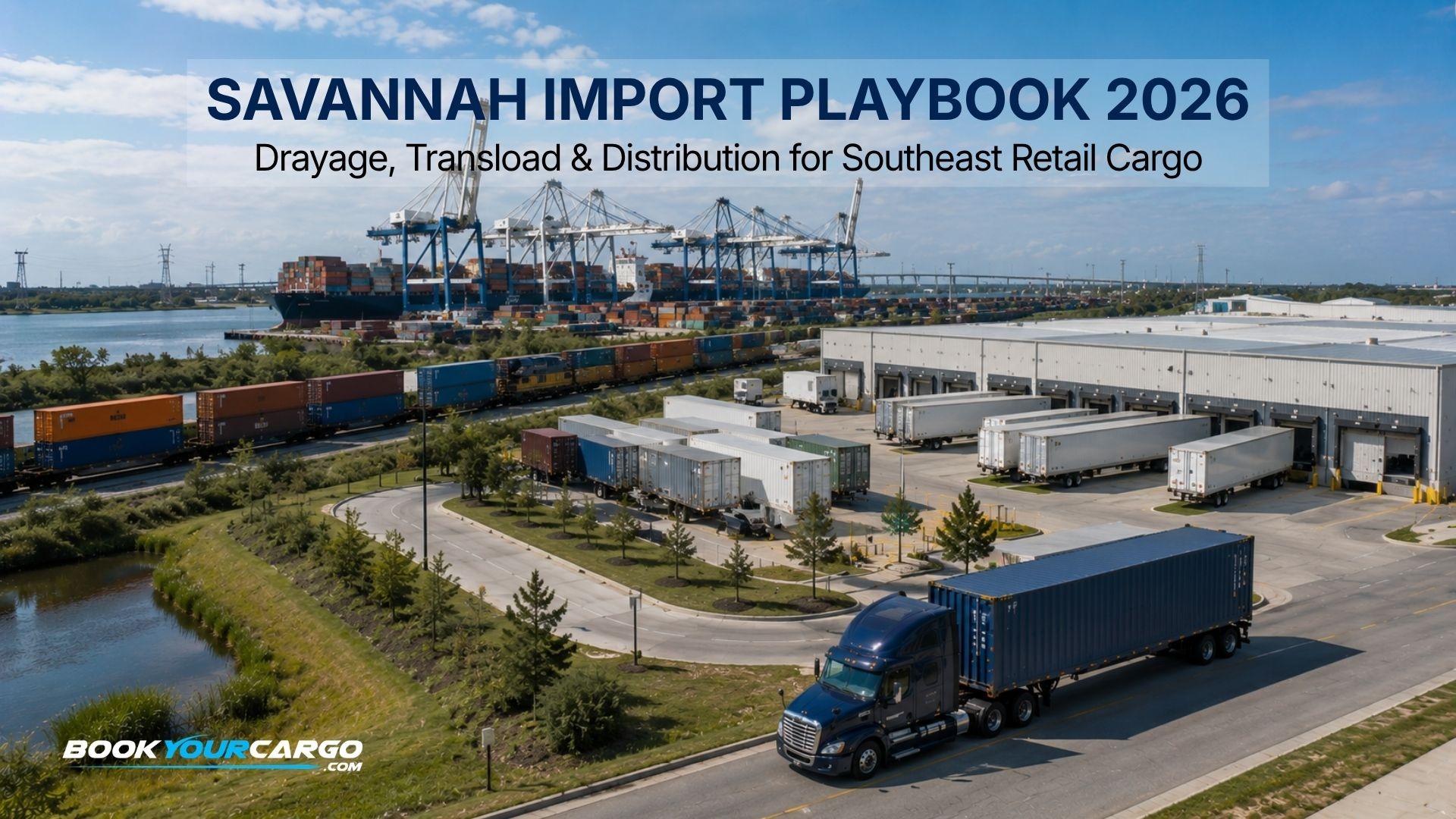
The Port of Savannah has become the default East Coast gateway for a specific kind of cargo: retail and consumer goods bound for Southeast distribution centers and inland markets. There is a reason the distribution real estate around Savannah has exploded, with major retail import warehouses clustering within a short drayage radius of the terminal. Garden City Terminal is the largest single container terminal in North America, its rail connectivity reaches the Midwest in two to three days, and an independent study cited by the Georgia Ports Authority found Savannah saves shippers roughly a thousand dollars per container compared to West Coast routing. For a retailer moving high volume into the Southeast, that math is decisive.
This playbook is built for the retail and consumer-goods importers, and the freight forwarders serving them, who land cargo at Savannah in 2026. It walks through how cargo actually moves from Garden City Terminal into a distribution network, when to deliver a container direct versus transload it into domestic equipment, how the Mason Mega Rail intermodal facility extends Savannah's reach inland, how to protect free time during retail peak season, and the operating disciplines that keep a Savannah import program running at the cost and speed that made the port attractive in the first place.
The Port of Savannah is the primary Southeast import gateway for retail and consumer-goods cargo, anchored by Garden City Terminal, the largest single container terminal in North America at over 1,300 acres. Drayage at Savannah moves containers from Garden City Terminal and Garden City Terminal West to nearby distribution centers, transload facilities, or the Mason Mega Rail intermodal facility for inland rail distribution. The port's advantage for retail importers is its concentration of distribution real estate within a short drayage radius, two-to-three-day double-stack rail service to inland markets like Atlanta, Charlotte, Memphis, Dallas, and Chicago, and immediate I-16 and I-95 highway access. For Southeast-bound retail cargo, the key operational decisions are direct drayage versus transload into 53-foot domestic trailers, free time management during retail peak season, and inland rail routing through Mason Mega Rail. BookYourCargo is a national drayage company that executes Savannah import drayage, transload, and distribution for retailers, freight forwarders, and NVOCCs.
What this playbook helps you control
- Free time and demurrage exposure at Garden City Terminal during retail peak season, when volume concentration compresses the window.
- The direct-drayage versus transload decision for cargo bound for Southeast distribution centers and inland markets.
- Inland reach through the Mason Mega Rail intermodal facility for cargo destined beyond the Southeast.
- Cube efficiency, by converting 40-foot ocean containers into 53-foot domestic equipment when the destination justifies it.
- Cost predictability across a high-volume retail import program running through a single Southeast gateway.
1. Why Savannah became the Southeast retail import gateway
Savannah's rise as a retail import hub is not an accident of geography alone. It is the product of a specific combination of scale, connectivity, and distribution ecosystem that together make it the lowest-friction path for consumer goods entering the U.S. Southeast. Four factors drive the concentration:
- Terminal scale. Garden City Terminal is the largest single container terminal in North America, spanning more than 1,300 acres with the crane and yard capacity to handle high retail volume without the congestion that constrains smaller gateways.
- Distribution ecosystem. A dense cluster of retail and consumer-goods distribution centers has developed within a short drayage radius of the terminal, which means cargo can move from vessel to DC quickly and cheaply, and the labor and warehousing ecosystem is built for retail throughput.
- Rail reach. The Mason Mega Rail intermodal facility, the largest on-terminal intermodal facility in North America, provides two-to-three-day double-stack rail service to inland markets including Atlanta, Charlotte, Memphis, Dallas, and Chicago, extending Savannah's reach far beyond the Southeast.
- Highway access. Immediate access to I-16 running east and west and I-95 running north and south puts key Southeast cities and manufacturing points within a one-to-two-day drive.
For a retail importer, the combined effect is a gateway where cargo lands at scale, moves to distribution quickly, and reaches inland markets efficiently. The drayage layer is what connects each of those steps, which is why a Savannah import program lives or dies on port drayage execution at Garden City Terminal.
2. The facilities that matter for a Savannah import program
The Port of Savannah is operated by the Georgia Ports Authority as an owner-operated terminal, which gives it flexibility that landlord ports do not have. For a retail import program, four facilities matter:
- Garden City Terminal. The primary container facility and the largest single container terminal in North America. Nearly all containerized retail cargo moves through Garden City Terminal, which uses FIRMS code L737 for U.S. Customs purposes. Truck appointments are required for all import pickups.
- Garden City Terminal West. A container storage yard that offers importers and exporters long-term storage options, useful for retail programs that need staging or buffer capacity near the terminal. It uses FIRMS code L738.
- Mason Mega Rail. The on-terminal intermodal facility, the largest of its kind in North America at 85 acres, where CSX and Norfolk Southern provide double-stack rail service inland. Mason Mega Rail works dozens of trains per week with the capacity to build long double-stack trains directly on the terminal.
- Ocean Terminal. Historically a breakbulk and RoRo facility, now undergoing a major renovation to add container capacity, with berth and yard improvements underway to serve large container ships and expand the port's overall container throughput.
The Port of Savannah uses UN/LOCODE USSAV on bills of lading and shipping documents, which is distinct from the terminal-level FIRMS codes that identify Garden City Terminal and Garden City Terminal West for customs purposes. Getting the correct FIRMS code onto customs filings matters, because the wrong code on an entry can generate a hold that costs free time.
3. Direct drayage versus transload for Southeast-bound retail cargo
The central operational decision in a Savannah retail import program is whether to deliver an ocean container directly to the distribution center or transload the cargo into 53-foot domestic equipment first. The right answer depends on the destination, the volume, and the distribution model.
When direct drayage wins
For distribution centers within the Southeast drayage radius of Savannah, direct delivery of the ocean container is usually the cleanest and cheapest path. The cargo moves from Garden City Terminal to the DC, gets unloaded, and the empty container returns. Short mileage means the cube inefficiency of a 40-foot ocean container relative to a 53-foot domestic trailer does not accumulate into meaningful cost, and direct delivery avoids the handling cost of a transload. For a retailer with a DC in the Savannah region or nearby Southeast metros, direct drayage is typically the default.
When transload wins
For cargo bound beyond the immediate Southeast, transloading into 53-foot domestic trailers frequently wins. A 53-foot domestic trailer carries materially more freight than a 40-foot marine container, so consolidating the contents of multiple ocean containers into fewer domestic trailers reduces the cost per unit delivered over longer distances. Transload also decouples the inland move from ocean container return, which frees the ocean equipment quickly and eliminates extended per diem on the marine box. For a retailer distributing from Savannah into the broader Southeast, Mid-Atlantic, or beyond by truck, transload is often the better economic choice. The full framework for this decision is laid out in the analysis of transloading versus direct drayage, and the underlying service detail sits within BYC transloading.
4. Reaching inland markets through Mason Mega Rail
For retail cargo destined well beyond the Southeast, the Mason Mega Rail intermodal facility is what makes Savannah competitive with any gateway in the country. As the largest on-terminal intermodal facility in North America, it lets CSX and Norfolk Southern build double-stack trains directly on the terminal, providing two-to-three-day service to inland markets including Atlanta, Charlotte, Memphis, Dallas, and Chicago. Georgia Ports also operates a direct rail connection to Rocky Mount, North Carolina via the CSX Carolina Connector, and inland terminals including the Appalachian Regional Port in North Georgia and the Gainesville Inland Port extend the port's inland footprint further.
For a retail importer, the practical value of on-terminal rail is that it removes a drayage leg on the origin side. Cargo bound inland by rail is loaded to the train on the terminal rather than being drayed to an off-dock ramp first, which reduces cost and handling. The rail drayage move then happens at the destination ramp, where the container is pulled and delivered to the inland DC. This is the intermodal structure covered in the broader analysis of rail drayage, applied to Savannah's on-terminal rail advantage.
5. Protecting free time during retail peak season
Retail import volume is seasonal, concentrating heavily in the pre-holiday months as retailers build inventory. Savannah handles roughly 14,000 truck gate moves daily and extends gate hours during the August to November peak, but peak volume still compresses free time. When a retail program is landing high container volume in a concentrated window, the free time clock becomes the binding constraint, and the cost of missing Last Free Day multiplies across a large container count.
Three disciplines protect free time during Savannah peak season:
- Plan pickup from vessel arrival, not container availability. During peak, appointment slots at Garden City Terminal fill fast. A drayage provider watching vessel discharge and capturing appointments early keeps containers moving before the free time clock becomes a problem.
- Use Garden City Terminal West or a nearby yard for staging. When distribution center receiving capacity is the constraint during peak, staging containers at Garden City Terminal West or a nearby yard converts terminal demurrage exposure into controlled dwell, buying the DC time to receive without penalty.
- Pre-position transload and rail capacity. A retail program that books transload and inland rail capacity ahead of peak avoids the scramble when volume arrives, keeping the whole Savannah-to-distribution flow moving at peak throughput.
The discipline of preventing demurrage before it forms is the same one covered in No-Surprises Drayage, applied to the specific pressure of retail peak season at a high-volume Southeast gateway.
6. Cost control checklist for a Savannah retail import program
A practical scoreboard for retailers and forwarders running import volume through the Port of Savannah. Each line is a place where cost or time is most often lost, and the action that protects it.
| Risk | What it costs if mismanaged | Action that protects it |
|---|---|---|
| Peak season free time compression | Demurrage multiplied across a large peak container count | Capture appointments from vessel arrival, stage at Garden City Terminal West when DCs are full |
| Wrong direct-vs-transload decision | Over-paying on cube for distant destinations, or over-handling for local ones | Direct for Southeast-radius DCs, transload into 53-foot for longer inland moves |
| Wrong FIRMS code on customs filing | Customs hold consuming free time | Verify Garden City Terminal L737 or Terminal West L738 on the entry before filing |
| Chassis dwell at the DC | Per diem stacking during slow DC unload | Drop and recover chassis, or transload to free the ocean box and chassis quickly |
| Origin drayage on rail-bound cargo | Unnecessary handling cost on inland freight | Use Mason Mega Rail on-terminal loading to skip the origin drayage leg |
| Unbooked peak transload and rail capacity | Bottleneck when peak volume arrives | Pre-position transload and inland rail capacity ahead of the August to November peak |
| No visibility across the import pipeline | Exceptions surfacing late, missed free time | Use live tracking and integration to monitor every container from vessel to DC |
7. How BookYourCargo runs a Savannah import program
BookYourCargo is a national drayage company with vetted carrier capacity at the Port of Savannah and across every major U.S. and Canadian port and rail ramp. For a retail or consumer-goods import program landing at Garden City Terminal, the operating model connects each step of the Savannah-to-distribution flow:
- Garden City Terminal drayage. Vetted carrier capacity for import pickups at Garden City Terminal and Garden City Terminal West, with appointment capture planned from vessel arrival to protect free time during retail peak.
- Transload and cube optimization. Transload of ocean containers into 53-foot domestic equipment for cargo bound beyond the Southeast radius, consolidating volume to reduce cost per unit delivered.
- Inland rail coordination. Coordination with Mason Mega Rail on-terminal loading and destination rail drayage for cargo destined for inland markets like Atlanta, Charlotte, Memphis, Dallas, and Chicago.
- Staging and warehousing. Staging capacity near the terminal and warehousing support so retail volume can flow at the pace the distribution network can receive.
- Pipeline visibility. Live tracking of every container from vessel discharge through delivery, with API and EDI integration into the importer or forwarder operating system.
BookYourCargo delivers this alongside nationwide drayage coverage and warehousing, so a retailer can run a Savannah import program as a single coordinated workflow rather than a series of disconnected handoffs. First-party rate context for the Southeast lives in the monthly BYC Drayage Index, which publishes regional rate trends going back to 2022. Inc. 5000-recognized, BBB Accredited, IANA Member, NCBFAA Member, and WOSB-certified through the U.S. Small Business Administration.
Frequently asked questions about drayage at the Port of Savannah
Run a Savannah import program at the cost and speed that made the port attractive
The Port of Savannah earns its place in a retail supply chain through terminal scale, distribution density, and inland rail reach, but that advantage only holds if the drayage, transload, and distribution layer executes cleanly from vessel to DC. If you are a retailer, consumer-goods importer, or freight forwarder running volume through Savannah in 2026 and want to talk to BYC about how your Southeast import program would execute, request a quote.
