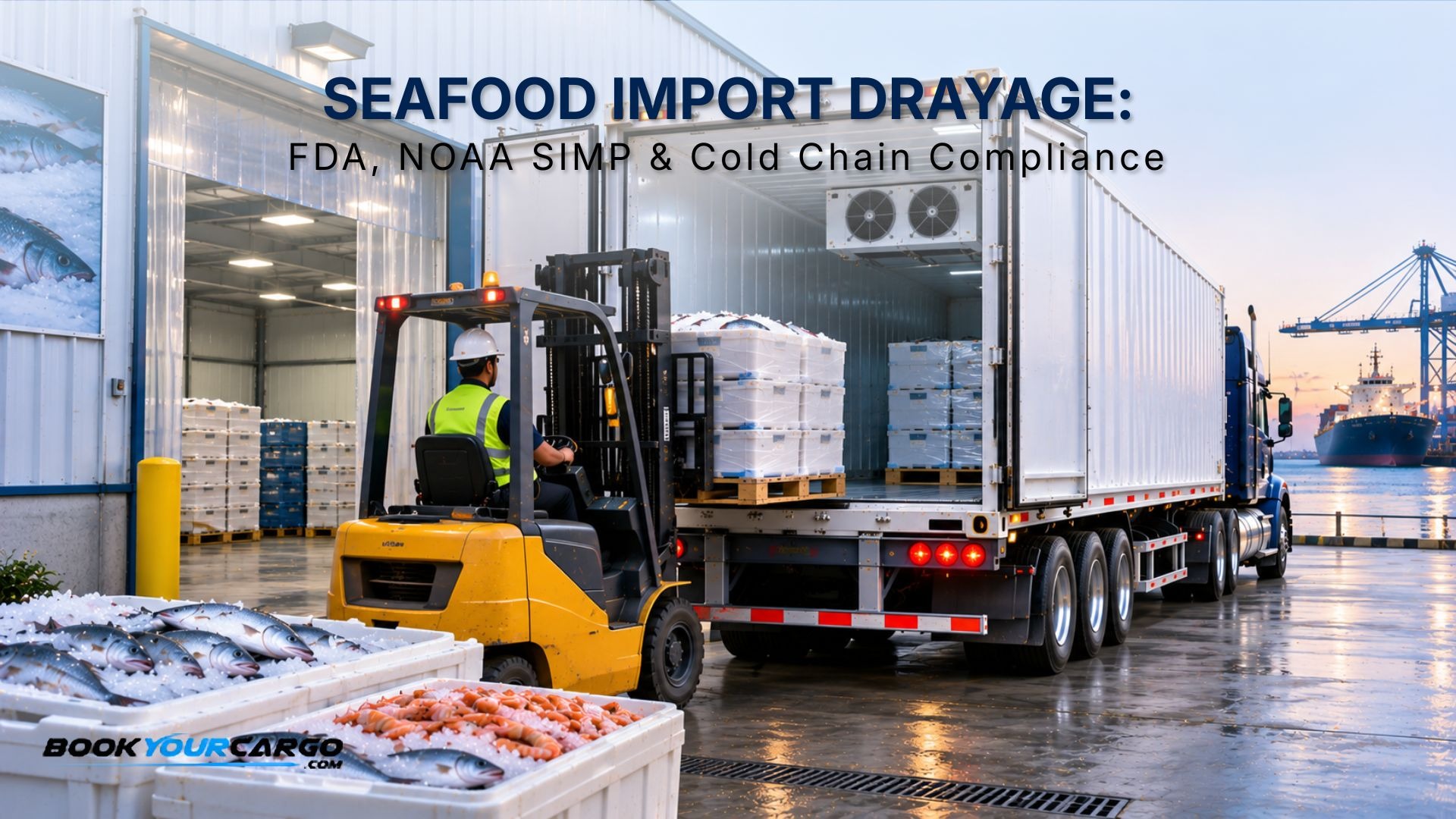
Seafood import drayage is the reefer move from the terminal to a cold store or processor, and before that container can be delivered for distribution it has to clear two separate sets of federal rules: FDA food safety requirements and NOAA Fisheries trade programs. A frozen shrimp container can be released by Customs and available at the terminal, and still be held because a harvest record or an importer verification step is missing.
The United States imported 6.4 billion pounds of edible seafood products in 2024, according to NOAA's Fisheries of the United States report. Much of it arrives frozen in reefer containers, which means the drayage leg carries both a paperwork clock and a temperature record.
Book Your Cargo handles seafood import drayage from the port to cold stores, processors and distribution centers, with genset coverage and temperature monitoring on the road leg, the operating temperature taken in writing on every reefer dispatch, and real-time container tracking from availability to delivery.
This guide is for general information. Seafood import requirements depend on species, origin and product form, and they change, so confirm the current position for your entry with your customs broker, FDA and NOAA Fisheries.
This guide covers FDA seafood HACCP importer requirements, seafood import alerts, the NOAA Seafood Import Monitoring Program, the Marine Mammal Protection Act import bans and other NOAA programs, temperature on the road leg, where the container has to go, traceability and labeling, and how Book Your Cargo moves seafood imports.
1. FDA seafood HACCP: what the importer has to verify
Seafood is the one FDA food category where the importer has its own HACCP duty. Under 21 CFR 123.12, a seafood importer must either import from a country with an active FDA agreement covering the product, or keep written verification procedures that set product specifications and use at least one affirmative step to confirm the foreign processor complies with seafood HACCP.
Affirmative steps listed in 21 CFR 123.12 | |
|---|---|
A | Obtain the foreign processor's HACCP and sanitation monitoring records for the lot |
B | Obtain a lot-by-lot or continuing certificate from a foreign government authority or competent third party |
C | Regularly inspect the foreign processor's facilities |
D | Keep an English copy of the processor's HACCP plan and a written guarantee on file |
E | Periodically test the product and keep an English written guarantee on file |
F | Use other measures that provide an equivalent level of assurance |
Records must be in English, and product without evidence that it was processed in compliance appears adulterated and is denied entry. Because seafood is covered by part 123, the Foreign Supplier Verification Program does not apply to fish and fishery products from a supplier that complies with it. FDA's seafood HACCP and FSMA guidance still asks importers to enter the FSVP affirmation of compliance code FSX on each entry.
The standard food import steps apply as well. FDA prior notice is due no less than 8 hours before a vessel arrives, and entries that are not released automatically go to FDA review, where a seafood container can sit under an FDA hold on imported food after Customs has released it.
How BYC handles this
Book Your Cargo tracks the FDA position alongside the terminal release and the last free day, and books the terminal appointment against the final release rather than the vessel arrival. When a seafood entry is held, the reefer is delivered only to the location the broker has declared for FDA, with the cargo complete and accessible there.
2. Seafood import alerts
FDA uses import alerts to apply detention without physical examination, known as DWPE, to products and firms with a history of violations. Seafood has its own series, and the alerts most likely to affect a reefer import cover histamine, Salmonella and aquaculture drugs.
Alert | What it covers |
|---|---|
16-105 | Fish and fishery products from listed firms for decomposition, histamine or indole |
16-81 | Seafood products due to the presence of Salmonella |
16-124 | Aquaculture seafood products due to unapproved drugs |
16-129 | Seafood products due to nitrofurans |
16-131 | Aquacultured shrimp, dace and eel from China and Hong Kong SAR |
16-119 | Fish and fishery products from listed importer and foreign processor combinations |
Sources: FDA import alerts 16-105, 16-81, 16-124, 16-129, 16-131 and 16-119.
One newer requirement applies to specific shrimp. After detecting cesium-137 in frozen shrimp from Indonesia in August 2025, FDA has required import certification for shrimp and spices from the Java and Lampung regions since October 31, 2025.
How BYC handles this
A shipment from a supplier on an import alert is likely to be detained on arrival, so the detention belongs in the drayage plan from the first booking. Book Your Cargo plans those containers off the terminal to a declared cold store, with the broker's confirmation, so the reefer is not running on a terminal plug while the importer works on the release.
3. The NOAA Seafood Import Monitoring Program
The Seafood Import Monitoring Program, known as SIMP, is a NOAA Fisheries traceability program that requires importers to report harvest data from the point of harvest to US entry, to keep illegally caught and misrepresented seafood out of US commerce. NOAA states that SIMP covers about half of US seafood imports.
SIMP covers 13 species groups: abalone, Atlantic cod, Atlantic blue crab, dolphinfish or mahi mahi, grouper, red king crab, Pacific cod, red snapper, sea cucumber, sharks, shrimp, swordfish, and tunas including albacore, bigeye, skipjack, yellowfin and bluefin.
For each entry of a covered species, the SIMP compliance guide requires data that includes:
- The harvesting vessel's name and flag state, and a unique vessel identifier where available.
- Evidence of authorization to fish or farm, and the gear type.
- Species, harvest area, or the farm address for aquaculture.
- Landing date, product form and quantity at landing.
- Point of first landing and the entity the fish was landed or delivered to.
The importer of record must hold an International Fisheries Trade Permit, which covers all NOAA trade programs, and the data is filed electronically through the Customs ACE system using the NOAA Fisheries message set. The importer keeps chain of custody records covering transshipment, processing and commingling for two years. In September 2026, NOAA announced plans to review SIMP, including removing unused data fields and adding automated screening; those plans had not been adopted at the time of writing.
4. Marine mammal import bans and other NOAA programs
Since January 1, 2026, fish and fish products from fisheries without a NOAA comparability finding under the Marine Mammal Protection Act import provisions cannot be imported into the United States. NOAA denied findings for all fisheries of 12 nations and gave partial findings to fisheries of 34 nations, and the findings run through December 31, 2029.
Where a product's country of origin and tariff code match the prohibited fisheries list, the entry needs a Certification of Admissibility, specific to the shipment, signed by an authorized foreign official and uploaded to the Customs document imaging system. Nations can reapply, and some bans have already been lifted, so the current list has to be checked for each origin.
Program | What the importer needs |
|---|---|
Antarctic toothfish | An International Fisheries Trade Permit and NOAA pre-approval of catch documentation for each frozen shipment, due 10 working days before arrival |
Tuna, swordfish and shark fins | An International Fisheries Trade Permit and catch or statistical documents; Atlantic bluefin needs an ICCAT electronic catch document number in the entry |
Shrimp | A State Department DS-2031 declaration with every shrimp import under the sea turtle protection rule |
Marine Mammal Protection Act | A Certification of Admissibility where the origin and tariff code match a prohibited fishery |
Sources: NOAA Antarctic marine living resources program, NOAA highly migratory species dealer guide and the 2026 shrimp certification notice. Wild-caught shrimp from uncertified nations or fisheries is refused entry.
A seafood container clears on harvest records, permits and certificates that are filed by the importer and broker, not on anything the truck can fix at the gate. Confirm SIMP, permit and certificate status before the pickup is booked, because a reefer waiting at the terminal for paperwork is running on a plug and against free time.
Send us your port, species, cold store and expected arrival, and we will come back with a drayage quote and a delivery plan built around the FDA and NOAA releases, with real-time container tracking on the move.
5. Temperature on the road leg
FDA's fish and fishery products hazards and controls guidance sets out how seafood temperatures are controlled. For histamine-forming fish, Chapter 7 says fish should be held as close as possible to the freezing point or held frozen, and gives a transit limit for refrigerated, not frozen, fish of 40 degrees Fahrenheit or below throughout transit, monitored with a continuous temperature recorder.
For frozen product, Chapter 12 states that time and temperature controls will usually not be needed for frozen product storage. Neither the seafood HACCP regulation nor the guidance chapters set a single regulatory frozen transport temperature, so the operating temperature comes from the importer, the buyer and the product specification.
Seafood is covered by the FDA sanitary transportation rule. Its exemptions are limited to food transshipped through the United States, food imported for future export, and food in facilities regulated exclusively by USDA, and the rule defines a carrier as a person who physically moves food by rail or motor vehicle. A drayage carrier moving reefer seafood is a carrier under the rule, and the shipper specifies the operating temperature in writing.
How BYC handles this
Book Your Cargo takes the operating temperature in writing on every reefer dispatch and keeps it on file, provides genset coverage on the road leg, and monitors temperature and power status in tracking until the container is delivered. When the cold store or the importer asks for evidence that the temperature was held during the drayage leg, the record already exists, as on every reefer drayage move.
6. Where the container has to go
Most seafood containers go to a cold store or processor near the port, where the product is devanned, checked and stored. Cold storage near the port takes the cargo off the terminal plug and free time, and gives held product a location FDA can examine.
Catfish is the exception to the FDA path. Fish of the order Siluriformes, which includes catfish, is regulated by USDA FSIS, and imported Siluriformes must be presented at an official import inspection establishment for reinspection by FSIS personnel. The importer files FSIS Form 9540-1 no later than the date of entry, shipments go from the port directly to the approved establishment, and unloading anywhere else counts as failure to present.
How BYC handles this
Book Your Cargo confirms the delivery location before dispatch on every seafood import: the cold store or processor for FDA-regulated seafood, the declared location for held product, and the official import inspection establishment for catfish. The reefer goes straight there under genset coverage, and the empty return is planned at the same time, the same discipline behind empty container returns and street turns.
7. Traceability and labeling
Seafood is prominent on FDA's Food Traceability List, which includes finfish, smoked finfish, crustaceans and molluscan bivalves. Foods on the list are subject to the additional traceability records rule, and FDA has said it will not enforce the rule before July 20, 2028, following a directive from Congress. Catfish is not on the list because USDA regulates it.
At retail, country of origin labeling for fish and shellfish requires retailers to show the country of origin and whether the product is wild or farm-raised. Imported product keeps the origin declared to Customs unless it is substantially transformed, which is why lot identity matters from the container onward.
For the drayage leg, the practical point is simple: deliver the container complete, with the container and seal numbers and the temperature record kept, so the lot that reaches the cold store is the lot on the entry. Seafood that also faces a USDA hold follows the same release discipline as other food and agricultural import drayage.
8. Real-time container tracking for seafood imports
Book Your Cargo provides real-time container tracking on every move, from availability to delivery. The team flags release, appointment and window changes before a truck is dispatched, not after it reaches the gate. That is how dry runs, missed appointments and avoidable storage charges are prevented.
On seafood imports, real-time container tracking keeps the FDA position, the terminal release and the cold store appointment in one view, and extends to temperature and power status on the road leg. The drayage technology platform carries release status, appointments and reefer data through to delivery.
Where BYC covers today
Inland ramps | Port gateways |
|---|---|
Chicago | New York and New Jersey |
Columbus | Norfolk |
Cincinnati | West Coast gateways |
Port drayage and national drayage coverage extends beyond these to the major US ports and rail ramps.
9. A seafood import drayage checklist
- Importer verification under 21 CFR 123.12 on file, and the FSX affirmation code on the entry.
- FDA prior notice confirmed no less than 8 hours before vessel arrival.
- Supplier checked against seafood import alerts before the first booking.
- For SIMP species, harvest and landing data filed, and the International Fisheries Trade Permit current.
- Origin checked against the Marine Mammal Protection Act prohibited fisheries list, with a Certification of Admissibility where needed.
- For shrimp, the DS-2031 declaration; for toothfish and listed tuna, the catch documents.
- Operating temperature given to the carrier in writing, with genset coverage and monitoring to the dock door.
- Delivery location confirmed: cold store, declared FDA location, or FSIS establishment for catfish.
Frequently asked questions
Seafood importers must meet FDA seafood HACCP importer requirements under 21 CFR 123.12, either by importing from a country with an active FDA agreement or by keeping written verification procedures with at least one affirmative step. FDA prior notice is due no less than 8 hours before a vessel arrives.
Depending on species and origin, NOAA Fisheries programs also apply, including the Seafood Import Monitoring Program, Marine Mammal Protection Act import provisions and catch documentation for toothfish and certain tuna.
SIMP is a NOAA Fisheries traceability program that requires importers to report harvest data from the point of harvest to US entry for 13 species groups, including shrimp, tunas, cod, crab, grouper, red snapper, mahi mahi, swordfish and sharks.
The importer of record must hold an International Fisheries Trade Permit, files the data through the Customs ACE system, and keeps chain of custody records for two years.
No, for fish and fishery products from a foreign supplier that is required to comply with and is in compliance with FDA's seafood HACCP regulation. Those importers must meet the importer requirements in 21 CFR 123.12 instead.
FDA guidance still asks seafood importers to enter the FSVP affirmation of compliance code FSX on each entry.
Fish and fish products from fisheries without a NOAA comparability finding under the Marine Mammal Protection Act import provisions can no longer be imported. NOAA denied findings for all fisheries of 12 nations and gave partial findings to fisheries of 34 nations.
Where the origin and tariff code match the prohibited fisheries list, the entry needs a shipment-specific Certification of Admissibility signed by an authorized foreign official.
For refrigerated, not frozen, histamine-forming fish, FDA guidance gives a transit limit of 40 degrees Fahrenheit or below throughout transit, monitored with a continuous temperature recorder, and says fish should be held as close as possible to freezing or held frozen.
There is no single regulatory frozen transport temperature for seafood, so the operating temperature comes from the importer, buyer and product specification, and the shipper gives it to the carrier in writing.
USDA. Fish of the order Siluriformes, which includes catfish, is regulated by FSIS, and imported Siluriformes must be presented at an official import inspection establishment for reinspection by FSIS personnel.
The importer files FSIS Form 9540-1 no later than the date of entry, and the shipment goes from the port directly to the approved establishment.
Several do. Import Alert 16-81 covers Salmonella and includes many shrimp firms, 16-124 and 16-129 cover unapproved drugs and nitrofurans in aquaculture products, and 16-131 covers aquacultured shrimp, dace and eel from China and Hong Kong SAR.
Since October 31, 2025, FDA has also required import certification for shrimp and spices from the Java and Lampung regions of Indonesia, after detecting cesium-137 in frozen shrimp.
Book Your Cargo tracks the FDA position alongside the terminal release, confirms the delivery location before dispatch, and delivers the reefer straight to the cold store, the declared FDA location or the FSIS establishment for catfish.
The operating temperature is taken in writing on every reefer dispatch, genset coverage and temperature monitoring run on the road leg, and real-time container tracking runs from availability to delivery.
