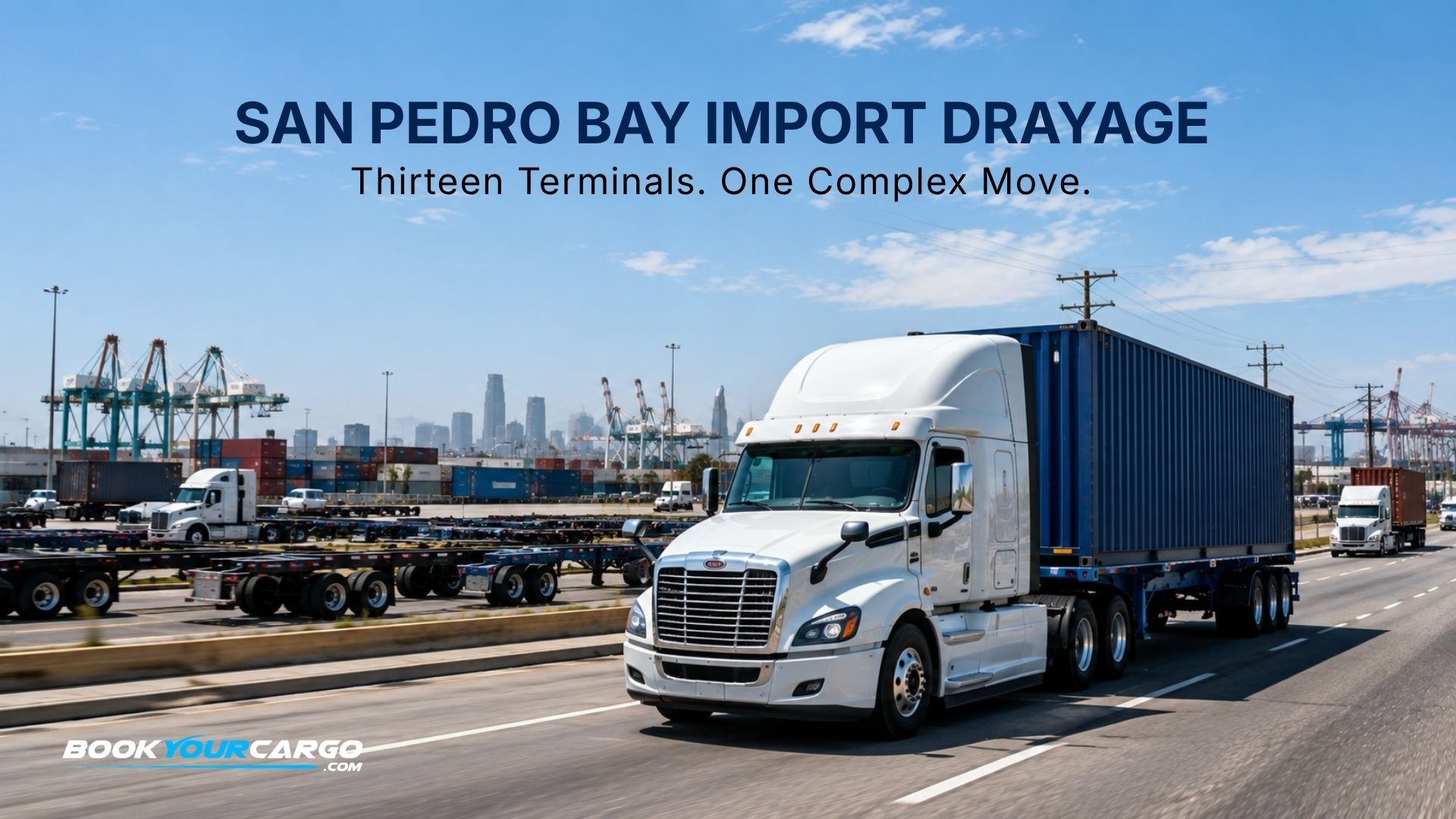
Roughly 31 percent of containers are imported or exported through a single stretch of the Pacific South West. The Port of Los Angeles and the Port of Long Beach together form the San Pedro Bay port complex, which handles more containers per ship call than any other port complex in USA. Los Angeles has been the number one container port in the Western Hemisphere for 26 consecutive years and moved 10.2 million TEUs in 2025. Long Beach set its own record the same year at 9,881,595 TEUs, with five of its six container terminals each handling more than a million TEUs. Together they account for 77 percent of West Coast market share.
That scale is why San Pedro Bay is the default landing point for Transpacific imports, and it is also why import drayage here is more difficult than at any other U.S. gateway. Thirteen container terminals operate across the two ports, each with its own appointment system, gate hours, chassis arrangement, and return rules. Empty container volume through Long Beach alone reached 3.96 million TEUs in 2025. A drayage program that treats San Pedro Bay as one destination rather than thirteen operating environments will lose containers to missed appointments, stranded empties, and per diem it never planned for. This guide covers how the complex is actually structured, how appointments and dual transactions work, how the Inland Empire distribution network absorbs the volume, and the disciplines that keep an import program moving.
The San Pedro Bay port complex, comprising the Port of Los Angeles and the Port of Long Beach, is the largest container gateway in the United States and handles more containers per ship call than any other port complex in the world. Together the two ports handled roughly 31 percent of all U.S. containerized waterborne trade and 77 percent of West Coast market share in 2025. The Port of Los Angeles moved 10.2 million TEUs across seven container terminals: APM Terminals Pacific, Fenix Marine Services, TraPac, Yusen Terminals, Everport Terminal Services, and the two West Basin Container Terminal facilities. The Port of Long Beach moved a record 9,881,595 TEUs across six container terminals. Import drayage at San Pedro Bay requires terminal-specific appointment management, dual transaction planning to pair a pickup with an empty return, chassis coordination, awareness that empty container volume ran to 3.96 million TEUs at Long Beach in 2025, and compliance with the ports’ Clean Truck Program and Port Drayage Truck Registry requirements. Most import cargo moves to Inland Empire distribution centers or transloads into domestic equipment. BookYourCargo is a national drayage company that executes import drayage across the Los Angeles and Long Beach terminals.
What this guide helps you control
- Terminal-by-terminal appointment capture across thirteen container terminals with different systems and rules.
- Dual transactions, pairing an import pickup with an empty return to cut trips and protect per diem.
- Empty container return, the constraint that strands equipment when return locations restrict.
- Chassis availability and the pool arrangements that differ by terminal and carrier.
- The direct-to-Inland-Empire versus transload decision for cargo bound beyond Southern California.
- Clean Truck Program registration and California clean-truck compliance on every move.
1. What the complex actually looks like
San Pedro Bay is two separate port authorities operating adjacent to each other, each leasing berths to independent terminal operators. An importer does not deal with a port; an importer deals with whichever terminal the ocean carrier calls. The structure matters because it determines how many different operating environments a drayage program has to work in.
The Port of Los Angeles
A department of the City of Los Angeles founded in 1907 and governed by the Los Angeles Board of Harbor Commissioners, the Port of Los Angeles spans 7,500 acres with 43 miles of waterfront and a 53-foot main channel. It operates 25 cargo terminals, of which seven are container terminals: APM Terminals Pacific, Fenix Marine Services, TraPac, Yusen Terminals, Everport Terminal Services, and two West Basin Container Terminal facilities. The port has 85 ship-to-shore container cranes and 122 miles of rail including five on-dock railyards and a classification yard. In 2025 it handled 10.2 million TEUs and 146 megaship calls from vessels of 13,000 TEU capacity or greater.
The Port of Long Beach
Long Beach operates six container terminals and moved a record 9,881,595 TEUs in 2025, up 2.4 percent, taking 48.9 percent of the cargo moving through San Pedro Bay. Imports reached 4,779,559 TEUs and exports 1,141,113 TEUs. For the first time, five of its six container terminals each handled more than a million TEUs, and two handled more than two million each. The port is building the Pier B on-dock rail support facility, begun in 2023 and slated for completion in 2032, which aims to cut average ship-to-train time from just under four days toward a target of 24 hours.
Thirteen container terminals is the number that shapes the drayage problem. Each has its own appointment system, gate schedule, empty return policy, and chassis arrangement, and none of that is standardized across the complex. This is the coverage challenge behind port drayage at the largest U.S. gateway.
2. Appointments: the gate that decides everything
At San Pedro Bay, having a truck, a chassis, and an available container is not enough. The move requires an appointment, and appointment availability can become one of the primary constraints at San Pedro Bay, especially during peak periods and terminal-specific surges. Three realities govern it:
- Systems differ by terminal. Each terminal runs its own appointment system with its own release windows, transaction types, and cancellation rules. A drayage provider has to operate in all of them rather than one, and slot release times vary, so monitoring has to be continuous rather than scheduled.
- Slots are released in waves and taken quickly. Appointment inventory opens on terminal-specific schedules and is consumed fast during peak. A provider watching release windows across every terminal captures slots that a provider checking once a day will never see.
- Standardization is coming but is not here yet. Long Beach is developing a Universal Trucking Appointment System, partially state funded, intended to let motor carriers schedule pickups and drop-offs across all six of its marine terminals, with the expectation of eventually extending to Los Angeles. Until that is fully in place, terminal-by-terminal appointment management remains the operating reality.
3. Dual transactions and the empty container problem
The single most expensive structural feature of San Pedro Bay import drayage is the imbalance between loaded imports and empty returns. Long Beach alone moved 3,960,925 empty TEUs in 2025, up 6.7 percent, against 4,779,559 loaded import TEUs. Nearly every import container becomes an empty that has to go back, and where and when it can go back is not the importer’s choice.
Why dual transactions matter
A dual transaction pairs an empty return with an import pickup in a single terminal visit, which cuts the number of trips, reduces gate congestion, and shortens the time equipment spends in the system. Executed well, it can reduce gate trips, empty miles, and chassis dwell. When a dual is not possible, the operation may require an additional terminal move, so return availability should be planned before the import is dispatched. Dual transactions depend on the empty return being accepted at the same terminal at the same appointment, which is why they require planning rather than improvisation.
When returns restrict
Terminals and ocean carriers periodically restrict which empties they will accept, by container type, by carrier, or by day. When returns restrict, empties accumulate on chassis and in yards, chassis stay tied up, and restricted returns can create detention or per-diem exposure depending on the carrier’s terms and the applicable regulatory framework, which is why return restrictions should be documented and disputed where appropriate. A drayage provider tracking return availability by carrier and terminal, and holding yard capacity for the periods when returns close, protects the importer from a cost that is entirely outside the importer’s control. This is the exposure that quietly builds behind an otherwise clean import program, and it is the discipline covered in No-Surprises Drayage.
4. Where the cargo goes: Inland Empire and the transload decision
Import volume at San Pedro Bay overwhelmingly serves two destinations: Southern California distribution centers, concentrated in the Inland Empire across Riverside and San Bernardino counties, and the national market beyond, reached by transload into domestic equipment or by intermodal rail.
- Direct to the Inland Empire. For cargo bound for a Southern California distribution center, the ocean container is drayed directly from the terminal to the facility. The mileage is significant enough that turn times and appointment timing matter, and the round trip can consume a substantial portion of a driver shift, so terminal timing, facility dwell, and appointment coordination materially affect daily capacity.
- Transload into domestic equipment. For cargo continuing beyond Southern California by truck, transloading the contents of ocean containers into 53-foot domestic trailers usually wins, because the domestic trailer carries materially more freight and the transload frees the ocean container to be returned quickly. The framework is laid out in the guide to transloading versus direct drayage.
- On-dock and near-dock rail. For cargo bound inland by rail, the Port of Los Angeles operates five on-dock railyards, and Long Beach is building Pier B to improve rail velocity across the complex. On-dock rail can remove an origin drayage leg by transferring containers directly from the marine terminal into the rail network, while near-dock options may still require a short local move, with the rail drayage move then happening at the destination ramp.
The right structure depends on the destination and the volume, and most large programs run all three in parallel. What they share is dependence on the terminal appointment and the empty return, which is why those two disciplines govern regardless of what happens downstream.
5. Clean truck compliance and terminal access
Every drayage move at the Los Angeles and Long Beach terminals operates within both port-access rules and California emissions regulation, and in 2026 those two need to be kept separate. Port access is governed by the ports’ own programs. The state zero-emission mandate is in a different position: CARB states that the Advanced Clean Fleets High Priority and Drayage requirements are currently not being enforced while related rulemaking continues.
- The Clean Truck Program and the ports’ truck registry. The San Pedro Bay ports operate a Clean Truck Program under the Clean Air Action Plan, now in its twentieth year, and trucks serving the terminals must be registered in the ports’ drayage truck registry. An unregistered or non-conforming truck does not get through the gate, which makes registry status an operational prerequisite rather than paperwork.
- California Air Resources Board status. CARB states that the Advanced Clean Fleets High Priority and Drayage requirements are currently not being enforced, and rulemaking is ongoing. This does not remove port-access obligations, and it does mean importers should verify the latest CARB position rather than plan capacity against a mandate that is not currently in force.
- Green Lanes and priority access. Long Beach has been working with marine terminal operators on a Green Lanes concept that would prioritize terminal access for trucks using green energy during the busiest parts of the day, which points toward equipment choice affecting turn times, not just compliance.
The practical consequence is that an importer’s effective capacity at San Pedro Bay is not the number of trucks a provider has; it is the number of registered, terminal-eligible trucks with appointment access. The working requirement is to use equipment that is eligible for terminal access today while continuing to verify the latest CARB requirements as the regulatory framework evolves.
6. Cost control checklist for San Pedro Bay import drayage
A practical scoreboard for importers moving containers through the Los Angeles and Long Beach terminals. Each line is a place where an import program most often loses money at this gateway, and the action that prevents it.
| Risk | What it costs if mismanaged | Action that prevents it |
|---|---|---|
| Missed appointment window | Container sits while free time runs | Monitor slot release continuously across every terminal your cargo lands at |
| No dual transaction planning | Two trips per container instead of one | Pair the empty return with the import pickup in a single terminal visit |
| Empty returns restricted | Per diem on containers that cannot be given back | Track return availability by carrier and terminal, hold yard capacity as a buffer |
| Chassis unavailable at the terminal | Available container that cannot be moved | Confirm the chassis arrangement per terminal and carrier before dispatch |
| Unregistered or non-conforming truck | Truck refused at the gate, appointment wasted | Use registered, compliant equipment across all dispatched capacity |
| Ocean container held during a long unload | Per diem stacking during distribution center dwell | Transload for onward truck moves to free the ocean box early |
| Coverage at only a few terminals | Exposure whenever cargo lands elsewhere in the complex | Use vetted capacity across all Los Angeles and Long Beach container terminals |
7. How BookYourCargo executes at Los Angeles and Long Beach
BookYourCargo is a drayage company with vetted carrier capacity across the San Pedro Bay terminals and every major U.S. and Canadian port and rail ramp. For importers running volume through the largest U.S. gateway, the operating model is built around the two constraints that actually govern it, appointments and empties:
- Complex-wide terminal coverage. Vetted carrier capacity across the Los Angeles container terminals, including APM Terminals Pacific, Fenix Marine Services, TraPac, Yusen Terminals, Everport, and West Basin, and across the Long Beach container terminals, so containers are pulled from wherever the carrier calls.
- Appointment management. Continuous monitoring of slot release across terminal appointment systems, with slots secured ahead of delivery commitments rather than after.
- Dual transaction and empty return planning. Import pickups paired with empty returns where the terminal permits, with return availability tracked by carrier and terminal and yard capacity available when returns restrict.
- Inland Empire delivery, transload, and rail. Direct delivery to Southern California distribution centers, transload into domestic equipment for cargo continuing beyond the region, and coordination with on-dock rail and destination rail drayage for intermodal freight.
- Terminal-eligible capacity and full visibility. Registered equipment meeting the ports’ Clean Truck Program and Port Drayage Truck Registry requirements across dispatched capacity, with live tracking from vessel discharge through delivery and empty return, and API and EDI integration into the importer or forwarder operating system.
This connects to BYC’s broader national drayage, transloading, and warehousing capabilities, execution runs on the BYC drayage technology platform, and first-party West Coast rate context lives in the monthly BYC Drayage Index, published going back to 2022. Inc. 5000-recognized, BBB A+ rated, IANA Member, NCBFAA Member, and WOSB-certified through the U.S. Small Business Administration.
Frequently asked questions about import drayage at Los Angeles and Long Beach
Make the largest U.S. gateway behave like one operation
San Pedro Bay gives importers unmatched service frequency and capacity, but it charges for complexity: thirteen terminals, thirteen appointment environments, and an empty return problem that runs to millions of containers a year. The programs that move cleanly here are the ones whose drayage provider works every terminal, watches every slot release, and plans the empty back before the container ever comes out. If you are an importer or freight forwarder moving containers through Los Angeles and Long Beach in 2026 and want to talk to BYC about how your import freight would execute, request a quote.
