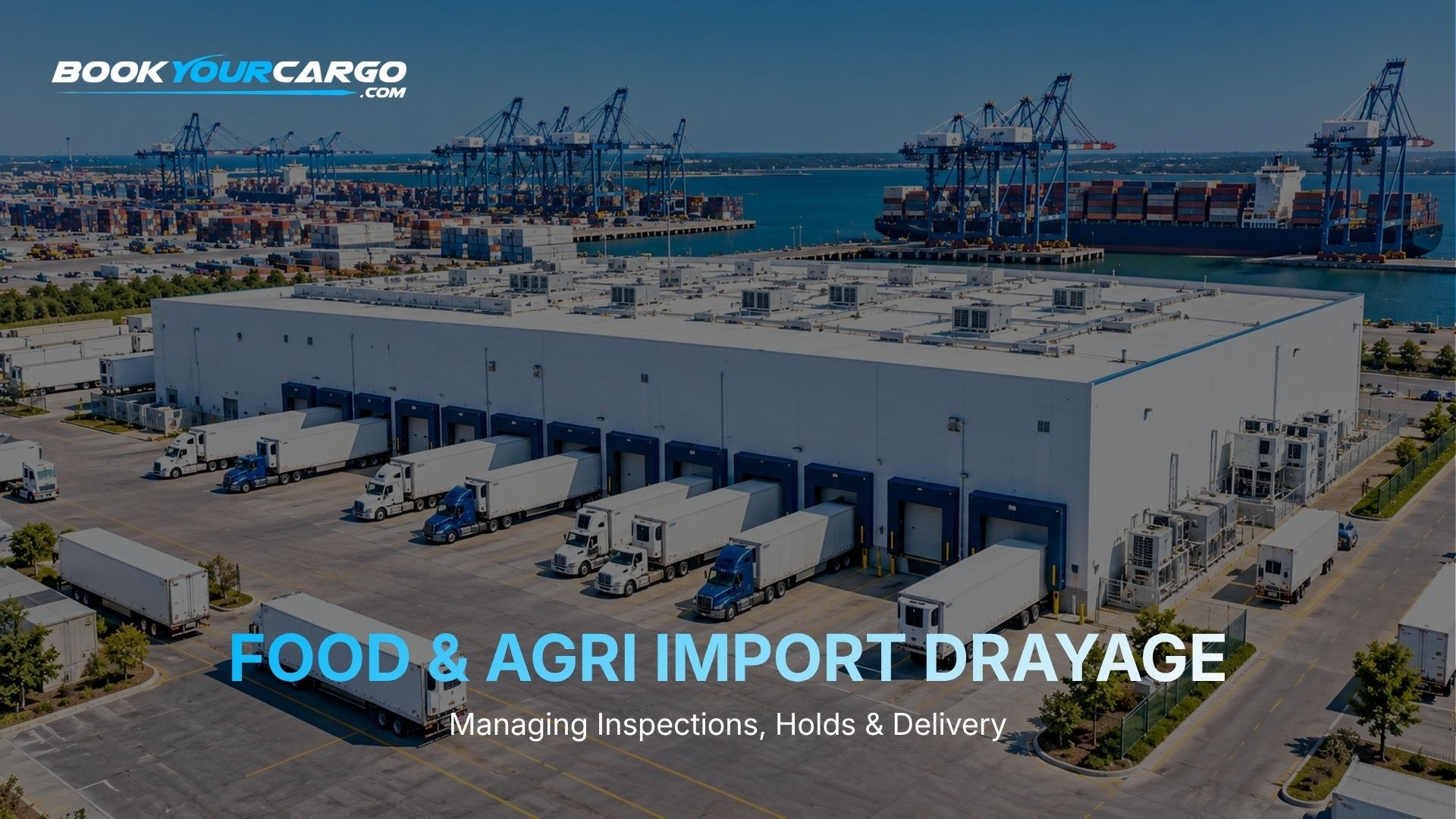
Cold storage near the port is where a refrigerated container hands its cargo to a temperature-controlled warehouse, and that handoff decides both the food safety record and how long the container keeps running up charges. A reefer sitting at a terminal needs a plug, a chassis and free time. Devanned into a cold store close to the berth, the same cargo needs none of them.
The handoff is also where federal food rules meet. The drayage leg into the cold store is covered by the FDA sanitary transportation rule, the cold store itself is a registered food facility with its own temperature record duties, and imported meat and poultry must go to a USDA-approved inspection establishment. Getting the sequence right protects both the cargo and the paperwork.
Book Your Cargo coordinates cold storage near the port for import and export reefer cargo, with genset coverage and temperature monitoring on the road leg, the operating temperature taken in writing on every reefer dispatch, and real-time container tracking from availability to delivery.
This guide is for general information. Confirm current requirements with FDA and USDA for your specific product and facility.
This guide covers what a port cold storage warehouse does, how devanning affects the container clocks, what the receiving check involves, what the rules ask of the cold store itself, how imported meat and poultry are handled, where held food waits, where port cold storage capacity sits, how cold storage supports exports, and how Book Your Cargo plans the handoff.
1. What a cold storage warehouse near the port does
A cold storage warehouse holds chilled and frozen goods at controlled temperatures. Near a port, it is also the point where ocean reefer cargo is unloaded, checked, stored, repacked or cross-docked onto domestic trucks. The Port of Los Angeles describes its harbor-area cold storage facilities as an integral part of perishable logistics, providing repacking services, blast freezing, USDA inspections and reefer logistics.
There is no federal rule that sets standard temperature zones for cold storage warehouses; facilities run chilled and frozen rooms to their customers' specifications. As reference points, FDA food storage guidance gives refrigeration at or below 40 degrees Fahrenheit and freezing at 0 degrees Fahrenheit, and one commodity has a regulated figure: consumer-packed shell eggs must be stored and transported at an ambient temperature no greater than 45 degrees Fahrenheit.
Service | What it does at the port |
|---|---|
Devanning | Unloads the reefer container into a temperature-controlled room |
Storage | Holds chilled or frozen product until it is sold, released or loaded for export |
Cross-docking | Moves product from the ocean container straight onto domestic trucks without long-term storage |
Repacking and blast freezing | Repacks or freezes product before onward distribution |
Inspection support | Hosts government inspections, including USDA reinspection at approved establishments |
2. How devanning changes the container clocks
A loaded reefer at a terminal runs several clocks at once. Terminal free time counts toward demurrage, the container needs a plug or genset to stay powered, a chassis is tied up underneath it, and equipment charges continue until the container goes back. Devanning into cold storage near the port moves the cargo off all of them at once.
On the equipment side, the Federal Maritime Commission treats detention as a financial incentive to return containers, and its demurrage and detention interpretive rule states that detention imposed when it cannot serve that purpose, such as when empty containers cannot be returned, is likely to be found unreasonable absent extenuating circumstances. The exact terms for any container are set by the carrier's tariff or contract, which is why returning the empty promptly after devanning is the usual way to stop the equipment clock.
Pull the reefer as soon as it is released, devan it into cold storage close to the berth, and return the empty. Every hour a loaded reefer spends on a terminal adds plug dependency, chassis time and free time exposure that a cold store does not.
How BYC handles this
Book Your Cargo pulls the reefer at release, delivers it to the cold store under genset coverage, and returns the empty once it is devanned, so the import runs as one sequence rather than three separate moves. The terminal appointment is booked against release, and the empty return is planned at the same time, the same discipline behind empty container returns and street turns.
3. The receiving check when the reefer arrives
The FDA sanitary transportation rule covers loading and unloading, and it applies to the receiver, meaning anyone who receives food in the United States after transportation. For food that requires temperature control for safety, the receiver must assess on arrival that the food was not subjected to significant temperature abuse, for example by determining the food's temperature, the ambient temperature of the vehicle and its temperature setting, and conducting a sensory inspection for off-odors.
Two related duties sit around that check. If there is an indication of a possible material failure of temperature control, the food shall not be sold or distributed unless a qualified individual determines it was not rendered unsafe. And the carrier must provide the shipper's operating temperature to the receiver on request, and demonstrate that the temperature was maintained when the shipper or receiver asks.
How BYC handles this
Book Your Cargo takes the operating temperature in writing on every reefer dispatch and keeps it on file, and live temperature and power status on the road leg runs through tracking. When the cold store asks for the operating temperature or for evidence that it was held during the drayage leg, the record already exists. The same discipline applies to every reefer drayage move.
4. What the rules ask of the cold store itself
FDA defines holding as storage of food, and its definition of holding names warehouses and cold storage facilities among the holding facilities. A facility holding food for consumption in the United States must register with FDA, unless it is regulated exclusively by USDA under the meat, poultry and egg inspection acts throughout the entire facility.
A cold store that only stores unexposed packaged food is exempt from most of the FDA preventive controls rule, but where it stores packaged food that requires time and temperature control for safety, it must meet modified temperature control requirements.
- Temperature controls. Establish and implement controls adequate to significantly minimize or prevent pathogen growth or toxin production.
- Monitoring. Monitor the controls often enough to show they are consistently performed.
- Corrective action. If temperature control is lost, correct the problem, evaluate all affected food for safety, and prevent food from entering commerce if it cannot be shown to be safe.
- Verification. Calibrate or check monitoring devices, and review monitoring and corrective action records within 7 working days, or a longer justified timeframe.
- Records. Keep records of monitoring, corrective actions and verification.
Before committing cargo, confirm the cold store is registered with FDA, runs temperature monitoring with documented corrective action, and can share the temperature record for your product. The record is what protects the cargo's value if a deviation is ever questioned.
Send us your port, commodity, temperature and cold storage needs, and we will come back with a drayage quote and a handoff plan from the terminal to the cold store.
5. Imported meat and poultry: USDA reinspection
Imported meat, poultry and egg products follow a USDA path rather than an FDA one. Imported meat must be reinspected by a USDA program inspector before it is allowed entry, and only at an official establishment or an official import inspection establishment approved by the agency. Poultry and egg products follow parallel rules.
The application for import inspection must reach USDA in advance of the shipment's arrival at the import establishment, and no later than when the entry is filed with US Customs and Border Protection. For the drayage leg, that means the reefer is delivered to the approved establishment named for reinspection, not simply to the importer's preferred warehouse. At the Port of Los Angeles, the port notes that near-port cold storage facilities provide USDA inspections among their services.
How BYC handles this
Book Your Cargo confirms the designated import inspection establishment before the pickup is dispatched, delivers the reefer there under genset coverage and temperature monitoring on the road leg, and returns the empty once it is devanned, so the meat or poultry import is not delivered to the wrong building and moved twice.
6. Held food and bonded storage
Cold storage is also where held food often waits. If FDA collects a sample, the owner or consignee must hold the product and not distribute it until FDA gives further notice. Food refused for missing or inadequate prior notice becomes general order merchandise, must move under custodial bond, and can be held at a secure facility outside the port only after FDA is notified of the location.
Customs bonded storage is organized by class, and the customs bonded warehouse classes include public bonded warehouses used exclusively for storing imported merchandise and importers' private bonded warehouses. None of the classes is defined by temperature, so a refrigerated building can operate under a bonded class, but the regulation does not single out refrigerated storage. Held food stays in storage until every agency involved in food and agricultural import holds has released it.
7. Where port cold storage capacity sits
Several port authorities publish their own figures for nearby cold storage and reefer capacity. The figures below are each port's own published wording.
Port | What the port publishes |
|---|---|
Savannah | Off-terminal cold storage facilities totaling 2,395,240 square feet, as close as three miles from Garden City Terminal, which has 3,246 reefer plugs |
Philadelphia | A 90,000 square foot cold storage facility at Tioga Marine Terminal, and a 165,500 square foot refrigerated warehouse announced in 2025 |
Virginia | Over 2,100 reefer plugs at its facilities, with off-dock refrigerated warehousing available |
Seattle and Tacoma | A wide selection of cold storage near both harbors, and the second-ranked US gateway for containerized reefer exports |
Los Angeles | Harbor-area cold storage providing repacking, blast freezing, USDA inspections and reefer logistics |
Sources: Georgia Ports Authority reefer facilities, PhilaPort Tioga Marine Terminal, Port of Virginia refrigerated cargo and Northwest Seaport Alliance refrigerated exports.
Proximity matters because the cold store is the destination of a short, repeated move. PhilaPort's concentration of cold storage is why PhilaPort reefer and perishable import drayage is planned around devanning speed, and Savannah's off-terminal cold storage shapes the Savannah import playbook for perishable importers.
8. Cold storage on the export side
Exporters use cold storage near the port in the opposite direction: product is held close to the terminal and loaded into the reefer there, rather than at an inland plant, so the loaded container only has to make a short move inside the cargo receiving window. That is useful for chilled dairy, meat and produce where the export window and the product clock run together.
Loading at a cold store makes the cold store the loader under the FDA sanitary transportation rule, with the duty to verify that the reefer is adequately prepared and, where the shipper specifies it, properly pre-cooled. For dairy exports, food-grade container inspection before loading is where that duty is met in practice.
How BYC handles this
Book Your Cargo coordinates the empty reefer to the cold store for loading, then books the loaded pickup inside the earliest return date and cargo cutoff for that booking, with genset coverage and temperature monitoring on the road leg to the terminal. Warehousing near the gateway lets the export move on the vessel schedule rather than the production schedule.
9. Real-time container tracking through the handoff
Book Your Cargo provides real-time container tracking on every move, from availability to delivery. The team flags release, appointment and window changes before a truck is dispatched, not after it reaches the gate. That is how dry runs, missed appointments and avoidable storage charges are prevented.
On reefer loads, real-time container tracking extends to temperature and power status on the road leg, so a problem is caught while the cargo can still be saved, and the cold store receives a container whose temperature record is complete. The drayage technology platform carries release status, appointments and reefer data through to delivery.
Where BYC covers today
Inland ramps | Port gateways |
|---|---|
Chicago | New York and New Jersey |
Columbus | Norfolk |
Cincinnati | West Coast gateways |
Port drayage and national drayage coverage extends beyond these to the major US ports and rail ramps.
10. A cold storage handoff checklist
- Cold store confirmed as FDA-registered, with temperature monitoring, corrective action and records for chilled and frozen product.
- For meat, poultry and egg imports, the USDA-approved import inspection establishment confirmed and the inspection application filed in time.
- Release, appointment and receiving slot at the cold store aligned before dispatch.
- Operating temperature given to the carrier in writing and available to the receiver.
- Genset coverage for the road leg and temperature monitoring through to the dock door.
- Receiving check on arrival: product temperature, unit setting and ambient temperature, and a sensory check.
- Empty return planned at the same time as the delivery.
- For held food, the storage location notified to FDA before any move to a secure facility.
Frequently asked questions
A cold storage warehouse holds chilled and frozen goods at controlled temperatures. Near a port, it is also where ocean reefer cargo is unloaded, checked, stored, repacked or cross-docked onto domestic trucks. FDA's definition of holding names warehouses and cold storage facilities among the facilities that store food.
There is no federal rule that sets standard temperature zones for cold storage warehouses. As reference points, FDA guidance gives refrigeration at or below 40 degrees Fahrenheit and freezing at 0 degrees Fahrenheit.
Because it moves the cargo off the terminal clocks. A loaded reefer at a terminal needs a plug or genset, ties up a chassis and runs against free time, while equipment charges continue until the container is returned. Devanning into cold storage close to the berth and returning the empty takes the cargo off all of those at once.
The Federal Maritime Commission treats detention as an incentive to return containers, and the exact terms are set by the carrier's tariff or contract, which is why prompt devanning and empty return is the usual way to stop the equipment clock.
Generally, yes. A facility holding food for consumption in the United States must register with FDA, and FDA's definition of holding names warehouses and cold storage facilities. The main exemption relevant to a cold store is a facility regulated exclusively by USDA under the meat, poultry and egg inspection acts throughout the entire facility.
A cold store holding both FDA-regulated and USDA-regulated products is not covered by that exclusive-USDA exemption.
Where a facility stores unexposed packaged food that requires time and temperature control for safety, FDA's modified requirements apply. It must establish temperature controls, monitor them, take corrective action if control is lost, verify by calibrating devices and reviewing records within 7 working days or a justified longer timeframe, and keep records of monitoring, corrective actions and verification.
Corrective action includes evaluating affected food for safety and preventing it from entering commerce if it cannot be shown to be safe.
Under the FDA sanitary transportation rule, the receiver of food that requires temperature control must assess that it was not subjected to significant temperature abuse, for example by checking the food's temperature, the ambient temperature of the vehicle and its temperature setting, and conducting a sensory inspection for off-odors.
If there is a possible material failure of temperature control, the food cannot be sold or distributed unless a qualified individual determines it was not rendered unsafe. The carrier must provide the shipper's operating temperature to the receiver on request.
Imported meat must be reinspected by a USDA program inspector before entry, and only at an official establishment or an official import inspection establishment approved by the agency. Poultry and egg products follow parallel rules.
The import inspection application must reach USDA in advance of the shipment's arrival at the import establishment and no later than when the entry is filed with Customs. The reefer is delivered to the approved establishment named for reinspection.
Yes. Exporters often hold chilled or frozen product in cold storage near the port and load the reefer there, so the loaded container only makes a short move inside the cargo receiving window.
Loading at the cold store makes it the loader under the FDA sanitary transportation rule, with the duty to verify that the reefer is adequately prepared and, where the shipper specifies it, properly pre-cooled.
Book Your Cargo coordinates cold storage near the port for import and export reefer cargo. On imports it pulls the reefer at release, delivers it to the cold store or the designated USDA import inspection establishment under genset coverage, and returns the empty once it is devanned. On exports it coordinates the empty reefer to the cold store and books the loaded pickup inside the cargo receiving window.
The operating temperature is taken in writing on every reefer dispatch, temperature monitoring runs on the road leg, and real-time container tracking runs from availability to delivery, with live temperature and power status on reefer loads.
