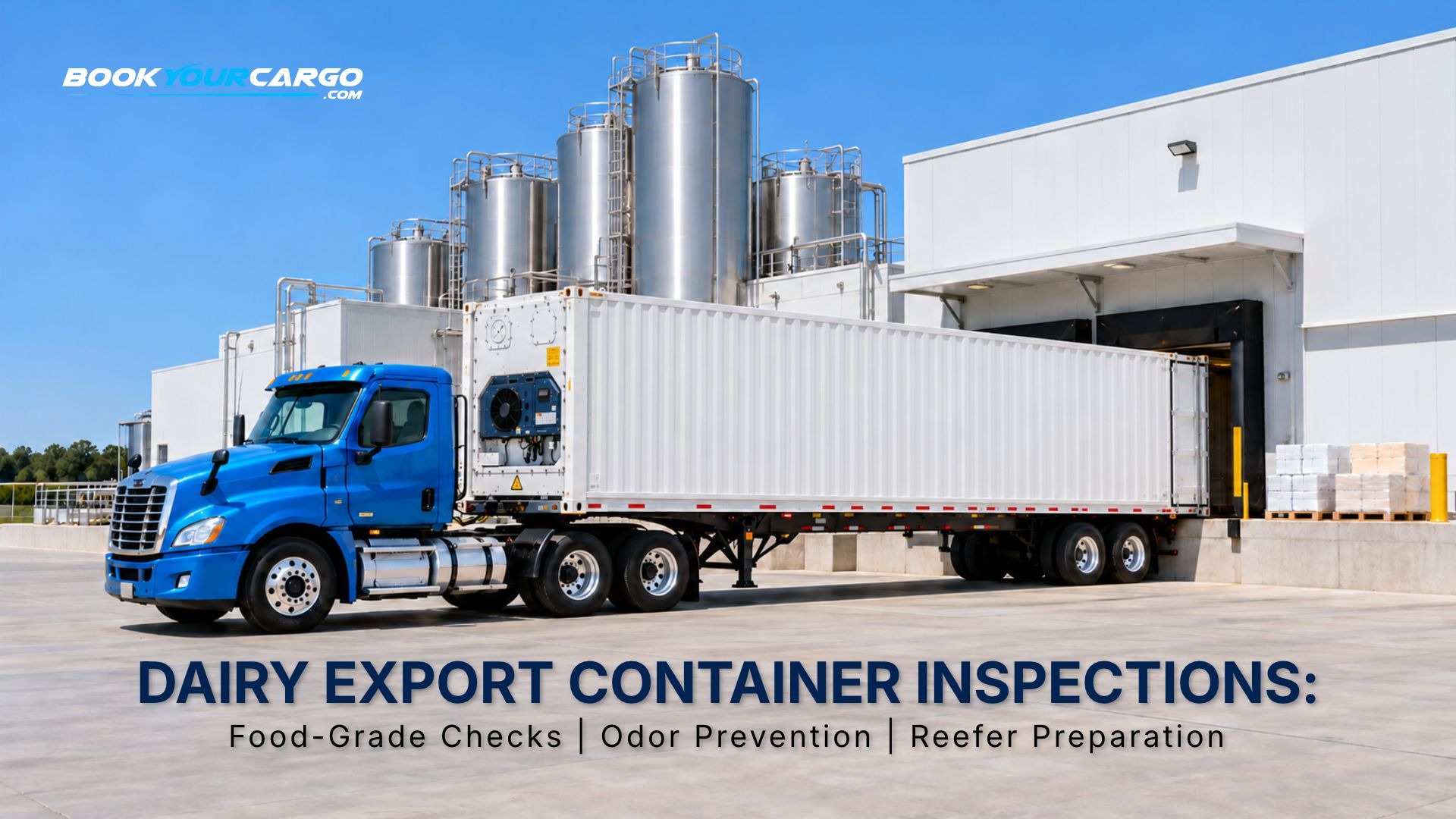
A dairy export can fail before a single carton is loaded, because the container itself is unfit for food. Federal rules put the duty to check the box on whoever loads it, and the drayage leg to the port sits squarely inside those rules.
Butter and cheese are among the most odor-sensitive cargoes there are. An empty that carried fish, onions or chemicals on its last trip can taint a load that left the plant in perfect condition, and nobody will know until the buyer opens the doors. The temperature can be right the whole way and the cargo can still be rejected.
Book Your Cargo runs dairy exports with genset coverage and temperature monitoring on the road leg, the operating temperature taken in writing on every reefer dispatch, and real-time container tracking from pickup to terminal gate-in.
This guide is for general information. Confirm current requirements with FDA for your specific product and operation.
This guide covers why a shipping container is regulated food equipment, who owns the inspection, why dairy is uniquely exposed to taint, what a pre-loading check actually covers, the gap in the standard gate inspection, reefer preparation, and what happens when a box has to be rejected.
1. A shipping container is regulated food transportation equipment
The FDA rule on sanitary transportation of human and animal food defines transportation equipment to include bulk and non-bulk containers. A shipping container carrying food on a truck in the United States is therefore regulated equipment, and the rule sets four requirements for vehicles and transportation equipment.
Requirement | What the rule says |
|---|---|
Design | Suitable and adequately cleanable for its intended use, so the food does not become unsafe |
Sanitary condition | Maintained in a sanitary condition for its intended use |
Temperature control | For food requiring temperature control for safety, designed, maintained and equipped to provide adequate temperature control |
Storage | Stored so that it does not harbor pests or become contaminated |
Two scope points matter for dairy. The rule covers movement by motor vehicle or rail within the United States, so the drayage leg to the port is covered while the ocean leg is not. And although the rule generally excludes food completely enclosed by a container, it carves back in food that requires temperature control for safety, so boxed cheese and butter in a reefer are inside it.
2. There is no exemption for exports
The scope of the sanitary transportation rule excludes only three things: food transshipped through the United States, food imported for future export and not consumed or distributed here, and facilities regulated exclusively by USDA under the meat, poultry and egg inspection acts. There is no exclusion for US-origin food being exported.
FDA addressed this directly when it finalized the sanitary transportation rule. Asked about export containers, it stated that the loader for a truck transportation segment moving food to a vessel port facility is subject to the rule because it is loading a motor vehicle, while the loader for the ocean segment is not. It also declined a request to exempt US-origin food bound for export.
3. Who actually owns the container inspection
This is the point most exporters get wrong. In the same rulemaking FDA recognized that, under typical industry practice, ocean containers are inspected and prepared for transportation by the person who loads them, such as the shipper or loader, and not by the owner or supplier of the container. The rule places no requirements on a container owner that is not itself a shipper, loader or carrier.
The loader's duties under the rule are specific.
- Food not fully enclosed. Before loading, the loader must determine that the equipment is in appropriate sanitary condition, including adequate physical condition, and free of visible evidence of pest infestation and of previous cargo that could make the food unsafe.
- Food requiring temperature control. Before loading, the loader must verify that each refrigerated compartment or container is adequately prepared, including that it has been properly pre-cooled if necessary, and meets other sanitary conditions.
- Reassigning duties. One party can be shipper, loader and carrier at once, and responsibilities can be reassigned only by written agreement.
Noncompliance carries real weight. The rule makes noncompliant food adulterated under the Food, Drug, and Cosmetic Act and makes the failure a prohibited act.
The steamship line supplies the box, but the loader owns the decision to load it. If the plant loads food into an unsuitable container, the regulatory exposure sits with the plant, not with the equipment provider.
How BYC handles this
Book Your Cargo delivers the empty to the plant on the loading schedule and, when a plant rejects a box as unfit, coordinates the swap with the equipment provider so a suitable container arrives before the loading window closes. On reefer dispatches the operating temperature is taken in writing and kept on file, which is the written instruction the rule expects the shipper to give the carrier.
4. Why dairy is the cargo most exposed to taint
Fat absorbs odor. USDA perishable food transport guidance states that fatty or oily foods such as butter, oleomargarine and meats are highly susceptible to contamination by strong odors, and that butter and margarine absorb odors very easily. It advises that trucks or trailers previously used for hauling odorous products such as fish, cabbage or onions be well cleaned and aired before being loaded with butter.
That guidance was written for truck trailers and dates from 1995, reprinted in 2008, so it is best read as a principle rather than as ocean container procedure. The Code of Practice for Packing of Cargo Transport Units, known as the CTU Code, applies the same principle to containers: closed units should be clean, dry and free of residue and persistent odors from previous cargo, and goods with tainting odors should not be stowed with sensitive merchandise.
The practical consequence for dairy is that a container can pass every structural check and still be unusable. Odor is not visible damage, and a box that looks clean can still carry its last cargo in the floor and walls.
Open the doors, let the air inside settle, and smell the box before anything is loaded. On dairy, an off-odor in the empty is a reason to reject it on its own, whatever the box looks like.
Send us your plant location and destination port, and we will come back with a drayage quote and real-time tracking on every load.
5. What a pre-loading check actually covers
The most complete recognized checklist comes from the CTU Code, issued jointly by the International Maritime Organization, the International Labour Organization and the United Nations Economic Commission for Europe. Its chapter on checking a unit before packing sets out the following.
Check | What to look for |
|---|---|
Approval plate | A valid safety approval plate and current examination date |
Exterior | Frame, walls and roof not significantly distorted, cracked or bent; doors that lock and seal; gaskets and weather strips in good condition |
Interior air | Doors opened long enough for the air inside to settle before anyone enters |
Floor and walls | No major damage, broken flooring or protrusions; no liquids or persistent stains |
Stain test | A stain that transfers to a gloved hand wiped over it means the unit should not be used |
Light test | Any light entering a closed unit marks a potential leak point |
Cleanliness | Free of previous cargo residue, odors, pests, soil and old labels or placards |
Two cautions apply. The CTU Code is a code of practice written in terms of should rather than shall, so it carries international authority but does not by itself bind a US operator. And the light test is a field check, distinct from the water spray test used to certify container weatherproofness when containers are built and type-approved under the ISO 1496 series. A box that passed the factory test years ago can still leak today.
6. The gap in the standard gate inspection
Most exporters assume the empty is checked when the truck collects it. It is checked, but not for this. The Uniform Intermodal Interchange and Facilities Access Agreement, known as the UIIA, is the contract under which motor carriers take equipment at US terminals and depots. Its required motor carrier pre-trip inspection lists sixteen items, and every one concerns the chassis and road safety: twist locks, slider pins, landing legs, tires, rims, lights, brake lines, the rear underride guard and similar.
Nothing on that list covers the inside of the container: not cleanliness, not odor, not the floor, not water tightness. The agreement also states that the parties make no express or implied warranty as to the fitness of the equipment.
That is the gap. The federal duty to check the interior exists, but the interchange process at the gate does not perform it. Unless someone checks the box deliberately, the first person to look inside it is the plant's loading crew.
The same term causes confusion on reefers. A reefer pre-trip inspection, usually called a PTI, is a carrier or depot test of the refrigeration machinery. It is unrelated to the motor carrier's road safety pre-trip at the gate, and neither one covers what the other does.
Do not assume the gate inspection covered the inside of the box. Build an interior check into the plant's loading procedure, and record it.
7. Preparing a reefer for dairy
Reefer preparation has a regulatory layer and a practical layer, and the two are often confused.
Pre-cooling: the shipper decides
FDA does not require pre-cooling in every case. When it finalized the rule it added the words if necessary to the pre-cooling provision, and stated that the shipper must determine whether pre-cooling the equipment is necessary for the food being shipped. Where the shipper does specify it, a carrier offering refrigerated equipment must pre-cool as specified.
Practice on pre-cooling an empty marine reefer is split. Ocean carrier loading guidance focuses on pre-cooling the cargo rather than the box: product should already be at transport temperature before loading, and one major carrier advises setting the unit no lower than carrying temperature, because a lower setting will not improve cooling and may damage the cargo. A cold chain industry guide notes that many international carriers advise against pre-cooling containers in hot, humid, open environments, because moist air entering a cold box condenses on its interior surfaces and can drip onto cartons. Marine insurers, by contrast, publish guidance to pre-cool the unit with the doors closed. The deciding factors are ambient humidity and whether the plant loads through a refrigerated dock.
Airflow and settings
- Never load beyond the red load line or past the end of the T-shaped floor channels that carry air under the cargo.
- Load to the edge of the T-floor and fill gaps so air does not bypass the load; one carrier advises that gaps should not exceed about 5 percent of floor area.
- Keep drain holes and floor channels clear of debris.
- Frozen cargo, such as butter held around minus 10 degrees Fahrenheit, runs with fresh-air ventilation closed. Chilled cargo, such as fresh butter around 39 degrees Fahrenheit or cheese, runs with ventilation set as the product requires.
How BYC handles this
Book Your Cargo runs refrigerated dairy moves with genset coverage on the road leg, so the unit keeps power between the plant and the terminal, and temperature monitoring on the road leg, so a deviation is flagged rather than discovered at gate-in. The operating temperature is taken in writing on every reefer dispatch, and plug availability at the receiving terminal is confirmed against the appointment, the same discipline that runs every reefer drayage move.
8. When a container has to be rejected
No regulation grants an explicit right to reject a container. The right is implied by the duty: a loader that has determined a box is unsuitable cannot load food into it without breaching the rule. The CTU Code is more direct, stating that a unit with a transferable stain should not be used and that a replacement should be requested.
Commercially, rejection happens under the interchange agreement. In one published dispute decision under the UIIA, a container was collected with no visible damage, its floor cracked during loading, the customer stopped loading and rejected it, and the equipment provider billed per diem. The panel found for the motor carrier, reasoning that the floor was not among the sixteen items the motor carrier was required to check and that its weakness could not have been found through visual inspection. That case involved lumber rather than food, but the mechanic is the same: rejection and replacement are routine when the defect is documented.
Photograph and record the condition when a container is rejected, and record the replacement. That record is what defends the per diem and the delay if either is later disputed.
How BYC handles this
A rejected empty is a timing problem as much as an equipment problem, because the loading window and the export cutoff do not move. Book Your Cargo returns the rejected unit, arranges a replacement against the same window and tracks both, so the plant schedule and the booking hold. In a tight equipment market, empty container returns and street turns are where usable replacement capacity tends to be found.
9. Real-time container tracking on every export move
Book Your Cargo provides real-time container tracking on every export move, from pickup to terminal gate-in. The team flags window changes and delays before the truck is loaded, not after it arrives at the terminal. That is how dry runs, missed cutoffs and wasted trips are prevented.
On reefer loads, that visibility extends to temperature and power status on the road leg, so a problem is caught while the cargo can still be saved. It also supports compliance: the rule requires that food not be sold or distributed after a possible material failure of temperature control unless a qualified individual determines it is safe, and knowing whether and when an excursion happened is what makes that determination possible. Real-time container tracking is part of how a chilled export is run, and the drayage technology platform carries status and appointments through to gate-in.
Where BYC covers today
Inland ramps and origins | Export gateways |
|---|---|
Chicago | New York and New Jersey |
Columbus | Norfolk |
Cincinnati | West Coast gateways |
National drayage coverage extends beyond these to the major US ports and rail ramps, and on Puget Sound Northwest Seaport Alliance drayage serves the Seattle and Tacoma dairy gateways as one.
10. A food-grade container checklist for dairy exports
- Who the loader is, and whether any duties have been reassigned in a written agreement.
- Approval plate valid and examination date current.
- Exterior free of significant damage, with working doors, seals and gaskets.
- Doors opened and the air allowed to settle before entry, then the interior checked for odor.
- Floor and walls free of damage, liquids and transferable stains; light test passed.
- No previous cargo residue, pests, soil or old placards.
- For reefers: pre-cooling decided by the shipper and recorded, drain holes and floor channels clear, and ventilation set for frozen or chilled cargo.
- Operating temperature given to the carrier in writing.
- Load weight planned against road limits, since powder loads run heavy; overweight container drayage applies where they exceed them.
- Any rejection photographed and recorded, with the replacement unit noted.
Frequently asked questions
Yes. The FDA sanitary transportation rule defines transportation equipment to include bulk and non-bulk containers, and requires that equipment be suitable and adequately cleanable for its intended use, maintained in a sanitary condition, stored so it does not harbor pests, and, for food requiring temperature control, designed and equipped to provide adequate temperature control.
The rule covers movement by motor vehicle or rail within the United States. The drayage leg of a dairy export is therefore covered, while the ocean leg is not.
Yes. The rule excludes only food transshipped through the United States, food imported for future export and not consumed or distributed here, and facilities regulated exclusively by USDA under the meat, poultry and egg inspection acts. There is no exclusion for US-origin food being exported.
When FDA finalized the rule, it stated that the loader for a truck segment moving food to a vessel port facility is subject to the rule, and it declined a request to exempt US-origin food bound for export.
The loader. FDA recognized that ocean containers are typically inspected and prepared by the person who loads them, such as the shipper or loader, rather than by the container owner, and the rule places no requirements on a container owner that is not itself a shipper, loader or carrier.
Before loading food requiring temperature control, the loader must verify that the container is adequately prepared, including properly pre-cooled if necessary, and meets other sanitary conditions. Duties can be reassigned between parties only by written agreement.
Because fat absorbs odor. USDA perishable transport guidance states that fatty or oily foods such as butter, oleomargarine and meats are highly susceptible to contamination by strong odors, and that butter and margarine absorb odors very easily. It advises that equipment previously used for fish, cabbage or onions be well cleaned and aired before carrying butter.
The CTU Code applies the same principle to containers, stating that closed units should be clean, dry and free of residue and persistent odors from previous cargo. A container can pass every structural check and still be unusable for dairy because of odor alone.
The CTU Code chapter on checking a unit before packing covers the approval plate, the exterior frame, walls, roof, doors and gaskets, the interior floor and walls, cleanliness, and two simple field tests. A stain that transfers to a gloved hand means the unit should not be used, and any light entering a closed unit marks a potential leak point.
The CTU Code is a code of practice rather than a binding regulation, but it is issued jointly by the International Maritime Organization, the International Labour Organization and the United Nations Economic Commission for Europe, and it is the most complete recognized checklist available.
No. The motor carrier pre-trip inspection required under the Uniform Intermodal Interchange and Facilities Access Agreement lists sixteen items, all concerning the chassis and road safety, such as twist locks, tires, lights and brake lines. Nothing on the list covers cleanliness, odor, the floor or water tightness, and the agreement disclaims any warranty as to the fitness of the equipment.
The federal duty to check the interior exists, but the interchange process does not perform it. Unless someone checks the box deliberately, the first person to look inside is the plant's loading crew.
FDA leaves it to the shipper. The rule requires pre-cooling only if necessary, and FDA stated that the shipper must determine whether pre-cooling the equipment is necessary for the food being shipped. Where the shipper specifies it, the carrier must pre-cool as specified.
Practice is split. Ocean carrier guidance focuses on pre-cooling the cargo to transport temperature before loading rather than using the box as a chiller, and many international carriers advise against pre-cooling containers in hot, humid, open environments because condensation forms inside. The deciding factors are ambient humidity and whether the plant loads through a refrigerated dock.
Book Your Cargo delivers the empty to the plant on the loading schedule and, when a plant rejects a box as unfit, returns the rejected unit and arranges a replacement against the same loading window and export cutoff, tracking both so the booking holds.
On reefer dispatches the operating temperature is taken in writing and kept on file, genset coverage and temperature monitoring run on the road leg, and real-time container tracking runs from pickup to terminal gate-in on every export move.
