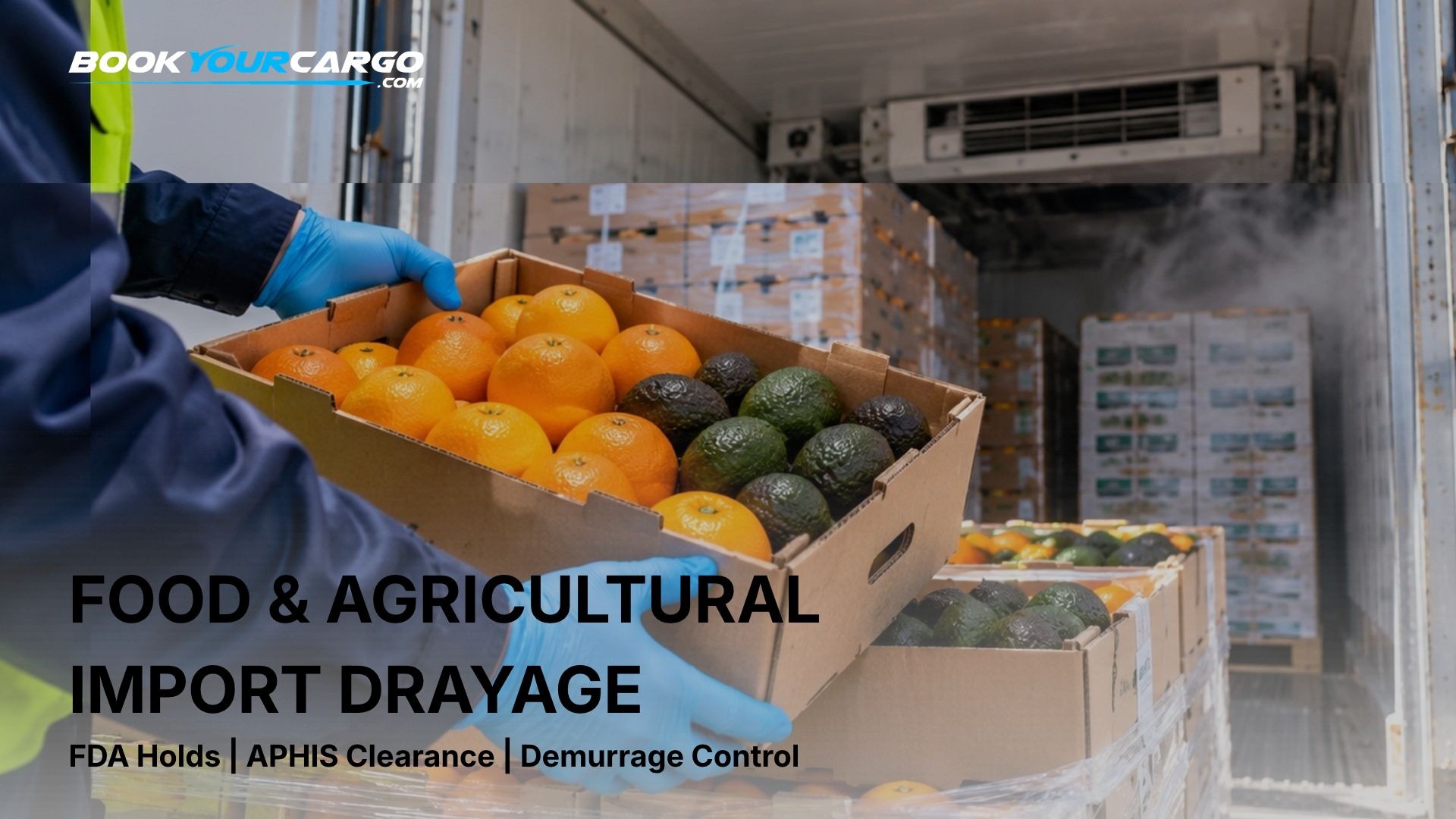
An imported food or agricultural container has to clear more than customs. The Food and Drug Administration (FDA) and the US Department of Agriculture Animal and Plant Health Inspection Service (APHIS) each hold independent authority over it, and a customs release does not override either one.
That matters to the drayage leg because the terminal free time keeps running while those agencies decide. A container can show as customs-released, sit inside its last free day, and still not be collectable, because a separate federal release is outstanding. The dispatch decision depends on every release, not the first one.
Book Your Cargo tracks each of those releases against the terminal clock and runs real-time container tracking from availability to delivery, so a food import moves the moment it can, and not before.
This guide is for general information. Confirm current requirements with FDA, USDA APHIS and US Customs and Border Protection for your specific product and origin.
This guide covers why a customs release is not the last gate, FDA prior notice and entry review, import alerts, APHIS permits and holds, cold treatment, wood packaging, who pays while a container is held, and how Book Your Cargo plans around each one.
1. Why a customs release is not the last gate
US Customs and Border Protection (CBP) refers every FDA-regulated shipment to FDA for an admissibility decision, and CBP's own regulation states that no food will be released except in accordance with the laws and regulations applicable to it. FDA decides independently, and during its review the product must be held and may not be distributed into US commerce until FDA has determined its admissibility.
APHIS runs a parallel track for plants and plant products. For imported fruits and vegetables, no person may move the commodity from the port of first arrival until an inspector has released it, ordered and completed treatment, authorized movement to another location for treatment or inspection, or ordered it reexported.
Agency | What it decides | What it can do to the container |
|---|---|---|
CBP | Entry and admissibility under customs law | Hold for examination; general order if not entered |
FDA | Admissibility under the Food, Drug, and Cosmetic Act | Request documents, examine, sample, detain or refuse |
USDA APHIS | Freedom from quarantine pests for plants and plant products | Hold, order treatment, order reexport or destruction |
Dispatch against the last release, not the first. On a food or agricultural import, CBP, FDA and where applicable APHIS each release separately, and the container is only collectable when every one of them has cleared alongside the carrier release and terminal availability.
2. FDA prior notice: the deadline before the vessel arrives
Every imported food shipment requires FDA prior notice of imported food, a requirement that comes from the Bioterrorism Act of 2002 and is codified in the Food, Drug, and Cosmetic Act. Any person with knowledge of the required information can submit it, and it must be submitted and confirmed by FDA ahead of arrival.
Mode of arrival | Prior notice deadline before arrival |
|---|---|
Water (vessel) | 8 hours |
Air | 4 hours |
Rail | 4 hours |
Road | 2 hours |
Notice can be filed no more than 30 calendar days ahead through the customs electronic filing system, or 15 calendar days ahead through FDA's own web interface. The deadline counts from the point FDA confirms the submission for review and issues a confirmation number, not from when it was sent.
The consequence of a missing or inaccurate notice is immediate. The food is refused admission and must be held within the port of entry unless CBP or FDA directs otherwise. It becomes general order merchandise, must move under custodial bond, and may not be delivered to the importer or consignee. Federal law adds that posting a bond does not authorize delivery while the food is held, and that it is to be removed to a secure facility as appropriate. Corrected notice must be submitted within 10 calendar days of the refusal.
How BYC handles this
Prior notice is filed by the importer or customs broker rather than by the drayage provider, but the drayage plan depends on it. Book Your Cargo confirms prior notice and entry status before a pickup is dispatched, so a statutory hold is identified on the screen rather than at the gate. Where CBP or FDA directs a held container to a secure facility, that move is coordinated with the broker under the direction given, not treated as a standard delivery.
3. FDA entry review: May Proceed, Hold and Detention
Once entry data reaches FDA it is screened electronically, and anything not released automatically is routed for FDA import entry review. Since August 4, 2025 that review has been centralized nationally under the FDA ImportShield program rather than handled port by port, so older guidance describing a local district reviewer is out of date.
FDA status | What it means for the container |
|---|---|
May Proceed Without FDA Examination | FDA does not need to examine; the shipment can move once every other release clears |
Hold, Notify FDA of Location for Examination | FDA intends to examine or sample; the product must not be distributed |
Detained | FDA has issued a Notice of Detention and Hearing; the importer must respond or the product is refused |
Two points from FDA's own guidance shape the drayage plan. First, FDA states that there are no specific statutory or regulatory requirements for it to complete its admissibility process within a set amount of time. There is no clock on the agency. Second, for an ordinary entry review FDA does not require the product to be held in a particular location, but expects the process to be conducted within the declared port of entry area. If a product has left and FDA then decides to examine it, CBP can issue a demand for redelivery.
A Notice of Detention and Hearing gives the importer a period to respond, which FDA describes as generally 20 calendar days in the notice, with extensions available on request. Without a successful response the product is refused, and refused food must be exported or destroyed within 90 days of the refusal notice.
Budget for an open-ended review on any food entry that is not routinely released. FDA has no deadline to decide while the terminal free time has a fixed one, and the gap between the two is where storage charges accrue.
4. Import alerts and detention without physical examination
An FDA import alert is a notice FDA uses to flag firms and products with a history of violations. A firm or product on an alert's red or yellow list is subject to detention without physical examination, known as DWPE, which means FDA can detain future shipments without testing them first. A green list exempts named firms from that treatment.
The burden then sits with the importer, who has to show FDA that the product does not have the violation listed on the alert, typically through private laboratory analysis. For the drayage leg, that means a predictable delay on every shipment from an affected supplier, which belongs in the free time plan from the first booking rather than being discovered on arrival.
Send us your port, commodity and expected arrival, and we will come back with a drayage quote and a pickup plan built around every release.
5. USDA APHIS: permits, phytosanitary certificates and holds
Fresh fruits and vegetables imported into the United States generally must enter under a permit issued by APHIS, and under the conditions the APHIS import permit specifies. Dried, cured or processed produce, nuts, and dried beans and peas are among the exceptions. A permit may name specific ports of entry, in which case the commodity can only enter there, and permit applications are due at least 30 days before the cargo reaches the port.
A phytosanitary certificate is the exporting country's official statement that the consignment was inspected and is considered free of US quarantine pests. It is issued by the foreign national plant protection organization, addressed to APHIS, and certifies the place of origin and conformity with US requirements.
When an APHIS inspector orders action on a consignment, the order is issued through an Emergency Action Notification, PPQ Form 523, where PPQ stands for Plant Protection and Quarantine. The owner must then destroy, reexport, move to an authorized site or treat the goods within the time and manner specified. Where produce is prohibited, lacks required documentation, is infested beyond treatment or carries soil, the entire lot may be refused entry.
One form is commonly confused here. PPQ Form 505 is the Lacey Act plant and plant product declaration, which records species, country of harvest, quantity and value. It is not a phytosanitary or permit document, and filing it does not release a produce shipment.
How BYC handles this
An APHIS hold is a hard stop: the regulation bars movement from the port of first arrival until an inspector releases or redirects the cargo. Book Your Cargo does not dispatch against an APHIS-regulated container until that release is confirmed, and where an inspector authorizes movement to another location for treatment or inspection, the move is scheduled to the directed site and window so the container is not held twice.
6. Cold treatment: when the clock depends on a temperature chart
Some imported fruit has to be cold treated against pests, held at a set pulp temperature for a set period, either before shipment, in transit, or at an APHIS-certified facility in the United States. APHIS cold treatment requirements for in-transit treatment include several rules that directly decide when a container can be collected.
- The container doors carry a numbered seal that may be removed only at the port of destination by an APHIS-authorized official.
- Temperatures must be recorded at least hourly, and gaps longer than an hour invalidate the treatment unless an APHIS official can verify the pulp stayed at temperature.
- Refrigeration continues until the vessel arrives and the fruit is released for unloading by an inspector, even where that prolongs the treatment period.
- Treated consignments may not be discharged until APHIS clearance is fully completed, including review and approval of the treatment record charts.
If a single live pest of concern is found when the fruit is sampled after treatment, the consignment is held until an investigation is completed. A failed or invalidated treatment is resolved through the Emergency Action Notification process, which can mean retreatment, movement to an authorized site, reexport or destruction.
A cold-treated container is not collectable when it is discharged. It is collectable when APHIS has approved the treatment records and released it, and that review is a step in its own right.
How BYC handles this
Cold-treated produce is a refrigerated move with a regulatory gate in front of it. Book Your Cargo holds the dispatch until APHIS clearance is confirmed rather than sending a truck to wait at the gate, then keeps the reefer under power with genset coverage and temperature monitoring on the road leg, the same plug-and-window discipline that runs every reefer drayage move.
Perishable imports concentrate where reefer plug capacity and cold storage sit close to the terminal. PhilaPort, with 2,500 reefer plugs, is one example, and PhilaPort reefer and perishable import drayage is planned around plug and warehouse capacity together.
7. Wood packaging material and the ISPM 15 mark
Imported cargo on wood pallets, crates or dunnage carries a separate requirement. Regulated wood packaging material must be treated and marked under International Standards for Phytosanitary Measures No. 15, known as ISPM 15, and the US wood packaging material import rule sets out what the mark must contain. It must be visible, preferably on two opposite sides, and include the approved symbol, the two-letter country code, a producer number assigned by the exporting country, and the treatment code: HT for heat treatment or MB for methyl bromide fumigation.
An inspector at the port of first arrival may order the immediate reexport of wood packaging that arrives without the required mark. The regulation reaches the wood packaging itself. Whether the cargo goes back with it depends on whether the two can practically be separated, which is decided operationally at the port rather than by a fixed rule, so unmarked packaging should be treated as a risk to the whole container until it is resolved.
8. Who pays while a container is held, and does demurrage stop?
The cost allocation is explicit. On the APHIS side, the owner of imported fruits or vegetables is responsible for all additional costs of inspection, treatment, movement, storage, destruction or other measures an inspector orders. On the FDA side, neither FDA nor CBP is liable for transportation, storage or other expenses resulting from a refusal, and federal law places the expenses of storage, cartage and labor on the owner or consignee.
Terminal charges are the part importers most often misjudge. No federal rule suspends demurrage while a government hold is in place. When the Federal Maritime Commission issued its demurrage and detention interpretive rule in 2020, it considered and declined to adopt a single approach to charges during government inspections. Instead the rule allows the Commission to consider, case by case, the extent to which charges are serving their intended purpose and any extenuating circumstances.
In practice, any free time extension during a hold is a term of the specific terminal or carrier tariff rather than a right, and the demurrage and detention invoice rules govern how charges must be billed and disputed. The importer's strongest position is a clean file, because complete, accurate and timely paperwork is one of the factors the Commission weighs.
How BYC handles this
The cost of a hold is driven by how long the container sits after it becomes collectable, not only by the hold itself. Book Your Cargo tracks every outstanding release against the last free day, books the terminal appointment for the window when the final release is expected, and dispatches as soon as it clears. That is the practical side of demurrage prevention on food freight: the hold is outside anyone's control, but the gap after it is not.
Where a released container cannot go straight to the consignee, warehousing near the port takes it off the terminal clock, and the customs hold and CBP exam process runs on the same release-tracking discipline.
9. Real-time container tracking on every import move
Book Your Cargo provides real-time container tracking on every import move, from availability to delivery. The team watches carrier, customs, FDA and APHIS status alongside the terminal clock and flags a change before a truck is dispatched, not after it reaches the gate. That is how dry runs, missed appointments and avoidable storage charges are prevented.
On food imports the value is in the sequencing. A container can clear customs on one day, FDA on another and APHIS on a third, and the useful moment is the hour the last of them clears. On refrigerated produce, real-time container tracking also carries temperature and power status on the road leg, so a problem after release is caught while the cargo can still be saved, and the drayage technology platform carries release status and appointments through to delivery.
Where BYC covers today
Inland ramps | Port gateways |
|---|---|
Chicago | New York and New Jersey |
Columbus | Norfolk |
Cincinnati | West Coast gateways |
Port drayage and national drayage coverage extends beyond these to the major US ports and rail ramps.
10. A food and agricultural import drayage checklist
- FDA prior notice confirmed, with the confirmation number, at least 8 hours before vessel arrival.
- FDA entry status checked: May Proceed, Hold for examination, or Detained.
- Import alert status of the supplier and product checked before booking, not after arrival.
- APHIS permit in place for regulated produce, with the permitted port of entry matching the routing.
- Phytosanitary certificate issued by the exporting country and matching the consignment.
- For cold-treated fruit, treatment records approved and APHIS clearance confirmed before dispatch.
- Wood packaging marked to ISPM 15, or the risk flagged before the vessel sails.
- Carrier release, CBP release and terminal availability aligned with every agency release.
- Last free day known, and the terminal tariff checked for any hold-related free time terms.
- For reefers, plug availability at the terminal and genset coverage for the road leg confirmed.
Frequently asked questions
Not necessarily. CBP refers every FDA-regulated shipment to FDA, and CBP regulation states that no food will be released except in accordance with the laws and regulations applicable to it. FDA decides admissibility independently, and imported fruits and vegetables also need an APHIS release before they can leave the port of first arrival.
A food container is collectable only when the carrier release, CBP release, terminal availability and every applicable agency release have all cleared. Dispatching against the first release rather than the last is the most common cause of a wasted trip on food freight.
For food arriving by vessel, prior notice must be submitted and confirmed by FDA at least 8 hours before arrival at the port. The deadlines are 4 hours for air and rail and 2 hours for road. Notice can be filed no more than 30 calendar days ahead through the customs electronic filing system, or 15 calendar days ahead through FDA's own web interface.
The deadline counts from the point FDA confirms the submission for review and issues a confirmation number, so a notice that has been sent but not confirmed does not meet it.
The food is refused admission and must be held within the port of entry unless CBP or FDA directs otherwise. It becomes general order merchandise, must move under custodial bond, and may not be delivered to the importer or consignee. Federal law states that posting a bond does not authorize delivery while the food is held.
Corrected prior notice must be submitted within 10 calendar days of the refusal. Neither FDA nor CBP is liable for the transportation, storage or other expenses that result.
There is no fixed time. FDA states that there are no specific statutory or regulatory requirements for it to complete its admissibility process within a set amount of time. Since August 4, 2025, that review has been centralized nationally under the FDA ImportShield program.
Because the terminal free time has a fixed deadline and FDA review does not, any food entry that is not routinely released should be planned with an open-ended review in mind, with the pickup booked against the expected release rather than the discharge date.
Detention without physical examination, known as DWPE, allows FDA to detain shipments without testing them first. It applies to firms and products on the red or yellow list of an FDA import alert, which is a notice FDA uses to flag firms and products with a history of violations. A green list exempts named firms.
The burden then sits with the importer to show the product does not have the listed violation, usually through private laboratory analysis. If the importer cannot, the product is refused and must be exported or destroyed within 90 days of the refusal notice.
Yes. For imported fruits and vegetables, the regulation states that no person may move the commodity from the port of first arrival until an inspector has released it, ordered and completed treatment, authorized movement to another location for treatment or inspection, or ordered it reexported.
Orders are issued through an Emergency Action Notification, PPQ Form 523, and the owner is responsible for all additional costs of inspection, treatment, movement, storage or destruction that an inspector orders. Where produce is prohibited, lacks required documentation or carries soil, the entire lot may be refused entry.
No federal rule suspends it. When the Federal Maritime Commission issued its demurrage and detention interpretive rule in 2020, it considered and declined to adopt a single approach to charges during government inspections, leaving it to consider case by case whether charges are serving their intended purpose and any extenuating circumstances.
Any free time extension during a hold is therefore a term of the specific terminal or carrier tariff rather than a right. Complete, accurate and timely paperwork is one of the factors the Commission weighs, which makes a clean file the importer's strongest position.
Book Your Cargo tracks carrier, customs, FDA and APHIS status against the last free day, books the terminal appointment for the window when the final release is expected, and dispatches as soon as it clears, so the container does not sit on the terminal after its last release. Where an agency directs a container to another site, that move is scheduled to the directed location and window.
Real-time container tracking runs on every import move from availability to delivery, and on refrigerated produce it carries temperature and power status on the road leg, with genset coverage keeping the unit powered once the container is released.
