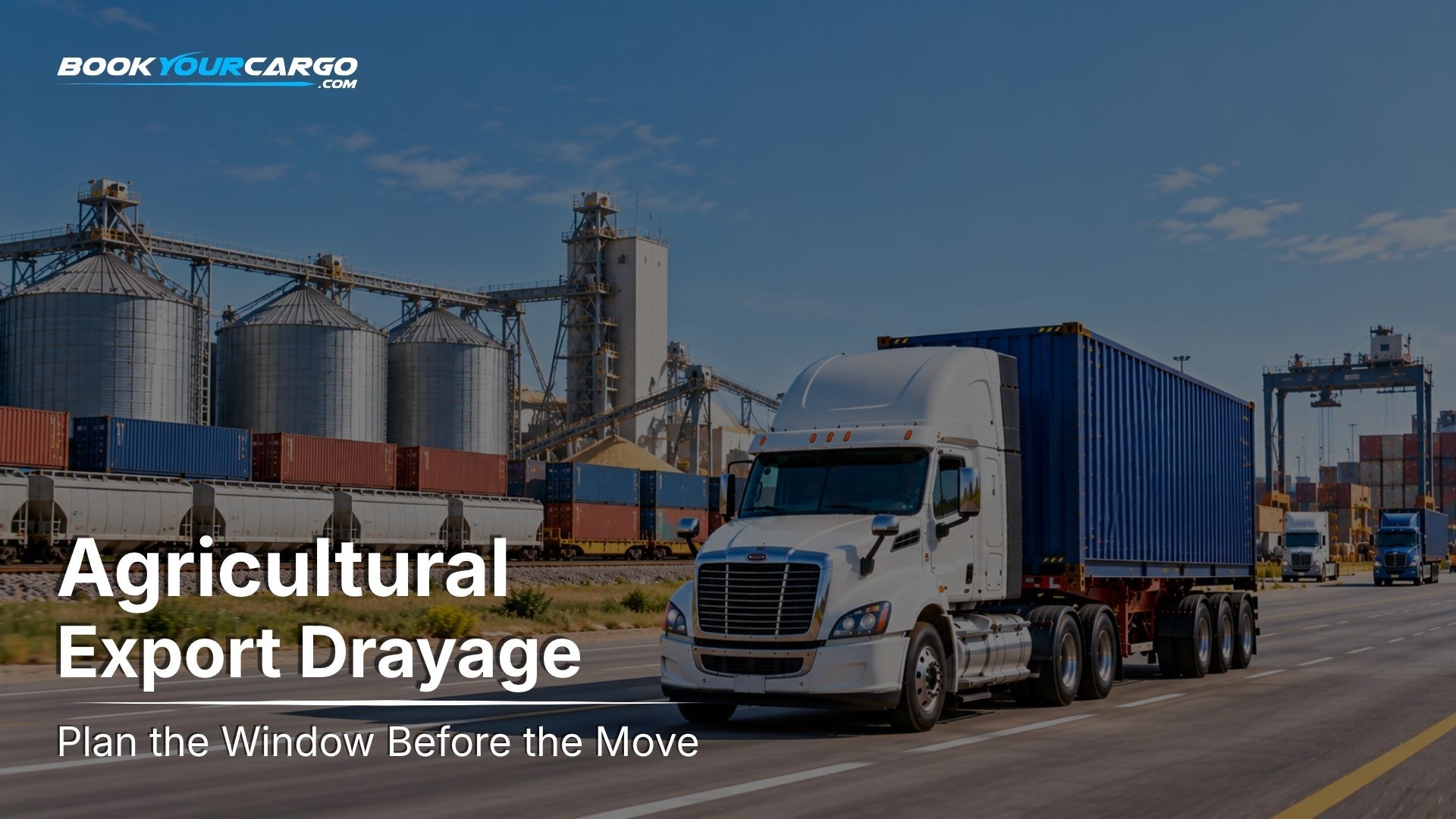
Import drayage races a clock that starts when the container lands. Export drayage races a clock that ends before the vessel sails. That inversion is the single most important thing to understand about moving agricultural commodities in containers, and it is why import playbooks fail when applied to export freight.
On an import, free time begins at discharge and the penalty for being slow is demurrage. On an export, the terminal will not receive the container before the earliest return date and will not receive it after the cargo cutoff. Arrive early and the gate turns the truck away. Arrive late and the box misses the vessel. The window is finite, it is set by the carrier, and it moves.
For agricultural exporters the problem compounds, because the cargo frequently starts hundreds of miles from the port. A cutoff change that an importer absorbs with a phone call can strand a load that is already in transit across two states. This is why Book Your Cargo runs real-time container tracking on every export move and flags window changes before a truck is loaded rather than after it reaches the gate.
This guide covers how much agricultural freight actually moves in containers, the export timeline and what each date governs, why empty equipment is the binding constraint inland, where containerized agricultural exports actually load, and how Book Your Cargo plans each of these moves.
1. How much agricultural freight moves in containers
Containers carry a minority of US agricultural exports by volume, and the share is smaller than the attention the sector receives would suggest. In 2025, containers carried 11 percent of total US waterborne grain exports, according to USDA Agricultural Marketing Service grain transportation reporting.
| Year | Containerized share | Context |
|---|---|---|
| 2020 | 10 percent | Before the pandemic-era equipment crisis peaked |
| 2023 | 14 percent | The high point in the published series |
| 2025 | 11 percent | Most recent figure |
Two cautions on that number, because it is widely misquoted. First, the USDA measure covers a defined basket of grains, oilseeds and feed products, including wheat, corn, sorghum, barley, soybeans, soybean meal and distillers dried grains. It does not include cotton, hay, pulses or tree nuts, so it cannot be described as the containerized share of agricultural exports generally. Second, destination matters: roughly 83 percent of US waterborne containerized grain exports were destined for Asia.
Containerized agricultural exports are a minority by volume and a majority of the operational difficulty. Bulk moves on a vessel schedule. Containers move on an equipment cycle, a drayage window and a gate appointment, each of which can fail independently.
2. The export timeline and what each date governs
The export window has a name in federal advisory work: the cargo receiving window. It is bounded by three dates, and the sequence is what an export dispatch is planned against.
| Date | What it governs |
|---|---|
| Earliest return date (ERD) | The first day the terminal will receive the loaded container for that vessel. Arrive before it and the gate refuses the truck. |
| Documentation cutoff | The deadline for shipping instructions and documentation to be lodged with the carrier. |
| Physical cargo cutoff | The last moment the loaded container can be received at the terminal for that sailing. |
The National Shipper Advisory Committee to the Federal Maritime Commission uses the term early return date for ERD, while carriers and terminals also render it as earliest receiving date. The two refer to the same gate-opening date.
A verified gross mass figure is also required before loading. Under international convention on verification of container gross mass, in force since July 2016, the shipper is responsible for providing a verified gross mass for a packed container, by weighing the packed container or by weighing all packages and adding the container tare using a certified method. Carriers typically impose their own VGM submission deadline, but that deadline is commercial practice rather than a regulated date in the sequence above.
Plan the load date from the earliest return date forward and the cutoff backward, then subtract transit time from origin. On inland agricultural freight that arithmetic decides the loading date at the farm or elevator, not the dispatch date at the port.
How BYC handles this
Book Your Cargo reads the earliest return date, documentation cutoff and physical cargo cutoff from each specific booking rather than from the vessel schedule, because the two frequently disagree. Gate appointments are then booked inside the correct window for that booking, and the loading date at origin is set by working backward from the cutoff with a transit buffer sized to the actual route rather than a standard allowance.
When a window moves, the move is replanned rather than attempted. That means reassessing the loading date, the appointment and the equipment together, because changing one without the other two is what produces a truck at a closed gate.
3. Why the window moves, and what that costs inland
The window is not stable. Federal advisory findings describe the problem in direct terms: ocean carriers are not giving adequate lead time on changes to the earliest return date for exporters to alter scheduled dispatch and loading times for cargo that may be hundreds of miles inland requiring days of preplanning.
In some cases the change is not communicated at all, and is discovered when drayage companies arrive at the terminal with loaded containers. The consequences named are extra chassis rental, dry run charges, yard storage and additional truck moves to the rail ramp or port.
A separate federal fact-finding effort reached the same conclusion for agricultural shippers specifically, noting that their cargo may take several days to reach a terminal, that some reported cargo already in transit when a delayed ERD was announced, and that some truckers had to turn around and return the container to the shipper while others had no option but to deliver early.
The alignment problem inside a single vessel call
There is a further complication that catches exporters booking across carriers. Most times, a vessel calling the same port will have two, three or four different earliest return dates and documentation and physical cutoff dates, depending on which carrier issued the booking confirmation.
One vessel, one terminal, four different windows. An exporter consolidating volume across carriers for the same sailing is therefore managing several separate dispatch problems, not one, and a window read from the wrong booking is a wasted trip.
This is also why terminal appointment capture matters more on exports than importers expect. The slot has to fall inside the correct carrier window, and a slot inside the wrong window is worth nothing.
4. Empty equipment is the binding constraint
The hardest part of an inland agricultural export is frequently not the loaded move to the port. It is getting an empty container to the origin in the first place.
USDA has stated the problem to the Federal Maritime Commission without hedging: finding available containers is one of the biggest transportation challenges facing US agricultural exporters, particularly products originating in the US heartland, and the lack of transparency in this area of the container market increases costs, delays shipments and in some cases leads to lost sales for US producers.
The structural cause is geographic. Import containers land at coastal population centers because that is where imported goods are consumed. Agricultural exports load in the interior. Every export container has to be repositioned against the grain of the import flow, and federal testimony describes empty containers sometimes requiring repositioning hundreds or more miles from a seaport or inland location to the particular rail ramp where the exporter needs them.
Confirm empty availability at the specific ramp before committing a loading date. An export booking with a confirmed window and no confirmed empty is not a plan, and the empty is the piece least under anyone local control.
How BYC positions empties at inland origins
This is the part of an inland agricultural export that most often decides whether a sailing is made, so Book Your Cargo treats empty positioning as the first step of the move rather than a precondition someone else supplies.
- Empty sourced before the loading date is committed. Availability is confirmed at the named ramp or depot for a specific date, so the loading date at the elevator is set against equipment that exists rather than equipment that is expected.
- Positioned to the loading site on the shipper schedule. Elevators and loading sites run on their own throughput, and an empty that arrives on the wrong day occupies a slot the shipper needed for something else. Delivery of the empty is scheduled to the site, not to the ramp.
- Capacity held at the inland ramps. BYC holds drayage capacity at the inland ramps, which is what makes repositioning practical, rather than sourcing a truck against each load as it comes up.
- Street turns used where the timing allows. An import container being returned near an export origin is the cheapest empty available, and matching the two removes a repositioning move entirely.
On soybean export programs out of the Ohio Valley, that sequence is the whole job. The loaded run to the North Atlantic gateways is straightforward; getting the right number of empties to the right elevators on the days the beans are moving is what has to be engineered, and it is planned several weeks ahead of the sailing rather than in the week before it.
Managing the empty side is a discipline of its own, and empty container returns and street turns is where the usable capacity in a tight equipment market tends to be found.
Loading soybeans, grain or feed for export?
Send us your loading location, port and target sailing, and we will come back with a drayage quote and a plan built around the window.
5. Where containerized agricultural exports actually load
Bulk and container agricultural exports leave the country through different doors, and conflating them produces the wrong network plan.
For soybeans, bulk exports move predominantly through New Orleans, at around 69 percent, and the Pacific Northwest at around 27 percent. Container exports of the same commodity move predominantly through California, at around 47 percent, and North Atlantic ports at around 40 percent. Five ports, Los Angeles, Long Beach, Tacoma, Norfolk and New York, account for roughly 90 percent of containerized soybean export volume.
The inland origin side is documented at national scale. US railroads originated 4.7 million tons of containerized grain in 2022. In the Kansas City region specifically, railroads originated 300,000 tons of containerized grain, nearly all of it destined for Los Angeles for export overseas.
Containerized agricultural exports are a West Coast and North Atlantic trade fed by inland rail, not a Gulf trade. Gulf ports dominate bulk agricultural tonnage, which is a different business with different equipment and different clocks.
Regional patterns differ by commodity and by origin. Ohio Valley agricultural commodity export drayage runs on proximity to the North Atlantic gateways, while Oakland agricultural and DFN export drayage serves a West Coast mix weighted toward dry nuts and dried fruit, known in the trade as DFN, rather than field crops. The LA and Long Beach DFN export lane is a third pattern again.
Cotton behaves differently from grain and is worth separating. It typically moves from warehouse to port by truck in multi-bale truckloads and is transferred into containers at the port rather than loaded at origin, which changes where the drayage leg sits in the chain.
Where BYC covers today
Export drayage only works where the inland origin and the export gateway are both covered, so coverage is held at both ends of the lane.
| Inland ramps and origins | Export gateways |
|---|---|
| Chicago | New York and New Jersey |
| Columbus | Norfolk |
| Cincinnati | West Coast gateways |
National drayage coverage extends beyond these to the major US ports and rail ramps, and rail drayage at the inland ramps is what makes an interior loading point viable for a container export at all.
6. Keeping the three freight types separate
Exporters and providers both lose money by treating agricultural container freight as one category. It is three, and they need different equipment and different planning.
| Category | Examples | Operating characteristic |
|---|---|---|
| Field crops and feed | Soybeans, corn, sorghum, soybean meal, distillers dried grains | Dry containers, weight-critical, inland origins, bulk-to-container transload common |
| Dry nuts and dried fruit (DFN) | Almonds, walnuts, pistachios, raisins | Dry containers, high value, West Coast origins, quality-sensitive to heat and moisture |
| Perishables | Fresh produce, meat, dairy requiring chill | Refrigerated equipment, plug and genset dependency, shelf life running alongside the export window |
The third category adds a clock the other two do not have. A dry container export is racing the cutoff. A reefer drayage export is racing the cutoff and the shelf life at the same time, with a plug and genset dependency on top. Book Your Cargo handles refrigerated export moves with genset coverage and temperature monitoring on the road leg.
How BYC handles heavy loads
Soybeans, grain, soybean meal and distillers dried grains all load heavy, and an agricultural export container is frequently closer to the road limit than the shipper expects. The container payload rating is not the operative number, because federal law caps gross vehicle weight at 80,000 pounds and that ceiling has to cover the tractor, the chassis, the container tare and the cargo together.
Every load is planned against road weight limits, rail ramp thresholds and the carrier payload limit for the specific equipment, so a box is not rejected or reworked at the terminal. Where a load genuinely runs heavy, overweight and tri-axle drayage equipment and overweight permits are arranged ahead of dispatch rather than discovered at the gate. The underlying weight and axle tests are covered in overweight container drayage.
Transloading for bulk-origin cargo
Much agricultural freight travels from the interior in bulk hopper cars and has to be containerized before it can be exported. Transloading is available through Book Your Cargo for exactly that step, moving the commodity from bulk into ocean containers at a near-port or inland transshipment point so the export booking can be met.
7. Real-time container tracking on every export move
Book Your Cargo provides real-time container tracking on every export move, from pickup to terminal gate-in. The team flags window changes and delays before the truck is loaded, not after it arrives at the terminal. That is how dry runs, missed cutoffs and wasted trips are prevented.
On export freight this matters more than on imports, because the failure mode is different. A late import accrues a charge while the container sits, and the charge can be disputed. An export that arrives outside its window is turned away, and the trip is simply lost. Federal findings describe exactly this pattern: cargo already in transit when a cutoff changed, and truckers turning around at the gate.
Visibility that surfaces a window change while the cargo is still at the elevator converts that lost trip into a replanned one. Real-time container tracking is therefore part of how the move is run rather than a reporting layer added on top of it, and the drayage technology platform carries availability, appointment and status through to gate-in.
8. What federal rules now require of carriers on exports
Federal law prohibits an ocean common carrier from unreasonably refusing to deal or negotiate with respect to vessel space accommodations, with the implementing rule effective September 2024. Carriers must also file export policies with the Federal Maritime Commission annually, covering pricing, services and equipment provision strategies, with the stated purpose of enabling the timely and efficient movement of export cargo.
9. An export drayage checklist
- The earliest return date, documentation cutoff and physical cargo cutoff, read from the specific booking rather than from the vessel schedule.
- Confirmed empty container availability at the named ramp or depot, with a date.
- Chassis availability for the loading date, confirmed separately from the container.
- Transit time from origin to the receiving terminal, with a buffer sized to the route rather than a standard allowance.
- A gate appointment that falls inside the correct carrier window.
- Verified gross mass determined and submitted ahead of the carrier deadline.
- Load weight checked against road limits, ramp thresholds and the carrier payload limit for that equipment.
- A named fallback if the window moves: an alternate sailing, a yard to hold the loaded box, or a decision rule on whether to deliver early.
- For perishables, plug availability at the receiving terminal and genset coverage for the road leg.
One reporting note for anyone researching equipment availability: USDA published an ocean shipping container availability report covering 18 intermodal locations between 2012 and 2017, but it was discontinued after carrier participation fell away. It is sometimes cited as though it were current. It is not.
Frequently Asked Questions
The clocks run in opposite directions. On an import, free time begins when the container is discharged and the penalty for moving slowly is demurrage. On an export, the terminal will not receive the loaded container before the earliest return date and will not receive it after the physical cargo cutoff, so the exporter is working inside a finite window rather than against an accruing charge.
The failure modes differ accordingly. A late import accrues charges while the container sits. An export that arrives outside its window is turned away at the gate, which means a wasted trip, extra chassis time and in the worst case a missed sailing.
They are the three dates that bound what federal advisory work calls the cargo receiving window. The earliest return date is the first day the terminal will receive the loaded container for a given vessel. The documentation cutoff is the deadline for shipping instructions and documentation to be lodged with the carrier. The physical cargo cutoff is the last moment the loaded container can be received at the terminal for that sailing.
ERD is rendered both as early return date, which is the term used by the National Shipper Advisory Committee to the Federal Maritime Commission, and as earliest receiving date by carriers and terminals. Both refer to the same gate-opening date.
Carriers move them, often with limited notice. Federal advisory findings state that ocean carriers are not giving adequate lead time on changes to the earliest return date for exporters to alter scheduled dispatch and loading times for cargo that may be hundreds of miles inland requiring days of preplanning, and that in some cases the change is discovered only when drayage companies arrive at the terminal with loaded containers.
The named consequences are extra chassis rental, dry run charges, yard storage and additional truck moves to the rail ramp or port. Book Your Cargo reads the window from each specific booking and flags changes through real-time container tracking before a truck is loaded, so the move is replanned rather than wasted.
Containers carried 11 percent of total US waterborne grain exports in 2025, according to USDA Agricultural Marketing Service reporting. The figure was 10 percent in 2020 and reached 14 percent in 2023.
That measure covers a defined basket of grains, oilseeds and feed products including wheat, corn, sorghum, barley, soybeans, soybean meal and distillers dried grains. It excludes cotton, hay, pulses and tree nuts, so it should not be described as the containerized share of agricultural exports generally.
Because the geography works against it. Import containers land at coastal population centers where imported goods are consumed, while agricultural exports load in the interior, so every export container has to be repositioned against the direction of the import flow. Federal testimony describes empties sometimes requiring repositioning hundreds or more miles from a seaport or inland location to the particular ramp where the exporter needs them.
USDA has told the Federal Maritime Commission that finding available containers is one of the biggest transportation challenges facing US agricultural exporters, particularly products originating in the US heartland, and that the lack of transparency in this market increases costs, delays shipments and in some cases leads to lost sales for US producers.
Empty positioning is treated as the first step of the move rather than a precondition supplied by someone else. Availability is confirmed at the named ramp or depot for a specific date before the loading date is committed, the empty is delivered to the loading site on the shipper schedule rather than to the ramp, and street turns are used where an import container returning near the export origin can be matched to the outbound load.
BYC holds drayage capacity at the inland ramps, which is what makes repositioning practical. On soybean export programs out of the Ohio Valley, getting the right number of empties to the right elevators on the days the beans are moving is planned several weeks ahead of the sailing rather than in the week before it.
Containerized agricultural exports are a West Coast and North Atlantic trade rather than a Gulf trade. For soybeans, container exports move predominantly through California at around 47 percent and North Atlantic ports at around 40 percent, and five ports, Los Angeles, Long Beach, Tacoma, Norfolk and New York, account for roughly 90 percent of containerized soybean export volume.
Bulk moves differently through the same country. Bulk soybean exports go predominantly through New Orleans at around 69 percent and the Pacific Northwest at around 27 percent. On the inland side, US railroads originated 4.7 million tons of containerized grain in 2022, including 300,000 tons from the Kansas City region, nearly all destined for Los Angeles for export.
