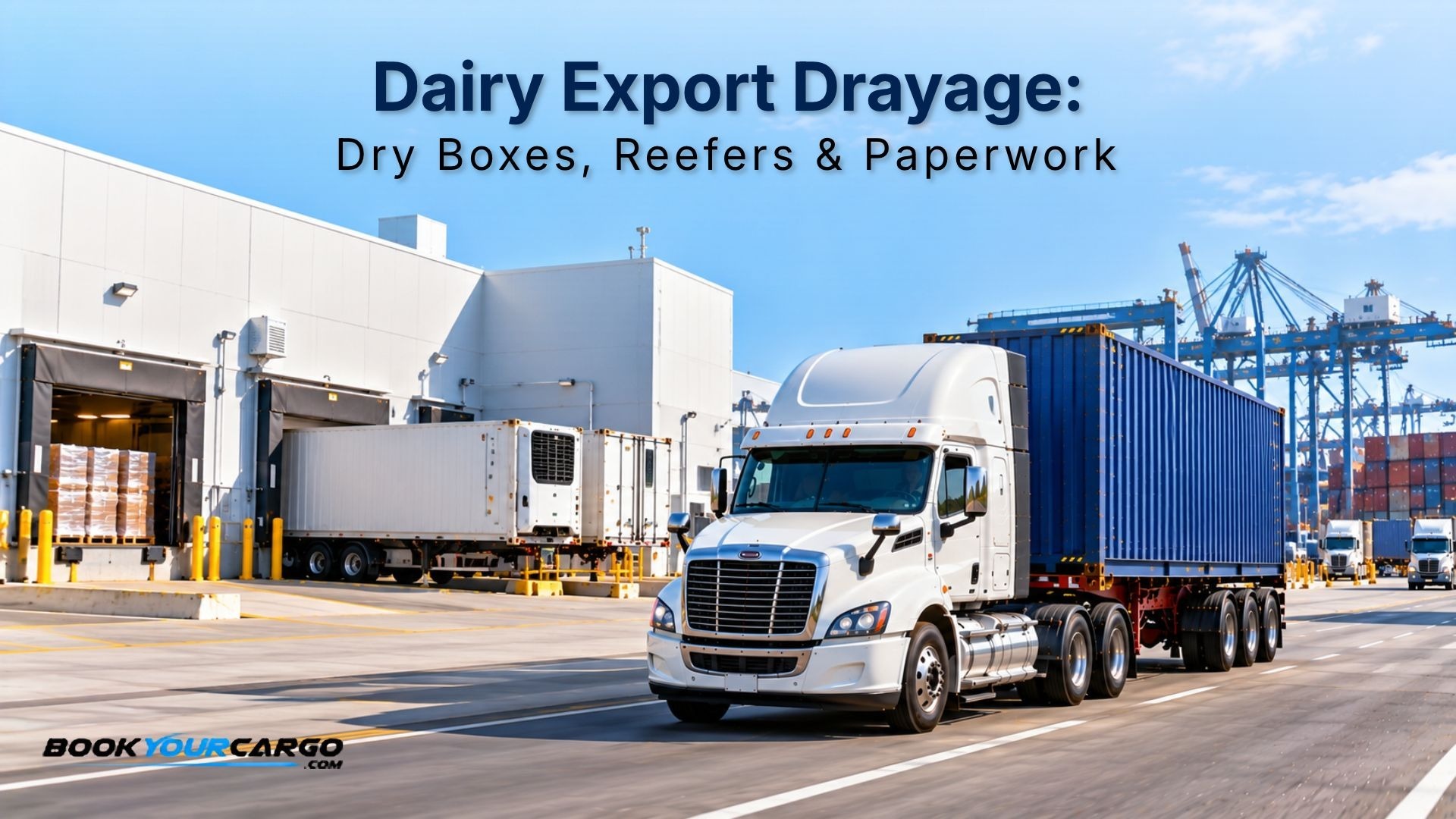
Dairy export drayage splits at a single question: is the product shelf-stable or chilled. Powders move in dry containers at ambient temperature. Cheese and butter move in refrigerated equipment. Those are two different operations with different equipment, different failure modes and different lead times, and the booking has to know which one it is.
The second thing to understand is where the binding constraints actually sit. No federal regulation sets an ocean transit temperature for cheese or butter. What federal rules do impose is a written instruction duty, a stop-distribution duty, and a plant eligibility gate that determines whether the cargo can be exported at all. The temperature number is the buyer specification. The paperwork is the law.
Book Your Cargo runs both sides of that split, dry container and refrigerated, with genset coverage and temperature monitoring on the road leg, and real-time container tracking on every export move.
This guide is for general information. Confirm current requirements with USDA AMS and FDA for your specific product and market.
This guide covers what the US actually exports and where it goes, which products need reefers and which do not, the plant listing and certificate chain that gates a shipment, the federal transport rule that applies to the drayage leg, the temperature references the trade works from, and how Book Your Cargo plans each of these moves.
1. What the US exports, and why it matters to the truck
US dairy exports reached 9.63 billion dollars and 2.32 million metric tons in 2025, representing more than 17 percent of US milk production that year, according to the US Dairy Export Council, which compiles federal trade data. The product mix matters operationally, because it determines the dry-to-reefer split across a program.
| Product category | 2026 forecast volume | Transport characteristic |
|---|---|---|
| Cheese and curd | 750,629 metric tons | Chilled |
| Dried whey | 674,246 metric tons | Shelf-stable powder |
| Nonfat dry milk and skim milk powder | 637,640 metric tons | Shelf-stable powder |
| Lactose | 428,767 metric tons | Shelf-stable powder |
| Butter and milkfat | 171,197 metric tons | Chilled or frozen |
Those are USDA Foreign Agricultural Service dairy world markets and trade forecast figures. Read as a transport problem, the table says most US dairy export tonnage is powder, and powder is a dry container business. Cheese is the largest single category and is the one that drives reefer demand.
The export intensity differs sharply by product, which explains the mix. USDA Economic Research Service has reported that dry skim milk products represent roughly 69 percent of US production by volume exported, against under 9 percent for butter and around 7 percent for cheese, and attributes the difference directly to powders being much easier to ship internationally with a lower risk of spoilage than fresh or refrigerated dairy products.
Dairy is not a reefer category. It is a powder business with a high-value chilled segment attached. Booking the whole program as reefer freight overstates equipment need; booking it all as dry freight loses the cheese.
How BYC handles heavy loads
Milk powder loads heavy. A container of nonfat dry milk or whey in 25 kilogram bags can sit close to the road limit before anyone treats it as a heavy load, and the container payload rating is not the operative number: federal law caps gross vehicle weight at 80,000 pounds, and that ceiling covers the tractor, the chassis, the container tare and the cargo together.
Every load is planned against road weight limits, rail ramp thresholds and the carrier payload limit for the specific equipment, so a box is not rejected or reworked at the terminal. Where a load runs genuinely heavy, overweight and tri-axle drayage equipment and overweight permits are arranged ahead of dispatch. The underlying weight and axle tests are covered in overweight container drayage.
2. Where dairy exports leave the country
Destination concentration is high and it points West. USDA Foreign Agricultural Service figures put Mexico at 26 percent of US dairy exports on a milkfat basis, followed by Canada at 12 percent and South Korea at 10 percent. On a skim-solids basis Mexico is 28 percent and mainland China 16 percent, followed by the Philippines, Canada and Indonesia.
Port concentration follows the same logic. USDA port profile data, built on bill of lading records, puts the dairy export gateways as follows.
| Port | Share of US dairy exports | Note |
|---|---|---|
| Los Angeles | 18 percent | Largest single dairy export gateway |
| Long Beach | 12 percent | Adjacent San Pedro Bay capacity |
| Seattle | 12 percent | Puget Sound, Asia-facing |
| Tacoma | 12 percent | Puget Sound, Asia-facing |
| New York and New Jersey | 11 percent | Largest non-West-Coast dairy gateway |
Two points worth holding. The four West Coast ports together account for roughly 54 percent of containerized dairy exports, which reflects the Asia and Mexico destination mix. But New York and New Jersey at 11 percent is a bigger dairy gateway than any single Puget Sound port, so this is not a West Coast only story.
Oakland does not appear in the top ten dairy export ports in that data, despite the assumption that it leads the category.
The figures above come from the most recent published edition of that USDA series and should be read as structural rather than current. On the Puget Sound side, Northwest Seaport Alliance drayage is the relevant capacity for Seattle and Tacoma volume, and the two terminals are planned as one gateway rather than two.
Where BYC covers today
A dairy export only works where the plant origin and the export gateway are both covered, so coverage is held at both ends of the lane.
| Inland ramps and origins | Export gateways |
|---|---|
| Chicago | New York and New Jersey |
| Columbus | Norfolk |
| Cincinnati | West Coast gateways |
National drayage coverage extends beyond these to the major US ports and rail ramps, and warehousing near the gateway is what allows a plant to ship on its own production schedule rather than the vessel schedule.
3. Which dairy products need a reefer
This is the operational core of a dairy export program, and it is worth being precise about what is established and what is practice.
| Product | Equipment | Basis |
|---|---|---|
| Nonfat dry milk, skim milk powder | Dry container | Shelf-stable; USDA commodity specifications describe bag packaging with no storage temperature requirement |
| Lactose, sweet whey powder | Dry container | Shelf-stable powder |
| Cheese | Refrigerated | Chilled through transit |
| Butter | Refrigerated or frozen | Chilled or frozen depending on hold time |
| High-protein whey concentrates and isolates | Varies | Mixed; some carry buyer-specified chill requirements |
USDA own dairy regulations maintain a structural distinction between dry storage and refrigerated storage for finished dairy products, and the dry storage provision requires only that control of humidity and temperature be maintained consistent with good commercial practice, with no numeric temperature. USDA perishable transport guidance covers butter, cheese and ice cream under dairy products and contains no entry at all for milk powders, whey or lactose, which is consistent with powders not being treated as temperature-controlled freight.
Two caveats are worth stating. No primary source publishes the percentage split of US dairy exports between dry and refrigerated containers, so any such figure should be treated with caution. And whey is genuinely mixed rather than cleanly one or the other, so the equipment decision on whey products belongs to the specification rather than to the category.
Decide equipment from the product specification, not from the commodity name. A dairy exporter shipping powder and cheese in the same week is running two equipment pipelines, and a reefer booked for powder is cost with no benefit.
How BYC handles reefer moves
Book Your Cargo runs refrigerated dairy export moves alongside dry container moves, and the reefer side carries the equipment and controls that chilled cargo actually needs.
- Genset coverage on the road leg. A reefer container needs continuous power between the plant and the terminal, and genset coverage is arranged as part of the dispatch rather than left to the equipment that happens to be available.
- Temperature monitoring on the road leg. The box is monitored between the plant and the terminal rather than assumed, so a deviation is a flagged event rather than something discovered at gate-in.
- Operating temperature taken in writing. The setpoint is taken in writing on every reefer dispatch and kept on file, which is what the federal transport rule requires of the shipper and what a claim file needs later.
- Plug and window planned together. Plug availability at the receiving terminal is confirmed against the appointment, because a reefer delivered into a terminal with no plug is a temperature problem rather than a parking problem.
Chilled dairy runs two clocks at once, the export window and the product condition, which is the same structure as any other reefer drayage move.
Shipping powder, cheese or butter for export?
Send us your plant location and destination port, and we will come back with a drayage quote and real-time tracking on every load.
4. The paperwork that gates the shipment
A dairy export is gated before the truck is ordered, by whether the producing plant is eligible to export to the destination at all. This is where a dairy export differs most from a general agricultural export.
Plant eligibility comes first
USDA Agricultural Marketing Service dairy export certification depends on the plant appearing on one of three lists: the FDA-maintained Interstate Milk Shippers list, the FDA European Union dairy plant reference list, or the USDA list of dairy plants surveyed and approved for grading service. Plants approved under the USDA program receive unannounced inspections covering more than one hundred items at least twice a year.
Product composition also determines eligibility. Products with at least 50 percent dairy content are handled as dairy products, composite products with 10 to 49 percent dairy content are handled separately, and products below 10 percent dairy content are not eligible for dairy certification.
The certificates themselves
- General sanitary certificate. Designed in 1997 and accepted by numerous countries, and issued under the USDA dairy sanitary certificate program. The default instrument where no country-specific form exists.
- Country-specific certificates. Negotiated government to government, with dedicated worksheets for a list of markets. The European Union and China operate under their own distinct regimes.
- Export verification program. The USDA dairy export verification program is an audited program, voluntary in principle but mandatory for market access to the European Union, Great Britain and Turkiye. It covers European antimicrobial resistance requirements and reaches back beyond the exporter to producers supplying milk and ingredients into the exported supply chain.
That last point is the one most often missed. The European verification requirement is not satisfied at the exporting plant alone. It extends up the supply chain, which means a market access problem can originate at a milk supplier the exporter does not control.
Three terminology points worth getting right
- There is no Grade A export certificate. The Grade A system reaches export documentation indirectly, because the Interstate Milk Shippers list is one of the three plant eligibility pathways, but it is not itself an export certificate.
- A certificate of free sale is not the general dairy document. FDA food export certificates of that type are issued for dietary supplements, medical foods and foods for special dietary use. For conventional dairy the FDA analogue is a certificate to a foreign government, and FDA own guidance states that USDA handles dairy export certification.
- The Foreign Supplier Verification Program runs the other direction. It governs US importers of foreign food and has no application to US dairy exports.
5. The federal rule that applies to the drayage leg
There is a federal transport regulation covering this move, and it is underused in dairy export discussion. The FDA sanitary transportation of human food rule applies to shippers, loaders, carriers and receivers. Its exclusions cover food transshipped through the United States, food imported for future export, and facilities regulated exclusively under the meat, poultry and egg acts. There is no exemption for US-origin food being exported, so the domestic drayage leg of a dairy export is covered while the ocean leg is not.
What the rule requires of shippers and carriers is procedural rather than numeric.
- Written temperature instruction. The shipper must specify the operating temperature to the carrier in writing. A verbal setpoint is not compliance.
- Adequate temperature control. Effective measures must ensure that food requiring temperature control for safety is transported under adequate temperature control. This is a performance standard with no prescribed number.
- Stop distribution on a possible failure. If any party becomes aware of a possible material failure of temperature control, the food shall not be sold or distributed unless a qualified individual determines the deviation did not render it unsafe.
- Equipment and records. Vehicles and transportation equipment must be designed, maintained and equipped as necessary to provide adequate temperature control, with associated record requirements.
How BYC meets this on every reefer dispatch
Book Your Cargo takes the operating temperature in writing on every reefer dispatch and keeps it on file. That satisfies the written instruction duty at the point it applies, and it gives the exporter a record if a temperature question is raised later.
6. The temperature references the trade works from
Since no regulation sets an ocean setpoint, the trade works from guidance and from buyer specification. USDA published transport guidance for perishable foods that remains the most commonly cited reference, and it gives the following for dairy.
| Product | Desired transit temperature | Note |
|---|---|---|
| Butter, fresh | 39 degrees Fahrenheit | Relative humidity 75 to 85 percent |
| Butter, frozen | Minus 10 degrees Fahrenheit | For extended hold |
| Cheeses, general | 34 to 40 degrees Fahrenheit | Relative humidity 65 to 70 percent |
| Hard cheeses by type | 30 to 34 degrees Fahrenheit | Attributed to refrigeration engineering standards |
| Process cheese and cheese foods | 40 to 45 degrees Fahrenheit | Higher tolerance than natural cheese |
That guidance dates from 1995 and was reprinted in 2008, so it should be cited with its date rather than presented as current standard. Two practical notes in it are worth carrying regardless of age: cheese oils off at 68 degrees Fahrenheit and above, with fat leaking from the body and the cheese turning rancid quickly, and butter absorbs odors very easily, so equipment that previously carried fish, cabbage or onions needs cleaning and airing before it takes butter.
The only binding numeric temperatures in US dairy regulation are plant-side, under the voluntary USDA grading program: products kept under refrigeration at 40 degrees Fahrenheit or lower after packaging until shipment, and freezer storage at zero degrees Fahrenheit or lower. Those govern the plant, not the container.
The ocean setpoint is therefore a commercial specification. It should be treated as a contractual number supplied by the buyer and passed to the carrier in writing, not as a regulatory requirement someone can look up.
7. Equipment constraints that have affected dairy exporters
Dairy exporters have at times faced equipment and vessel space shortages, which is why equipment planning rather than temperature management is usually the harder part of a dairy export program.
Federal fact-finding covering the disruption years reached broader conclusions that bear directly on perishable exports: exporters, particularly agricultural exporters, were affected by a lack of container availability due to constrained capacity, and exporters and drayage operators reported untimely notice when empty containers were not accepted at one terminal and drayage operators were directed to an alternative terminal.
USDA responded with a program that funded pop-up container yards at the Port of Oakland and the Northwest Seaport Alliance, both of which had the ability to pre-cool refrigerated shipping containers to receive perishable commodities. That a federal program funded reefer pre-cooling capacity is itself evidence of where the infrastructure gap sat.
One reporting gap to be aware of: USDA does not publish a dairy transportation report. Its recurring transportation reporting is grain and fresh-produce oriented, and dairy appears only incidentally as a commodity row in port profiles.
How BYC handles the window
A dairy export runs on the same cargo receiving window as any other export, and Book Your Cargo reads the earliest return date, documentation cutoff and physical cargo cutoff from each specific booking rather than from the vessel schedule, because a vessel calling one port can carry several different windows depending on which carrier issued the booking.
Gate appointments are booked inside the correct window, and when a window moves the move is replanned rather than attempted. On chilled dairy that replanning includes the plug and the power, not just the appointment. The window mechanics themselves are covered in agricultural export container drayage, and empty container returns and street turns is where equipment availability is usually recovered in a tight market.
8. Real-time container tracking on every export move
Book Your Cargo provides real-time container tracking on every export move, from pickup to terminal gate-in. The team flags window changes and delays before the truck is loaded, not after it arrives at the terminal. That is how dry runs, missed cutoffs and wasted trips are prevented.
On reefer loads, that visibility extends to temperature and power status, which means a problem can be caught while the cargo can still be saved. A reefer that loses power on the road is recoverable if someone knows within the hour and is a claim if nobody knows until gate-in. That difference is the entire argument for monitoring a chilled export rather than inspecting it on arrival.
It also matters for compliance. The federal transport rule requires that food not be sold or distributed after a possible material failure of temperature control unless a qualified individual determines the deviation did not render it unsafe. Knowing that an excursion happened, and when, is what makes that determination possible at all. Real-time container tracking is therefore part of how a chilled export is run, and the drayage technology platform carries availability, appointment and status through to gate-in.
9. A dairy export drayage checklist
- Plant eligibility for the destination market, confirmed against the applicable list before the booking is made.
- The certificate required for that market, and whether an audited verification program applies.
- Equipment decision taken from the product specification: dry for powders, refrigerated for cheese and butter, specification-led for whey concentrates.
- Written operating temperature issued to the carrier, retained in the file.
- Load weight checked against road limits, ramp thresholds and the carrier payload limit for that equipment.
- The earliest return date and cargo cutoff for the specific booking, with transit time from plant to terminal.
- Reefer plug availability at the receiving terminal and genset coverage for the road leg, confirmed rather than assumed.
- Equipment history for butter loads, given odor absorption.
- A documented response if a temperature excursion is detected, including who the qualified individual is.
Frequently Asked Questions
It depends entirely on the product. Powders ship in dry containers at ambient temperature, which covers nonfat dry milk, skim milk powder, lactose and sweet whey powder. Cheese and butter ship in refrigerated equipment. High-protein whey concentrates and isolates are mixed, and the equipment decision for those belongs to the product specification rather than the commodity category.
This matters commercially because most US dairy export tonnage is powder. USDA Economic Research Service has reported that dry skim milk products represent roughly 69 percent of US production by volume exported, against under 9 percent for butter and around 7 percent for cheese, attributing the difference to powders being easier to ship internationally with lower spoilage risk.
There is no regulated ocean transit temperature for cheese or butter. The setpoint is a commercial specification supplied by the buyer. USDA transport guidance, dating from 1995 and reprinted in 2008, gives desired transit temperatures of 39 degrees Fahrenheit for fresh butter, minus 10 degrees Fahrenheit for frozen butter, and 34 to 40 degrees Fahrenheit for cheeses generally, with hard cheeses by type at 30 to 34 degrees Fahrenheit.
The only binding numeric temperatures in US dairy regulation are plant-side under the voluntary USDA grading program, requiring refrigeration at 40 degrees Fahrenheit or lower after packaging until shipment and freezer storage at zero degrees Fahrenheit or lower. Those govern the plant rather than the container.
Plant eligibility comes first. USDA Agricultural Marketing Service issues dairy export certificates only where the producing plant appears on one of three lists: the FDA Interstate Milk Shippers list, the FDA European Union dairy plant reference list, or the USDA list of dairy plants surveyed and approved for grading service.
The certificate itself is either a general sanitary certificate, designed in 1997 and accepted by numerous countries, or a country-specific certificate negotiated government to government, with the European Union and China operating distinct regimes. Market access to the European Union, Great Britain and Turkiye additionally requires an audited USDA export verification program that reaches back to producers supplying milk and ingredients into the exported supply chain.
No. There is no Grade A export certificate. The Grade A system reaches export documentation indirectly, because the Interstate Milk Shippers list is one of the three plant eligibility pathways for USDA dairy export certification, but Grade A certification is not itself an export document.
Two related points are worth getting right. A certificate of free sale is not the general dairy document either, because FDA issues that instrument for dietary supplements, medical foods and foods for special dietary use, with a certificate to a foreign government being the FDA analogue for conventional dairy. And the Foreign Supplier Verification Program applies to US importers of foreign food, not to US exporters.
Yes. The FDA sanitary transportation of human food rule applies to shippers, loaders, carriers and receivers, and its exclusions cover food transshipped through the United States, food imported for future export, and facilities regulated exclusively under the meat, poultry and egg acts. There is no exemption for US-origin food being exported, so the domestic drayage leg is covered while the ocean leg is not.
What it requires is procedural rather than numeric. The shipper must specify the operating temperature to the carrier in writing, effective measures must ensure transport under adequate temperature control as a performance standard with no prescribed number, and if any party becomes aware of a possible material failure of temperature control the food shall not be sold or distributed unless a qualified individual determines the deviation did not render it unsafe.
Genset coverage on the road leg so the container has continuous power between the plant and the terminal, temperature monitoring on the road leg so a deviation is a flagged event rather than a discovery at gate-in, and the operating temperature taken in writing on every reefer dispatch and kept on file. Plug availability at the receiving terminal is confirmed against the gate appointment.
Real-time container tracking runs on every export move from pickup to terminal gate-in, and on reefer loads that visibility extends to temperature and power status, so a problem can be caught while the cargo can still be saved.
Los Angeles is the largest single dairy export gateway at 18 percent of US dairy exports, followed by Long Beach, Seattle and Tacoma at 12 percent each, and New York and New Jersey at 11 percent, according to USDA port profile data built on bill of lading records. The four West Coast ports together account for roughly 54 percent of containerized dairy exports, reflecting the Asia and Mexico destination mix.
Oakland does not appear in the top ten dairy export ports in that data. These figures come from the most recent published edition of that USDA series and should be read as structural rather than as a current live measure.
