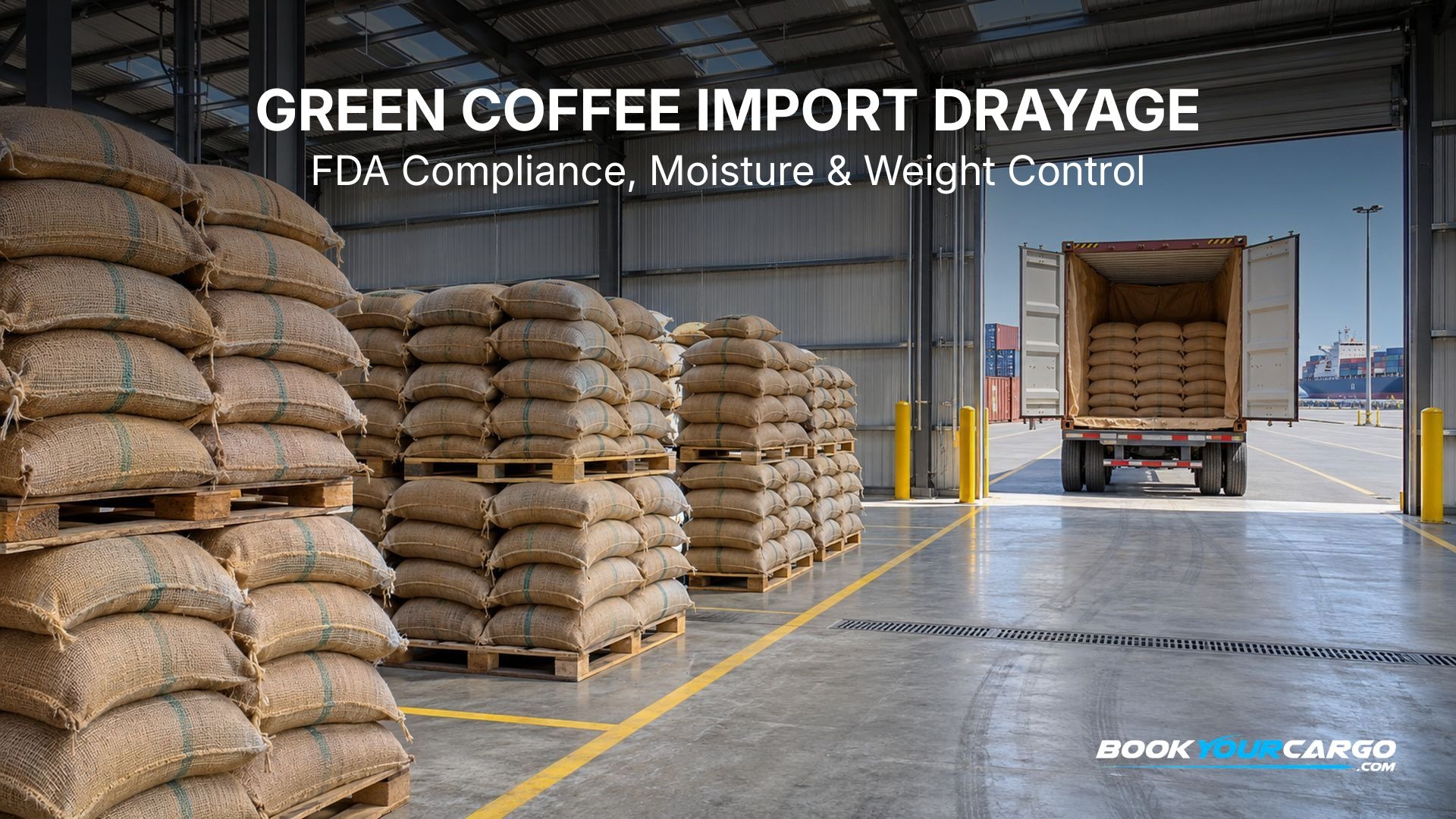
Green coffee import drayage is the move that takes unroasted beans from the terminal to a coffee warehouse or roaster, and it decides whether the coffee arrives dry, on time and at a building that can sample, weigh and store it. Green coffee travels in ordinary dry containers, but it is a regulated food, a moisture-sensitive cargo and, in bulk, one of the heavier loads a 20-foot container carries.
Each of those three facts shapes the inland leg. FDA rules decide when the coffee can be distributed, condensation risk decides how long a loaded container should sit, and payload decides which chassis can carry it legally.
Book Your Cargo handles green coffee import drayage from the port to coffee warehouses, roasters and distribution centers, with real-time container tracking from availability to delivery and overweight and tri-axle capacity for heavy bulk loads.
This guide is for general information. Confirm current FDA, USDA and exchange requirements for your origin, product and warehouse with your customs broker.
This guide covers what FDA requires for green coffee imports, what USDA APHIS does and does not restrict, the FDA quality standards for green coffee beans, ICE-licensed coffee warehouses and delivery ports, bags and bulk liners, moisture and condensation, container weight, and how Book Your Cargo moves green coffee from the port.
1. What FDA requires for green coffee imports
Green coffee is food under FDA rules, so the standard food import requirements apply. FDA prior notice must be submitted and confirmed no less than 8 hours before a vessel arrives at the port, and any person with knowledge of the required information may submit it.
Foreign facilities that manufacture, process, pack or hold food for consumption in the United States must register with FDA. Farms are exempt, and so is a foreign facility whose food goes on to further processing at another foreign facility before export, beyond labeling or similar minor activity.
The Foreign Supplier Verification Program applies to green coffee, but the rule gives it specific relief. Under 21 CFR 1.507, an importer that documents that the food could not be consumed without application of an appropriate control does not have to run the usual supplier verification steps, and the rule names coffee beans as an example. Other options in the same section rely on written assurances from the customer that processes the food.
Entries that are not released automatically go to FDA review, and a coffee entry can still be under an FDA hold on imported food after Customs has released it and the terminal shows it as available.
How BYC handles this
Book Your Cargo tracks the FDA position alongside the terminal release and the last free day, and books the terminal appointment against the final release rather than the vessel arrival. When a coffee entry is held, the container is delivered only to the location the broker has declared for FDA, with the cargo complete and accessible there.
2. What USDA APHIS restricts on coffee
The USDA Animal and Plant Health Inspection Service has a coffee-specific rule, but its reach is narrow. Under 7 CFR 319.73, unroasted coffee, coffee leaves and used coffee sacks may not be imported into Hawaii or Puerto Rico, and covered cargo arriving there may not be unloaded or transshipped there. The rule protects coffee-growing areas within US jurisdiction from coffee pests.
The rule does not set a separate permit or origin restriction for green coffee entering the continental United States. Coffee plants and seeds for planting fall under a different set of APHIS rules for plants for planting. In August 2026, APHIS also published a proposed rule on coffee imports into Hawaii and Puerto Rico that would let it update those prohibitions by notice, with comments closing on October 5, 2026.
Other plant health requirements, such as the rules for any wood packaging shipped with the cargo, apply to coffee containers the same way they apply to other food and agricultural imports.
3. FDA quality standards for green coffee beans
FDA does not have an import alert written only for green coffee. Its coffee and tea import alert list contains general alerts that apply across products, covering issues such as filth, pesticides, Salmonella and FSVP non-compliance.
The coffee-specific standards sit in FDA compliance policy guides. Under CPG Sec. 510.500, FDA may take action when an average of 10 percent or more of the beans are insect-infested, insect-damaged or moldy, or when the beans grade poorer than New York Green Coffee Association Grade 8.
Reconditioning follows CPG Sec. 560.300. Detained lots with live external insects must be fumigated in the immediate area of the port, and lots with insect damage or mold must be fully reconditioned before they move to the roaster.
A detained coffee lot with live insects is fumigated near the port, not at the roaster. Plan the first move to a port-area warehouse or fumigation site, and the move to the roaster only after FDA allows it.
How BYC handles this
Book Your Cargo plans a detained coffee container as two moves when the lot has to be reconditioned near the port: the first to the warehouse or fumigation site the broker has arranged, and the second to the roaster once the lot is cleared. Warehousing near the port gives the coffee a place to wait without holding the container on the terminal.
4. ICE-licensed coffee warehouses and delivery ports
The ICE Coffee "C" futures contract has its own delivery system, and the exchange's coffee rules name the ports where exchange-grade coffee can be delivered. In the United States, delivery is at licensed warehouses in the Port of New York District, New Orleans, Miami, Houston and Virginia, with Virginia meaning within 25 miles of Norfolk.
Coffee delivered against the contract has to be sampled, graded, weighed and certified, and only lots with a certificate of grade can be delivered. The exchange rules give licensed warehouses defined roles in that process, including sampling at least 10 percent of the bags, weighing, and re-bagging coffee that arrived in supersacks or lined containers.
Delivery port | Licensed warehouse locations on the current ICE list |
|---|---|
New York District | Three warehouses, all in New Jersey: Keasbey, Jersey City and Edison |
New Orleans | Four warehouses, including Harahan, Louisiana |
Houston | Six warehouses |
Miami | Two warehouses |
Virginia | One warehouse, in Suffolk |
Source: ICE licensed coffee warehouses list, June 2026 to May 2027. ICE has also introduced a Coffee "C" Metric contract of 10 metric tons, with delivery points at the New York District, Miami, New Orleans, Houston and Virginia among others.
Not every coffee container goes to a licensed warehouse. Roasters and importers also receive coffee directly or at their own warehouses, but the licensed warehouse locations show where coffee-handling capacity is concentrated. That concentration is part of the picture for Port of New Orleans drayage, Port Houston drayage and Port of New York and New Jersey drayage.
How BYC handles this
Book Your Cargo covers the New York and New Jersey and Norfolk gateways, two of the delivery areas on the ICE list. The delivery is booked against the warehouse's receiving appointment, so the container arrives when the dock can take it for sampling and weighing, and the empty return is planned at the same time.
5. Bags or bulk liners: what is in the container
Green coffee is shipped in woven bags or loose in lined containers. The International Coffee Organization uses the 60-kilogram bag as its standard statistical unit, but actual bag weights vary by origin. For exchange delivery, the ICE rules require bags of sisal, henequen, jute, burlap or similar woven material weighing at least 700 grams, with no inner lining.
Origin | Typical bag weight published by an importer |
|---|---|
Brazil | 59 to 60 kilograms |
Colombia | 70 kilograms |
Central America, Mexico, Peru, Ecuador and Bolivia | 69 kilograms |
Most African and Asian origins | 60 kilograms |
Source: Royal Coffee bag weight guide. The UK P&I Club's cargo guidance on coffee gives examples of 250 bags of 70 kilograms or 300 bags of 60 kilograms per container, and notes that shipping coffee loose in lined containers raised the capacity of a 20-foot container from 18 to 21 tonnes.
The packing method changes the receiving plan. Bagged coffee is unloaded bag by bag at the dock, while a bulk liner is discharged at a facility equipped to handle it, which is why the delivery address and the warehouse's equipment need to be confirmed before the container is dispatched.
How BYC handles this
Book Your Cargo confirms with the consignee whether the container is bagged or lined and whether the receiving dock can handle it before the pickup is dispatched, so a bulk liner is not delivered to a building that only unloads bags and then moved a second time.
Send us your port, warehouse and expected arrival, and we will come back with a drayage quote and a delivery plan built around the FDA release and the warehouse appointment, with real-time container tracking on the move.
6. Moisture and condensation in coffee containers
Green coffee absorbs and releases moisture, and the International Coffee Organization's Resolution 420 sets a moisture range of no lower than 8 percent and no higher than 12.5 percent, measured under ISO 6673. The ICO applies the resolution on a voluntary basis among exporting members.
The bigger risk on the import side is condensation inside the container. The UK P&I Club's coffee guidance states that the risk is highest when coffee loaded in warm, humid climates is discharged into cold regions, and that containers on the outside of the stack suffer most. It recommends lining containers with heavy-duty kraft or corrugated paper and unloading promptly.
Its guidance on containerized cargo adds two limits. Kraft paper can quickly become saturated, and desiccants alone are unlikely to prevent condensation where temperatures swing widely. Green coffee moves in standard or ventilated dry containers, and ventilated containers are comparatively rare in the trade.
In cold months, a loaded coffee container should not wait longer than it has to. Pull it at release and deliver it for prompt unloading, because the time a warm-loaded container spends sitting in cold weather is when moisture forms inside it.
How BYC handles this
Book Your Cargo pulls coffee containers at release and delivers them against a confirmed receiving slot, so the container is unloaded promptly rather than waiting at the terminal or in a yard. Where the warehouse cannot receive straight away, the delay is flagged before dispatch, and the empty return is planned once the container is unloaded, the same discipline behind empty container returns and street turns.
7. Container weight: when green coffee gets heavy
Federal rules cap vehicles on the Interstate System and reasonable access routes at 80,000 pounds gross vehicle weight, with limits of 20,000 pounds on a single axle and 34,000 pounds on a tandem axle group, and lower where the bridge formula requires.
A standard 20-foot container has a tare weight of about 2,300 kilograms. Loaded with 21 tonnes of bulk coffee, the container and cargo together weigh about 51,400 pounds before the chassis and tractor, which leaves about 28,600 pounds of the federal gross limit for the truck itself. Bagged loads are usually lighter, but the weight on each axle group still has to be checked against the limits.
That is why heavy coffee containers are planned as overweight container drayage from the start. A tri-axle chassis spreads the load across three axles instead of two, which can keep axle weights within the limits where a standard chassis would not.
How BYC handles this
Book Your Cargo checks the declared cargo weight before dispatch on every coffee container and assigns overweight and tri-axle drayage where the load calls for it, so a heavy bulk container is not discovered at the scale.
8. Real-time container tracking for coffee imports
Book Your Cargo provides real-time container tracking on every move, from availability to delivery. The team flags release, appointment and window changes before a truck is dispatched, not after it reaches the gate. That is how dry runs, missed appointments and avoidable storage charges are prevented.
For coffee importers, real-time container tracking keeps the FDA position, the terminal release and the warehouse appointment in one view, so the container moves as soon as it can and is unloaded before condensation becomes a risk. The drayage technology platform carries release status and appointments through to delivery.
Where BYC covers today
Inland ramps | Port gateways |
|---|---|
Chicago | New York and New Jersey |
Columbus | Norfolk |
Cincinnati | West Coast gateways |
Port drayage and national drayage coverage extends beyond these to the major US ports and rail ramps.
9. A green coffee import drayage checklist
- FDA prior notice submitted and confirmed no less than 8 hours before vessel arrival.
- FSVP position documented, including any reliance on 21 CFR 1.507 for coffee beans.
- FDA status checked separately from the CBP release before the pickup is booked.
- Delivery address confirmed: licensed warehouse, importer warehouse or roaster, and whether it handles bags or bulk liners.
- Declared cargo weight checked and a tri-axle chassis assigned where the load calls for it.
- Receiving appointment booked so the container is unloaded promptly, especially in cold months.
- For detained lots, the port-area fumigation or reconditioning site agreed before the first move.
- Empty return planned at the same time as the delivery.
Frequently asked questions
Green coffee is food under FDA rules. The shipment needs FDA prior notice, submitted and confirmed no less than 8 hours before a vessel arrives, and foreign facilities that hold or pack food for the US must register with FDA, with exemptions including farms.
The Foreign Supplier Verification Program applies, but 21 CFR 1.507 gives relief where the importer documents that the food could not be consumed without an appropriate control, and the rule names coffee beans as an example.
The USDA APHIS coffee rule in 7 CFR 319.73 bars unroasted coffee, coffee leaves and used coffee sacks from Hawaii and Puerto Rico. It does not set a separate permit or origin restriction for green coffee entering the continental United States.
Coffee plants and seeds for planting fall under different APHIS rules, and general requirements such as those for wood packaging still apply to the container.
FDA does not have an import alert written only for green coffee. Its coffee and tea import alert list contains general alerts covering issues such as filth, pesticides, Salmonella and FSVP non-compliance.
Coffee-specific standards sit in FDA compliance policy guides, which allow action when an average of 10 percent or more of beans are insect-infested, insect-damaged or moldy, or when beans grade poorer than New York Green Coffee Association Grade 8.
Under the ICE Coffee "C" rules, coffee can be delivered at licensed warehouses in the Port of New York District, New Orleans, Miami, Houston and Virginia, with Virginia meaning within 25 miles of Norfolk.
The current ICE list places the New York District warehouses in Keasbey, Jersey City and Edison, New Jersey, and the Virginia warehouse in Suffolk.
It depends on the packing. The UK P&I Club gives examples of 250 bags of 70 kilograms or 300 bags of 60 kilograms per container, and notes that shipping coffee loose in lined containers raised the capacity of a 20-foot container from 18 to 21 tonnes.
Bag weights vary by origin, from about 60 kilograms for Brazil and most African and Asian origins to 69 or 70 kilograms for Central and South American origins.
The UK P&I Club recommends lining containers with heavy-duty kraft or corrugated paper and unloading promptly. The risk is highest when coffee loaded in warm, humid climates is discharged into cold regions, and containers on the outside of the stack suffer most.
Kraft paper can become saturated and desiccants alone are unlikely to prevent condensation where temperatures swing widely, so prompt pickup and unloading on arrival matter.
It can be. A 20-foot container loaded with 21 tonnes of bulk coffee weighs about 51,400 pounds with the container before the chassis and tractor, against a federal gross limit of 80,000 pounds and axle limits of 20,000 pounds single and 34,000 pounds tandem.
Heavy coffee containers are planned as overweight moves, often on a tri-axle chassis that spreads the load across three axles.
Book Your Cargo tracks the FDA position alongside the terminal release, checks the declared weight and assigns overweight and tri-axle drayage where needed, and delivers against the warehouse's receiving appointment so the coffee is unloaded promptly.
Coverage includes the New York and New Jersey and Norfolk gateways, and real-time container tracking runs on every move from availability to delivery.
